

The Real ROI of AI In Call Centers (Cost Savings + Efficiency Breakdown)
AI delivers real cost savings in call centers — but ROI is progressive, not immediate, and depends heavily on execution. The strongest returns come from augmenting agents with AI tools like intelligent routing, real-time assist, automated QA, and self-service bots — not replacing them outright. Most initiatives fail due to poor strategy, weak integration, or lack of ongoing optimization. Organizations that combine AI with outsourced expertise consistently see the best results, reducing deployment complexity while sustaining long-term efficiency gains.
Read Time: 6 minutes
Table of Contents
Artificial intelligence has quickly taken over the customer experience world. What once was a future trend is now a present-day priority for leaders to integrate into daily operations. A survey conducted by McKinsey had almost 90% of respondents report that they use AI regularly in some aspect of their business. This shows that across most industries, organizations are beginning to invest heavily in intelligent tools with the expectation that these technologies will transform performance and reduce costs. However, when it comes to AI call center ROI, the reality is slightly more complex.
Without a doubt these new technologies can drive measurable AI call center cost savings, but organizations that approach AI as a simple quick fix often fail to realize its full potential. The ROI of AI in customer service comes from how well that technology is integrated into the organization and balanced with human agents.
This is usually where most companies fall short because they invest in tools but overlook execution. The organizations seeing the strongest call center automation ROI take a different approach. They use AI to elevate the capabilities of their staff as well as a way to make more informed decisions. These companies understand that in order to reduce call center costs with AI, they must also work on process optimization and their customer experience design.
In this blog, we are going to break down what ROI really means in an AI-powered environment and why a hybrid model that combines AI with outsourced expertise delivers the strongest and most sustainable results.
What "ROI" Actually Means in AI-Powered Call Centers
When you are evaluating AI contact center efficiency, you typically start by looking at cost reduction. It makes sense that saving money is usually the biggest reason companies look to optimize their processes. While lowering expenses is important, it's only one dimension of ROI. The value of AI extends across efficiency, experience, and scalability.
One of the biggest misconceptions about AI call center ROI is that it is immediate and linear. In practice, ROI is progressive meaning early gains come from efficiency improvements while larger financial returns are realized over time.
Another common misunderstanding is the assumption that AI replaces human agents. The reality is the most effective implementation of AI position it as a support system rather than a substitute. AI cuts down on the amount of repetitive work and equips agents with everything they need to operate at a higher level.
This is why the most accurate way to think about ROI is as a system outcome. It is the result of aligning AI tools with well-designed processes and properly trained staff.
The Key Metrics Executives Should Track
To fully understand the ROI of AI in customer service organizations should track performance of operations as well as customer experience. There are many possible data points to examine, but a few core metrics consistently provide the clearest picture of impact:
- Cost per contact: This is one of the most direct indicators of cost per call reduction AI can deliver. Comparing costs before and after implementation allows organizations to quantify how automation and efficiency improvements are impacting the bottom line.
- Average handle time (AHT): AI-driven tools reduce the time agents spend resolving issues by providing them with real-time insights and recommendations. Lower AHT is a major contributor to AI call center cost savings.
- First call resolution (FCR): When AI improves accuracy and equips agents with better information, issues are resolved more quickly and effectively. Higher FCR reduces repeat contacts and overall call volume.
- Agent utilization and productivity: One of the most significant benefits of call center productivity improvement AI is the ability to increase output without increasing headcount. AI allows agents to handle more interactions with greater efficiency.
- Customer satisfaction (CSAT): While often overlooked in ROI calculations, improved customer experience leads to higher retention and long-term revenue growth.
Tracking these metrics together provides a more realistic view of how AI is impacting cost and performance.
Where AI Actually Drives Cost Savings
To understand how organizations can effectively reduce call center costs with AI, we need to look at where those costs come from. Call centers are complex operations with multiple cost drivers, and AI influences each of them in different ways.
Labor is typically the largest expense followed by training, quality assurance, and infrastructure. Inefficiencies like long handle times or misrouted interactions create hidden costs that are often more significant than they appear.
One of the most important distinctions to make is between automation and augmentation. While full automation does reduce costs in specific scenarios, it is not a universal solution. Over-automation typically leads to poor customer experiences and higher churn.
Augmentation enhances performance. It allows agents to work more efficiently and deliver better outcomes. This is where the most sustainable and scalable AI contact center efficiency is achieved.
High-Impact AI Use Cases That Reduce Costs
While AI can be applied in many ways, certain use cases consistently deliver the strongest call center automation ROI. These applications focus on improving efficiency and enhancing decision-making.
- Intelligent call routing: AI ensures that customers are directed to the most appropriate resource on the first attempt which helps improve resolution rates.
- Agent assist tools: Real-time guidance helps agents navigate interactions more effectively and provide personalized service.
- Automated QA: Instead of relying on manual sampling, AI can evaluate every single interaction which provides more consistency in performance management.
- Self-service (chat/voice bots): By handling high-volume, low-complexity inquiries, self-service tools significantly reduce call volume and provide agents with more time to work on more complex tasks.
Each of these contributes to AI in outsourced call centers and plays a crucial role in driving both efficiency and cost reduction.
The Hidden Costs of Implementing AI In-House
The potential benefits of AI in CX are compelling, but many organizations underestimate the complexity and cost of implementing these solutions internally. The initial investment alone can be substantial, requiring not only technology purchases but also integration with existing systems and the development of supporting infrastructure.
AI also requires ongoing attention. Models need to be trained, updated, and monitored to ensure they consistently learn and improve. Without continuous optimization, performance stagnates or can even decline.
Another challenge is adoption because organizations invest in AI tools but fail to fully integrate them into daily operations. Issues like minimal agent training on technology or poor visibility into performance can lead to underutilization and limits the potential for AI call center ROI.
Talent is another part of the equation that is sometimes the hardest part to get right. Effectively implementing AI requires hiring people who understand advanced analytics and customer experience. These roles can be challenging to fill, and even once you have staff in place, there is still the risk of turnover. Without the right team in place, even a strong investment in AI can struggle to deliver results.
Why Many AI Initiatives Fail to Deliver ROI
Many in-house AI initiatives fail to provide meaningful ROI. More often than not, it's because of how it is implemented. AI has the potential to drive strong AI call center ROI, but only with a clear plan and the right operational support. Five common pitfalls of AI implementation are:
- Lack of clear strategy: Without a clear goal, AI deployment can become fragmented and ineffective. Having the right tools without well-defined objectives leaves organizations with disconnected solutions that fail to drive growth.
- Over-automation: It can be tempting to automate as much as possible as quickly as possible, but that approach can backfire. Customers need human support for complex or sensitive issues and pushing everything through automation can lead to a drop in satisfaction.
- Poor integration: AI works best when it fits into existing workflows. Systems that can't connect to CRMs or knowledge bases add complexity rather than driving efficiency.
- Misalignment between AI and agents: AI turns into a barrier when agents are not properly trained on it. Employees that don't understand how to use these tools effectively limit any real chance of call center productivity improvement AI.
- Lack of ongoing optimization: AI needs continuous monitoring and refinement to prevent performance from plateauing or declining.
These challenges show that achieving the benefits of AI in BPO requires a thoughtful approach with a commitment to ongoing optimization.
Why AI + Outsourced Call Centers Deliver Better ROI
If you want to maximize the ROI of AI in customer service, the most popular way to do that is by blending AI with outsourced call center expertise. This approach takes care of many of the challenges associated with in-house implementation.
Outsourced providers bring established infrastructure, experienced teams, and proven workflows. This significantly reduces the complexity of deployment and allows organizations to get the benefits of AI more quickly. Instead of starting from scratch, they can leverage existing expertise and just focus on optimization.
Another key advantage is that outsourced partners understand that AI requires constant optimization. They take care of it, so you don't have to. This ensures that AI continues to deliver value as business needs evolve.
This model is great for driving AI contact center efficiency because it blends advanced technology with operational expertise. Organizations should use this model to get a more flexible, cost-effective solution.
How a Hybrid AI + Human Model Maximizes Returns
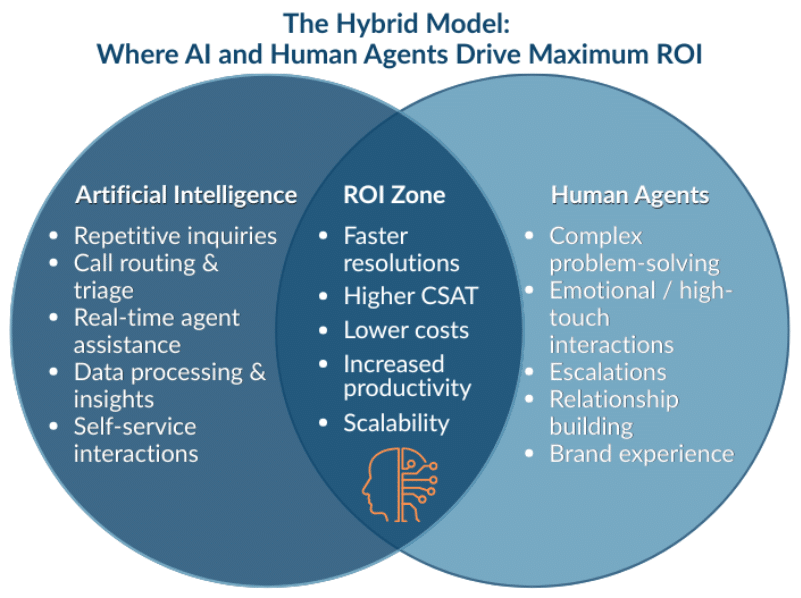
Successful implementations of AI in outsourced call centers are built on a hybrid model that leverages the strengths of both technology and human agents. Rather than choosing between automation and human interaction, this model integrates the two in a way that maximizes efficiency and experience.
AI is great at handling repetitive, basic tasks. It processes information quickly and provides real-time insights. Human agents bring empathy and problem-solving skills that are essential for more complex interactions. Organizations can combine these strengths to create a system where AI reduces workload and improves accuracy, while agents focus on delivering high impact experiences.
This model also supports scalability because as demand increases, AI can absorb additional volume. This gets rid of the need to go through the lengthy, and expensive, process of hiring more staff. This flexibility also means customers get fast, personalized service, regardless of whether there is a higher volume of inquiries or not.
Ultimately, a strong AI call center ROI is built through the right combination of AI and people. Organizations that take a strategic, integrated approach see meaningful gains in customer experience and efficiency. ROI CX Solutions helps make that possible by bringing together advanced AI capabilities, experienced agents, and proven workflows to ensure you're implementing AI and getting real results from it.