
Balancing Automation and the Human Touch: Best Practices For AIaaS
Balancing automation and the human touch in AI as a Service (AIaaS) customer support means using AI to handle high-volume, routine interactions while empowering human agents to manage complex, sensitive, or relationship-driven conversations. Best practices include automating repetitive tasks like basic inquiries and routing, implementing clear escalation paths to human agents, integrating AI with existing systems to maintain context, and continuously optimizing workflows based on performance data. A well-designed hybrid AI-human model improves efficiency, reduces costs, and delivers faster service while preserving the empathy and expertise that drive strong customer relationships.
Read Time: 7 minutes
Table of Contents
Businesses are adopting AI customer support solutions to meet rising service expectations while controlling costs and staffing challenges. Through AIaaS customer service and AI call center automation, organizations can automate routine interactions and improve efficiency. A strong hybrid AI human support model ensures automation drives speed while human agents handle complex, high-value conversations. When implemented strategically, AI strengthens customer experience, scalability, and long-term loyalty.
Why Businesses Are Adopting AIaaS for Customer Support
Customers demand more from businesses than ever before. According to recent industry research, 90% of customers say an immediate response is important when they reach out for support, with 60% defining "immediate" as 10 minutes or less. These expectations are forcing companies to rethink how support is delivered.
Rising customer expectations is only one piece of the puzzle. Businesses are also facing staffing shortages, increasing labor costs, agent burnout, and the difficulty of scaling with demand. Traditional support models are no longer sustainable.
This is why organizations are turning to AI customer support solutions and scalable AIaaS customer service models. Through strategic AI call center automation and advanced AI contact center solutions, companies can manage high-volume, basic interactions while maintaining consistency and controlling costs. Modern contact center automation tools reduce repetitive workloads, so human agents can focus on more complex conversations.
The objective is balance. A well-designed hybrid AI human support model allows businesses to meet 24/7 service expectations while preserving the empathy and expertise that builds customer loyalty.
Customer Experience Expectations
Customer expectations are evolving faster than traditional models can keep up. Speed has become a baseline requirement. Customers want instant answers and interactions that feel personalized rather than transactional.
They also expect continuity. Regardless of when or where they reach out, they don't want to repeat information or navigate through disconnected systems. Friction increases abandonment and churn.
To mee these demands at scale, organizations are implementing AI-powered customer service capabilities that enable consistent omnichannel engagement.
Yet customer expectations are not the sole reason AI adoption is increasing. Behind the scenes, operational pressures are making transformation necessary.
Operational Drivers
While rising customer expectations are highly visible, the operational strain is just as significant. Contact centers continue to face hiring shortages, high turnover rates, and escalating labor costs.
At the same time, repetitive processes consume valuable agent bandwidth. This increases operational expenses while also contributing to burnout and reduced engagement. Scaling support through headcount alone is no longer efficient or sustainable.
These pressures are prompting organizations to rethink traditional service delivery models and incorporate automation more strategically. Aligning technology with workforce needs helps businesses improve efficiency without getting rid of quality.
The next step is understanding exactly where AI delivers the greatest impact and where human expertise remains essential.
Where AI Adds the Most Value
Automation in customer experience does not work to eliminate the human element. It is about understanding where AI delivers peed, consistency, and scalability, and where human empathy and judgement remain essential. The most effective CX strategies focus on where AI drives the greatest impact, not just whether to use it.
Thoughtfully deploying AI customer support solutions enables businesses to lower cost per interaction, increase speed and accuracy, and deliver more consistent service across channels. The real opportunity lies in identifying processes that create the greatest operational lift.
Automating Routine Interactions
Automation works best when it focuses on repetitive, rules-based tasks. A few of these include:
- Instant responses to high-volume inquiries
- Account balance checks
- Shipping updates
- Appointment scheduling
- Password resets
AI handles these interactions immediately, which helps reduce queue times while keeping service consistent during peak periods.
- Lead intake and qualification
- Capture prospect information automatically
- Ask structured pre-qualification questions
- Route leads based on urgency, revenue potential, or geography
This ensures sales teams focus on high-value opportunities, improving conversion rates.
- Reducing repetitive agent workload
- Free agents from transactional interactions
- Enable focus on complex problem-solving and escalations
- Improve engagement and retention by letting agents do more meaningful work
Automating these repetitive tasks increases efficiency while also creating space for agents to tackle complex issues and build stronger customer relationships. With these routine tasks automated, the next opportunity is to use AI to guide interactions more intelligently and generate actionable insights.
Improving Routing and Insights
AI in customer support makes the entire experience smarter and more efficient. AI analyzes customer intent, sentiment, history, and urgency to route interactions with precision, connecting each customer to the right agent without unnecessary transfers. This speeds up resolution times and increases satisfaction because it ensures customers are helped by the most capable resource for their needs.
Before a conversation even reaches a live agent, AI can gather key information like account numbers, issue types, and order details. Capturing this data upfront helps agents focus on resolving problems rather than collecting information. At the same time, predictive analytics embedded in AI systems work to forecast call volumes, identify patterns of at-risk customers, and flag signals of potential dissatisfaction. This helps support teams address concerts before they escalate.
While AI can handle many tasks efficiently, there are still areas where human agents provide irreplaceable value.
Where Human Agents Remain Essential
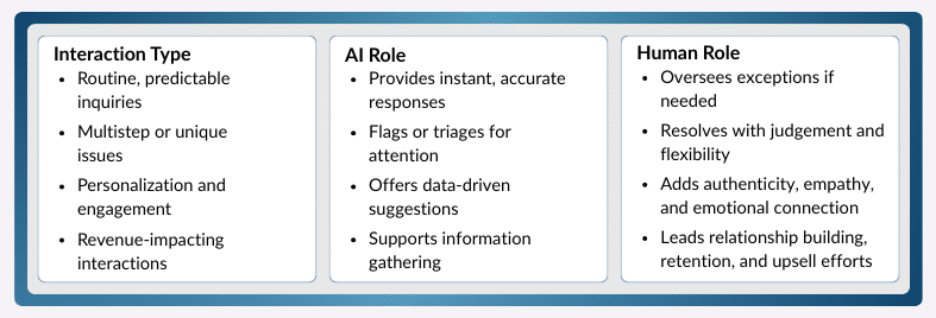
Despite rapid advancements, AI cannot replicate the unique human skills that drive meaningful customer experiences. Empathy, nuanced judgement, and relationship-building are crucial in situations where understanding emotions, context, and long-term impact is essential. Human agents are great at making decisions that require more than rules or data.
The most successful organizations recognize the boundaries of automation and strategically blend AI and human support. AI takes care of routine tasks while agents focus on interactions that require personal connection. This approach empowers agents to use their expertise where it matters most.
These human-driven interactions are particularly important in complex or sensitive situations where decisions carry significant consequences or emotions to run high.
Complex or Sensitive Interactions
Certain customer interactions go beyond rules and routines, requiring emotional intelligence. When customers are frustrated, human agents play a critical role in de-escalating tensions and restoring trust. Their ability to read tone and respond with empathy ensures that service recovery is effective in ways AI cannot replicate.
High-value clients and enterprise accounts also benefit from the human touch. These customers expect personalized attention and proactive communication, and human agents are uniquely equipped to build relationships that foster long-term loyalty and deepen brand affinity. Additionally, situations involving negotiations or sensitive personal matters demand skills that remain firmly in the human domain.
By handling these complex and sensitive interactions, human agents complement AI's efficiency, so customers get both speed and care.
Exception and Relationship Management
Automation thrives in predictable environments, but humans shine when relationship building is required. Skilled agents are essential for interactions that go beyond standard workflows, where judgment and adaptability make all the difference.
In these situations, human agents deliver value in several key ways:
- Handling non-standard or multi-step issues: When a problem doesn't fit the predefined path, agents can assess context, adjust the approach, and provide solutions tailored to the unique situation.
- Creating personalized experiences: AI can leverage data to personalize interactions, but humans bring authenticity, creativity, and emotional intelligence, fostering stronger connections.
- Driving retention, upselling, and building trust: High-value conversations depend on rapport and persuasive communication. Human involvement builds loyalty and long-term trust in ways automation cannot replicate.
AI does improve speed, consistency, and efficiency, but human agents create loyalty and manage the exceptions that define outstanding customer experiences. This balance in place helps organizations maximize both operational efficiency and long-term customer value.
Best Practices for Hybrid AI + Human Support
To maximize performance, organizations must intentionally design their hybrid and AI and human support model rather than simply layering automation onto outdated systems. A successful strategy begins with aligning technology and talent around clear roles. AI should manage front-end triage, data capture, and routine inquiries, while human agents take care of high-value conversations. Thoughtfully structured workflows allow automation to enhance agent performance instead of competing with it.
Equally important is ensuring smooth transitions between AI systems and human representatives. Customers should never feel trapped in a bot loop or forced to repeat information. Integrated systems should allow data to transfer from automation to live support. This consistency makes interactions feel unified rather than fragmented.
However, implementing AI is not a one-time deployment. Ongoing optimization is needed to sustain results. Things like routing logic, escalation triggers, and automation thresholds should be continuously refined based on real performance data and customer feedback. Regular audits ensure automation continues to support business objectives.
With a well-designed hybrid foundation in place, the next priority is establishing clear escalation processes that ensure no complex interaction falls through the cracks.
Build Strong Escalation Processes
Automation delivers efficiency, but without clear escalation safeguards, it can create friction. A strong hybrid support model depends on knowing exactly when AI should continue handling an interaction and when it should step aside. Escalation is a critical design feature that protects both customer satisfaction and operational performance.
Clear triggers should be built into every workflow. AI should be able to recognize signals like rising negative sentiment, failed responses, or high-value customer status. Systems will hold onto interactions for too long without these defined thresholds.
Equally important is preventing automation loops. Repetitive bot responses erode trust and increase the likelihood of churn. Intelligent call routing AI guardrails ensure that progress stalls and escalation happens quickly.
Strong escalation frameworks typically include:
- Sentiment-based triggers to detect frustration or urgency
- Attempt limits to prevent repeated failed responses
- Complexity flags for multi-step or non-standard issues
- Priority routing for VIP or high-value customers
- Full context transfer to eliminate repetition during handoff
After ensuring the right issues reach the right people, organizations can focus on how AI enhances the performance of those agents.
H3: Use AI to Enhance Agent Performance
AI's value goes beyond customer-facing automation. AI is great for supporting agents in real-time to help them deliver consistent, high-quality service. This shift is most visible in how daily work changes for frontline teams.
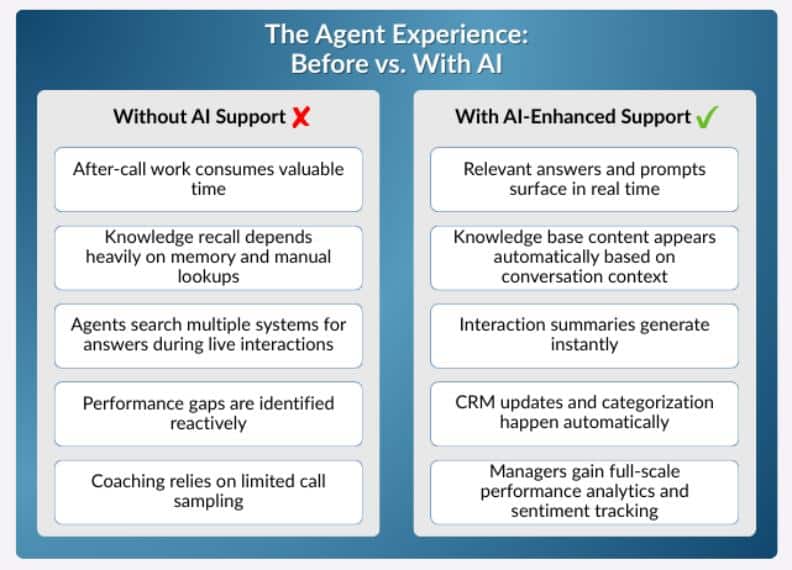
Another benefit of AI blending with human agents is it reduces administrative drag while increasing precision. It turns insights into action during the interaction, not weeks later in a report. And it gives managers visibility into trends that would otherwise remain hidden.
AI strengthens agents rather than replacing them, raising the overall performance of the organization. To fully realize these advantages, organizations must avoid the common pitfalls that derail AI initiatives.
Common AI Implementation Mistakes
While AI can transform customer service, poor implementation can frustrate customers and limit the impact of your investment. Organizations often stumble not because AI is ineffective, but because common implementation challenges are overlooked. There are five key areas to watch:
- Over automation: This can make customers feel ignored or misunderstood, especially in complex situations where human empathy is critical. The goal is to enhance human interaction, not remove it.
- Weak system integration or poor data quality: AI systems are only as effective as the data they can access. Outdated CRMs and siloed information prevent AI from providing accurate insights and personalized responses.
- Lack of training: Even the most sophisticated AI will fail if employees don't know how to use it properly. Agents need clear guidance on how AI can support their work, when to rely on automation, and how to intervene when judgment is necessary.
- Misalignment with customer expectations: AI systems that don't account for the context, preferences, or history of customer interactions make experiences frustrating.
- Neglecting ongoing optimization: AI implementation requires regular evaluation and updates based on real-world usage. Without this, even well-designed systems can under perform.
Recognizing and addressing these challenges early on will help organizations avoid common pitfalls that derail AI optimization.
How to Successfully Implement AIaaS
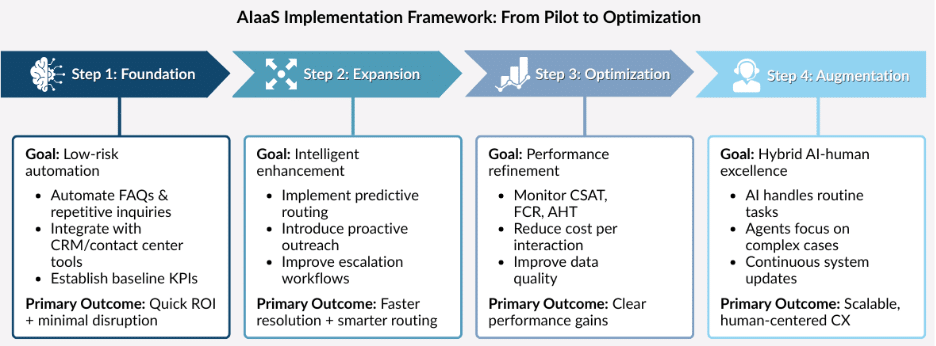
Implementing AIaaS should focus on building a structured rollout that maximizes ROI. Organizations that generate the strongest results treat AI as an enhancement to their service model rather than a replacement.
Smart implementation typically starts with high-volume, low-risk automation to deliver fast efficiency gains while minimizing disruption. Early wins build internal confidence and allow teams to refine workflows before expanding further.
Once foundational automation is stable, organizations can scale into more advanced capabilities like predictive routing and proactive outreach. This phased approach will help prevent over-automation and ensure customers still receive human support when needed.
Measurement is what turns implementation into long-term success. AIaaS performance should be tracked through KPIs including:
- Customer Satisfaction (CSAT)
- First Contact Resolution (FCR)
- Average Handle Time (AHT)
- Cost per interaction
- Escalation rates
- Customer retention
Ongoing monitoring helps teams make any changes to workflows as needed. AI must continuously learn and improve to deliver sustained value. Thoughtfully deployed automation strengthens consistency while preserving personalization.
A study by Zendesk found that 70% of customer experience leaders believe AI improves efficiency across every digital interaction. But the future of customer support isn't fully automated; it's augmented. Adopting a hybrid AI-human model provides organizations with speed and scalability without sacrificing the human touch.
AI is not a replacement for human support because when it is implemented strategically, it empowers agents while providing more consistent experiences. The companies that come out on top will not be those who automate the most, but those who automate thoughtfully while empowering meaningful human connection.
Another option you have is to partner with experts in AI customer support outsourcing, like ROI CX Solutions, to ensure your AI customer experience strategy is scalable, integrated, and continuously optimized. Rather than managing everything in-house, organizations can leverage proven frameworks that combine automation with experienced human support teams. Connect with us today to discover how we use AIaaS to build and protect the relationships that matter most.