

Scaling Content Moderation for Growing Companies
Scaling content moderation requires more than adding headcount—it demands a structured approach to handle rising content volume, complexity, and risk without sacrificing speed or accuracy. As platforms grow, in-house teams often struggle with inefficiencies, inconsistent enforcement, and escalating costs driven by staffing, technology, and compliance demands. The most effective model combines AI-assisted automation with human oversight, supported by standardized workflows and clear performance metrics. For many companies, outsourcing moderation provides the flexibility, global coverage, and cost control needed to scale efficiently while maintaining platform safety and user trust.
Read Time: 9 minutes
Table of Contents
Outsourced content moderation is no longer simply a cost-management tactic; it's a strategic lever for scaling safely, maintaining platform trust, and optimizing operational efficiency. By choosing the right partner, platforms can extend coverage globally, respond to unpredictable content surges, and enforce policies consistently across diverse user communities.
Why Content Moderation Becomes Harder to Scale
As digital platforms grow, content moderation quickly shifts from a manageable operational function into a trust and safety challenge. What once worked for a small or mid-sized platform will usually break under the pressure of rising content volumes and expanding user bases. An organization focused on growth needs to prioritize scalable content moderation.
More organizations than ever before are exploring content moderation outsourcing and enterprise content moderation solutions for growing platforms that blend human expertise, AI assisted content moderation, and global coverage.
Exploding Content Volume
User growth and higher engagement levels dramatically increase moderation workload. Every new feature creates additional content streams that require review. Real-time formats like comments, livestreams, and short-form videos accelerate enforcement times, leaving little margin for error.
Organizations that do not have scalable processes are most likely facing a few challenges such as:
- Backlogs
- Delayed responses
- Inconsistent enforcement
These gaps make it hard for users to trust the brand and can even allow harmful content to spread unchecked. Volume spikes also add further strain to internal teams, making it difficult to maintain service levels without significant overstaffing.
Increasing Content Complexity
Moderation platforms rarely deal with just one type of content. Text, images, video, audio, livestreams, and emerging formats each require different moderation approaches and skillsets. Applying consistent policies across formats adds another layer of complexity.
As content variety grows, maintaining, standardized enforcement becomes increasingly difficult. Teams need to be equipped with specialized workflows, advanced tooling, and ongoing training, to ensure accuracy without slowing moderation speed. It can be challenging for internal teams to keep pace with this level of operational complexity.
Rising Brand and Compliance Risk
Inadequate moderation carries serious brand and compliance consequences. Harmful or illegal content can damage customer trust and often fuel churn. At the same time, global regulatory pressure around content governance and platform responsibility continues to intensify.
Reactive moderation practices often become more expensive and riskier than proactive moderation strategies. Platforms face higher exposure to fines, legal action, and reputation damage, if they can't scale moderation alongside growth.
As platforms grow, the real challenge is not whether moderation is expensive, but how and where those costs accumulate.
So, what is the true cost of scaling content moderation, and how can it be controlled without sacrificing quality?
Understanding the True Cost of Scaling Moderation
The cost of content moderation extends far beyond hourly wages or headcount increases. While staffing is often the most visible expense, the true financial impact of scaling moderation lies in four distinct factors:
- Operational inefficiencies
- Workforce instability
- Technology demands
- Risk exposure
Organizations lacking a clear framework for measuring moderation ROI frequently underestimate costs and overestimate the sustainability of in-house models.
Leaders evaluating scalable content moderation need to consider direct and indirect expenses as well as the opportunity cost of delayed or inconsistent enforcement. A comprehensive cost view enables smarter decision making around resourcing, tooling, and whether content moderation outsourcing can deliver greater efficiency and control at scale.
Direct Operational Costs
Direct costs form the foundation of moderation spend, but they rise quickly as volume increases.
Moderation needs a specialized workforce that can apply nuanced policies consistently across diverse content types. Companies must invest heavily in recruiting, onboarding, and continuous training for content moderators. Platform scaling leads to increased recruiting spending and longer time-to-productivity.
Effective moderation also depends heavily on a growing stack of tools like AI assisted content moderation. Scaling will require that infrastructure grow with it which means higher licensing, customization, and integration costs. Organizations will also need internal teams that take care of performance and data security across these systems.
Lastly, maintaining accuracy and policy adherence will require dedicated QA teams and performance management processes. Growing moderation operations add management costs that are usually overlooked during early-stage scaling.
Hidden Cost Drivers
The most underestimated moderation expenses are the least visible. Content moderation is cognitive and emotionally demanding work. A study found that 42% of content moderators experience symptoms of PTSD. It also found that most third-party moderators stay with their employer for less than a year. While this increases recruiting and training costs, it also disrupts consistency that compounds expenses overtime.
Another when considering content moderation cost and ROI is that moderation policies rarely stay static. Constant changes mean there has to be ongoing retraining. Each update increases the risk of inconsistent enforcement, especially when teams are already stretched thin.
QA failures and poor decisions can trigger backlash from users and damage your brand's reputation. Downstream costs like legal fees and customer churn often outweigh the original cost of proactive moderation investment.
Global platforms will need continuous moderation across various time zones and languages. Maintaining constant coverage inflates operational costs compared to centralized models.
Key Efficiency Metrics to Track
To accurately assess moderation performance and ROI, leaders need to focus on a few key metrics.
- Cost per moderation case
Tracking total moderation costs against the number of cases handled provides a baseline efficiency metric. Rising cost per case can indicate issues with workflow, staffing, or automation
- Throughput and productivity rates
Metrics like cases handled per moderator per hour show how effectively teams scale under increased volume. Declining productivity signals there is something wrong with training or tools.
- Accuracy and quality benchmarks
Precision, recall, and QA pass rates measure how consistently moderators apply policies. High accuracy reduces downstream work, making quality a critical driver of long-term cost control.
- Internal vs outsourced cost comparison
Comparing in-house moderation costs against outsourced content moderation services provides clarity on scalability and ROI. For many growing organizations, outsourced models make it easier to scale without sacrificing quality.
Together, these metrics help leaders have a clear view of whether moderation operations can scale efficiently. However, efficiency alone is not enough. As platforms expand, the next challenge becomes ensuring consistent moderation coverage at all hours and on a global scale.
Achieving Global and Always-On Moderation Coverage
Moderation coverage needs to be constant because today's users expect safe experiences regardless of location or time zone. Achieving global and always-on moderation coverage is how companies can build platform trust, which helps support growth.
Higher volume can also increase the impact of moderation gaps, so it's important to balance speed, consistency, and scalability while preparing for unpredictable demand patterns.
Importance of 24/7 Monitoring
24/7 content moderation services have become a baseline expectation rather than a differentiator. Moderation users engage with platforms constantly and expect harmful content to be addressed quickly. Delayed enforcement creates the perception that a platform is unsafe or poorly managed.
Moderation coverage that is limited to specific hours means harmful content can remain visible for extended periods. These gaps increase the likelihood of user harm and negative press.
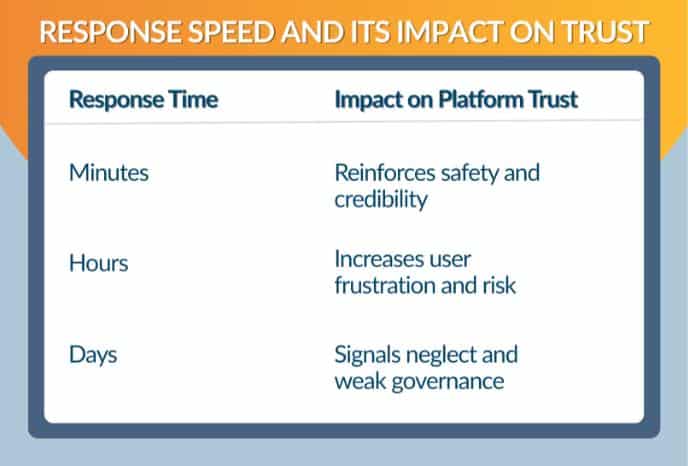
Faster response times strengthen user confidence in safeguards.
Supporting Global and Multilingual Communities
Global growth introduces complexity that goes beyond scale alone. Regional context can drastically alter how content should be interpreted. Automated tools often struggle with these subtleties, increasing the risk of false positives or missed violations.
Moderators who understand local language and cultural context are better equipped to apply policies accurately and consistently. This helps platforms maintain relationships with regional user communities.
While local expertise is critical, enforcement standards must remain consistent globally. Centralized policy frameworks combined with localized execution help ensure fairness and compliance without hurting moderation practices.
Managing Demand Surges
Content moderation is rarely linear. Sudden surges in content volume can cause backlogs, slower response times, and increased error rates. Scalable moderation operations rely on flexible staffing models that can expand or contract quickly. Having workforce flexibility helps platforms maintain service levels without permanent overstaffing.
Organizations can also get always-on moderation coverage by using analytics and forecasting to anticipate demand. Historical data, engagement trends, and real-time analytics can be used to forecast volume fluctuations so companies can adjust resources proactively. Predictive planning allows for more stable, cost-efficient moderation operations.
Global, always-on moderation coverage requires more than just staffing and scheduling. It is reliant on systems, workflows, and tools that help teams work efficiently at scale. Which is why technology and process optimization are the next critical steps in building a sustainable moderation strategy.
Improving Efficiency Through Technology and Process Optimization
As moderation operations scale, efficiency becomes the defining factor between sustainable growth and escalating cost. Technology and process optimization allow platforms to handle increasing content volumes without sacrificing consistency. When applied thoughtfully, automation, workflows, and data-driven insights turn moderation into a scalable, operational function.
Automation and AI are crucial in accelerating moderation speed and extending coverage. However, the greatest gains come from pairing intelligent tools with well-designed processes that support teams and allow for continuous improvement. These working together help platforms moderate more effectively while controlling cost and risk.
AI and Automation in Moderation
AI-assisted moderation and automation play a critical role in helping platforms scale without increasing headcount or cost. Automated systems help platforms process, sort, and prioritize large amounts of material faster than manual review alone. These tools help surface potentially harmful or policy-violating content early, so moderation teams can focus attention where risk is highest, and response times matter most.
Automation is particularly good at handling easier tasks like first-pass reviews, pattern recognition, and prioritization across queues. AI-assisted workflows improve throughput and shorten response times, which is key for maintaining trust and safety in digital environments.
However, these tools do have clear limitations. Context, cultural nuances, tone, and other forms of harmful behavior fall outside the scope of automated decision making. Over-reliance on AI can cause a variety of errors, especially in complex or sensitive content categories. For this reason, successful moderation programs use AI to assist, rather than a replacement for human judgment.
The most effective moderation strategies combine automation with structured human oversight. Clear and continuous feedback between moderations and AI systems help balance speed with accuracy. The right blend of AI and automation will help moderation operations scale sustainably without compromising quality.
Standardizing Workflows and Quality Assurance
Scaling moderation operations need to have standardized workflows and QA processes to help ensure decisions are aligned with platform policies. Without structure, moderation efforts fragment quickly, causing rework, inconsistency, and elevated risk.
Core components of standardized moderation workflows include:
- Clearly documented enforcement policies and decision frameworks
- Standardized case routing, escalation paths, and review queues
- Consistent onboarding and training materials across teams and regions
These reduce ambiguity for moderators and support repeatable decision-making across content types and markets.
AI-Assisted Moderation Workflow At Scale
| Moderation Stage | Primary Role | Value Delivered |
|---|---|---|
| Automated intake & filtering | AI systems | Rapidly scan and categorize high-volume content |
| Risk scoring & prioritization | AI systems | Surface high-risk or time-sensitive content first |
| Contextual review & decisions | Human moderators | Apply judgment, nuance, and policy interpretation |
| Escalation & edge cases | Senior moderators | Handle complex, sensitive, or ambiguous content |
| Quality assurance & feedback | QA teams + AI | Improve accuracy and retain models over time |
To maintain consistency over time, scalable moderation programs rely on structured quality assurance and calibration processes. These programs align teams as policies evolve, and risks change.
Effective QA and calibration programs usually focus on:
- Regular sampling and review of moderation decisions
- Cross-team calibration sessions to reinforce policy interpretation
- Continuous feedback loops to address accuracy gaps and training needs
Reporting adds a final layer of optimization by making performance visible and actionable. These dashboards allow leaders to identify trends and proactively manage risk. With these elements all working together, moderation operations scale more effectively without sacrificing quality or user trust.
Even with optimized systems in place, many growing platforms find that scaling moderation requires more flexibility and operational resilience, making outsourced moderation a huge proponent of long-term growth.
How Outsourced Moderation Enables Scalable Growth
Content moderation demands quickly exceed the capabilities of internal teams as platforms scale. Outsourced content moderation services provide operational flexibility, cost efficiency, and access to trained expertise without the constraints of traditional hiring. By partnering with an experienced provider, like ROI CX Solutions, platforms can respond quickly to growth while maintaining high-quality enforcement.
BPO partners bring established moderation infrastructure and trained teams that can take years to develop internally. Outsourcing allows organizations to scale proactively so they can maintain compliance even during unexpected spikes.
Workforce Flexibility and Rapid Expansion
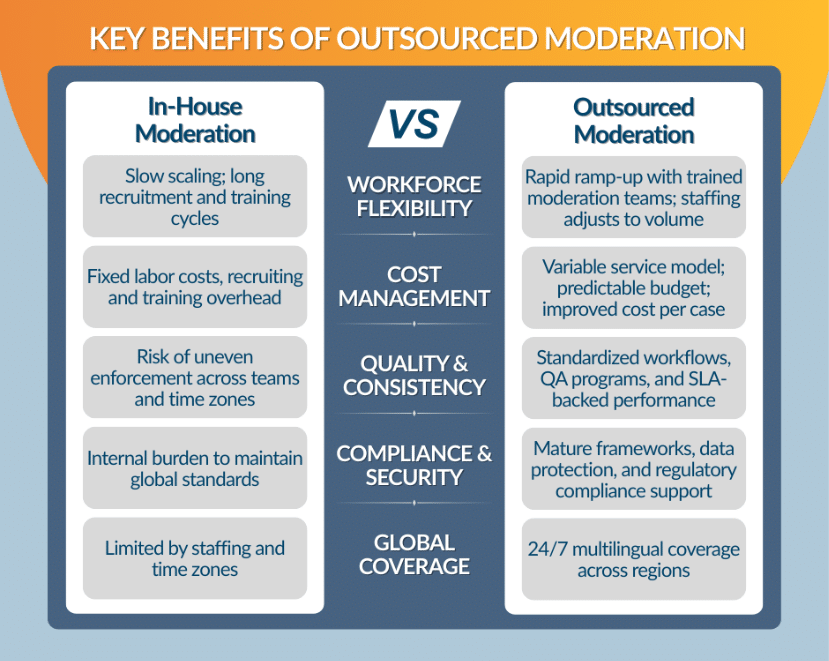
One of the most significant advantages of outsourced moderation is the ability to scale quickly in response to platform growth or unexpected demand. Internal hiring cycles can be slow, sometimes taking weeks or even months, leaving teams understaffed during critical periods. Outsourced moderation partners provide access to specialized teams ready to handle whatever comes their way.
This flexibility means organizations can adjust staffing to accommodate spikes without overstaffing or incurring unnecessary costs. By leveraging a provider like ROI CX Solutions, organizations get a workforce capable of delivering high-quality moderation at scale.
Cost Optimization and Predictable Budgeting
Outsourced moderation offers platforms a clear path to more predictable and efficient budgeting. Internal moderation teams require ongoing fixed investment in salaries, benefits, and infrastructure, which can make costs difficult to scale with demand. Shifting to an outsourced model helps companies pay for capacity as needed, avoiding the overhead of permanent staffing.
In addition to labor savings, outsourcing reduces recruiting, onboarding, and training overhead. Experienced moderation providers maintain trained teams and have established workflows, eliminating much of the internal administrative burden. The combination of these efficiencies with transparent pricing models, and measurable performance metrics, gives leadership a clear understanding of overall moderation value.
Compliance and Risk Mitigation
Internal moderation teams also struggle to manage legal, regulatory, and reputational risks. Experienced BPO partners operate within established governance frameworks, performance SLAs, and secure operational environments, so moderation decisions are compliant with evolving requirements.
Data security is another advantage of outsourcing. Leading moderation providers implement strict protocols to protect sensitive user information. This level of security and oversight can be challenging and costly to maintain in-house.
Outsourced moderation also supports compliance with global content moderation services. Providers track regulatory changes and standards, to help organizations adapt policies quickly. This helps prevent fines, legal challenges, and reputational damage. Outsourcing offers a comprehensive approach to managing moderation risk at scale.
While outsourcing unlocks scalability and efficiency, the impact depends on choosing a content moderation partner that matches your needs, quality standards, and long-term strategic vision.
What to Look for in a Content Moderation Partner
Choosing the right content moderation partner is one of the most important decisions a growing platform can make. The ideal partner will help you scale quickly and efficiently, while also aligning with your quality expectations. Evaluating potential providers across several key dimensions ensures that outsourcing delivers real value, rather than simply shifting tasks externally.
A few key considerations when selecting a partner are:
- Scalability and flexibility
Look for a provider that can ramp resources up or down to match volume fluctuations and unexpected spikes. The ability to scale quickly and effortlessly is crucial for growing platforms.
- Workforce expertise
Experienced, trained moderation teams ensure high accuracy and consistent policy enforcement. A partner with specialized skillsets reduces onboarding time and improves operational efficiency.
- Technology and process integration
AI-assisted tools, standardized workflows, and QA processes enable faster moderation and consistent quality. Make sure that the partner's technology stack can integrate smoothly with existing systems
- Compliance and security
The provider should maintain governance frameworks, strict data protection protocols, and should be aware of evolving regulations. This protects both your users and your brand from risk.
- Transparency and reporting
Look for clear performance metrics, reporting dashboards, and defined SLAs. Regular insights enable better decision-making and ROI tracking.
Careful evaluation of these factors will help you find an outsourcing partner that supports growth and user trust.
For organizations ready to scale moderation without compromise, ROI CX Solutions offers experienced teams, proven processes, and technology-driven solutions to meet your unique platform needs. Contact us today to find out how we can help you scale efficiently and confidently.