

The Hidden Costs of In-House Technical Support And How Outsourcing Can Save Your Business
In-house technical support carries significant hidden costs beyond salaries, including recruiting, training, infrastructure, management overhead, and productivity loss, all of which increase as demand grows and create scalability and service risks. Outsourcing reduces total cost of ownership by eliminating these expenses, providing immediate access to skilled teams and advanced tools, and offering predictable, scalable support. It not only lowers costs but also improves efficiency, service quality, and customer experience while freeing internal IT teams to focus on strategic initiatives.
Read Time: 7 minutes
Table of Contents
For many organizations, having an internal IT help desk feels like the safest option because they maintain total control and communication seems easier. However, when companies conduct a true technical support cost comparison, the numbers often tell a different story.
The reality is that the total cost of maintaining in-house support goes beyond salaries. As demand grows and customer expectations increase, the hidden costs and operational risks quietly erode margins. What we are seeing now more than ever before is an increase in organizations turning to outsourced technical support to cut costs and improve performance.
Below, we break down the true cost of in-house support and explain how technical support outsourcing can reduce IT support costs and even improve customer experience.
The True Cost of In-House Technical Support
At first, calculating support costs seems easy: salary multiplied by headcount. This approach doesn't work because it understates the real financial commitment.
The difference between visible and hidden operational expenses is huge. You have to consider not only payroll, but also overhead costs that accumulate across departments, making the burden much higher.
As your organization grows, so will the complexity of maintaining in-house technical support. What starts as a lean team quickly becomes a substantial fixed-cost center.
Direct Costs Most Companies Underestimate
When organizations evaluate in-house vs outsourced technical support, they often assume the main expense is employee salary. Base compensation only represents a portion of the true financial costs. Things like recruitment cycles, infrastructure, and continuous training significantly increase total spend.
The cost of maintaining even a small internal support team compound quickly. A growing company will need to invest more in not just personnel, but tools and training to maintain service quality. These expenses are frequently undercalculated when a company is working on a technical support cost comparison.
Below are the four most common direct cost categories businesses underestimate:
- Salaries, benefits, and payroll: Competitive compensation is needed to attract and retain skilled support technicians.
- Recruiting and onboarding expenses: Hiring technical talent involves job postings, recruiter fees, and background checks.
- Ongoing technical training and certifications: Continuous education is essential to keep pace with evolving software, cybersecurity threats, and hardware platforms.
- Licensing, hardware, and infrastructure costs: Ticketing systems, remote monitoring tools, cybersecurity platforms, and physical equipment all add up.
While these expenses are relatively easy to quantify, they still represent only one part of the total cost equation. Many organizations overlook the indirect operational costs that accumulate behind the scenes and often have an even greater impact on long-term profitability.
Indirect Costs That Impact the Bottom Line
Indirect costs are harder to measure but significantly affect the cost of maintaining an internal support team. Theses costs come from operational efficiencies, resource allocation changes, and the broader organizational impact of managing technical support.
Internal IT teams typically handle high volumes of routine service requests while also dealing with more complex, strategic initiatives. This creates competing priorities that can reduce productivity and increase risk. These hidden costs can outweigh the perceived savings of keeping support functions in-house.
Four factors to watch out for are:
- Management oversight and leadership bandwidth: IT leaders and senior staff spend significant time on routine support operations rather than working on higher level initiatives.
- Employee turnover and knowledge loss: Technical support roles experience higher turnover, leading to repeated hiring cycles and loss of internal knowledge.
- Downtime, service inconsistency, and customer churn: Limited coverage or inconsistent expertise can lead to unresolved issues that negatively affect the customer experience.
- Opportunity cost of internal teams handling routine issues: Highly skilled IT professionals are diverted from innovation-focused projects to address basic tasks.
Combined with direct operational expenses, these hidden factors drive the true cost of maintaining internal support teams' way up. They also bring operational challenges and risks that become more prominent as the organization grows.
Operational Risks of Keeping Technical Support In-House
Maintaining internal technical support in-house introduces a range of operational risks that become more difficult to manage over time. Teams are typically built around current demand, so even slight increases in ticket volume can quickly drain resources. Scaling an internal team is another beast of its own because it causes internal delays that could potentially leave your business understaffed.
Another operational risk that tends to be forgotten is how difficult it can be to provide 24/7 technical support services. It requires staff day and night, weekends, and occasionally holidays. According to Uptime Crew, traditional hiring models frequently fail to provide workers who are fully prepared for the technical and scheduling demands of continuous operations. This highlights the real-world challenges and operational limitations that many organizations face when attempting to staff a round-the-clock in-house support team.
Internal teams also face technology limitations that come from only being able to access a patchwork of tools rather than a fully integrated service management platform. This means visibility can be limited, and resolution times increase. These inefficiencies become more pronounced as an organization grows, and teams struggle to maintain consistent experiences.
These operational challenges aren't just inconvenient; they negatively impact your customers and brand reputation.
Recognizing the operational strain of maintaining an internal support team leads many businesses to start exploring alternatives that provide better scalability and resilience. Many consider outsourced enterprise technical support solutions because they help reduce risk while improving service quality.
How Outsourced Technical Support Reduces Total Cost of Ownership
Organizations that want to avoid all the risks that come with internal support should turn to outsourced technical support. Instead of taking on hiring internally, companies rely on a team of experienced specialists provided by a third-party partner. This approach gets rid of the overhead that comes from recruitment and onboarding, while ensuring trained personnel are available immediately without the delays that come from building an internal team.
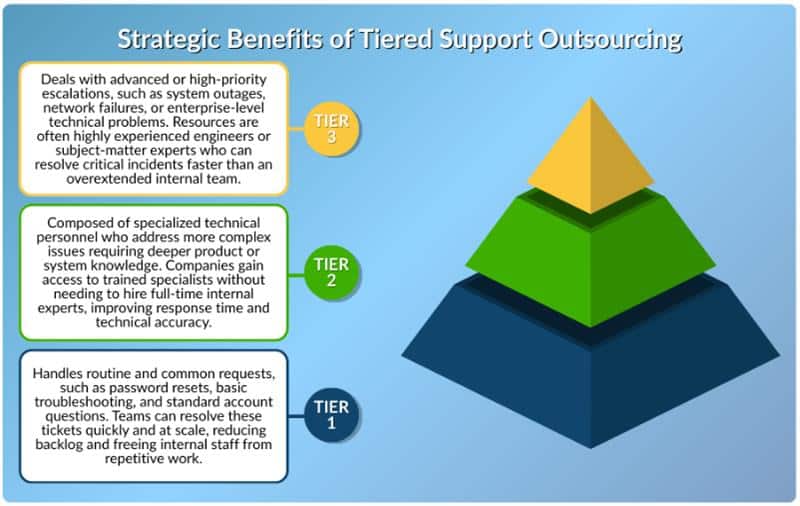
Outsourcing also provides access to shared infrastructure and enterprise-grade tools that would normally be too expensive to implement internally. Things like automation, advanced CRMs, and more efficient ticketing platforms help companies have better resolution times. Companies are also able to implement Tier 1, Tier 2, and Tier 3 support outsourcing models, which ensures that simple enquiries are handled quickly while specialized issues receive expert attention.
Financial Advantages Executives Care About
From a strategic standpoint, outsourcing provides measurable financial benefits that resonate with executives. Cost predictability improves as organizations pay for service levels rather than dealing with unpredictable spikes with internal teams. Capital expenditures are also reduced because the outsourcing partner maintains and updates systems needed for the IT teams. Additionally, outsourced support enables faster scalability during periods of growth or seasonal spikes.
The ROI of IT help desk outsourcing can be tracked using specific metrics including:
- Cost per ticket: Measures the average cost to resolve a support request
- First call resolution (FCR): Tracks the percentage of tickets resolved on the first interaction.
- Average Handle Time (AHT): Measures the speed of resolving support requests across Tier 1, 2 and 3.
- Customer Satisfaction (CSAT) and Net Promoter Score (NPS): Quantifies user experience and loyalty.
Consistently tracking these metrics will help executives quantify the measurable ROI of outsourced technical support.
Cutting costs is great, but outsourcing also provides opportunities that can help organizations align IT operations with broader business objectives.
Beyond Cost Savings: The Strategic Value of Outsourcing
Reducing expenses is one of the initial reasons companies look to outsource technical support; however, the benefits are so much more significant. One of the most significant advantages is the ability to free internal IT teams from basic, tedious tasks by offloading them to a specialized outsourcing partner. It enables these teams to work on innovation, system improvements, and strategic initiatives that help with growth.
Outsourced providers also have structured processes and specialized expertise that improve overall efficiency. Having this reliable support improves customer satisfaction and loyalty.
Moreover, outsourcing supports broader digital transformation initiatives. Having an outsourcing partner provides organizations with new tools like AI solutions, without overburdening internal IT staff. This high level of expertise and staffing flexibility makes outsourced technical support a great way to grow your business
Recognizing the benefits is one thing but understanding how outsourcing fits your organization's unique structure and objectives is essential for success.
How to Evaluate Whether Outsourcing Is Right for Your Organization
Before committing to an outsourced technical support model, organizations should carefully evaluate the financial and operational impacts. A structured assessment will hlep you compare in-house vs outsourced technical support, quantify potential savings, and anticipate the operational impact.
Key factors to consider when considering the cost of outsourcing technical support include:
- Financial and operational indicators: Review total cost of ownership, per-ticket costs, scalability needs, and potential savings compared to maintaining an internal team.
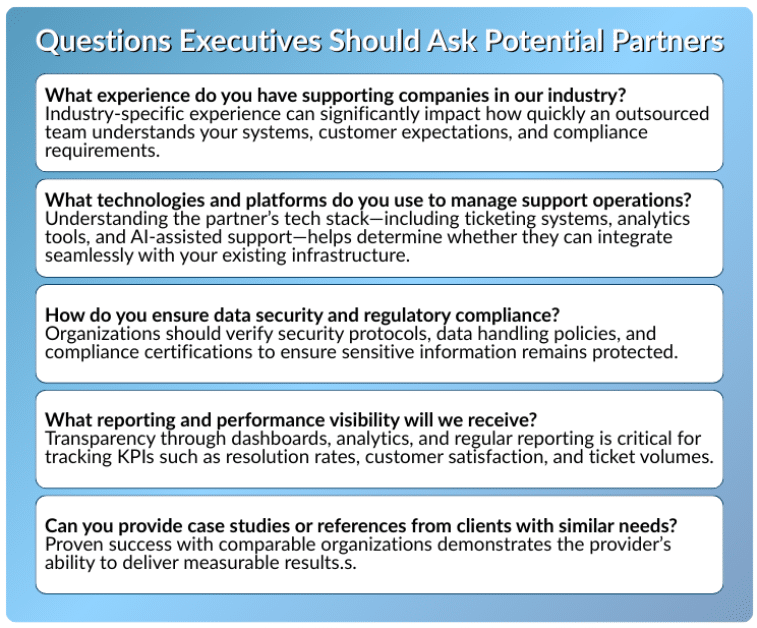
- Risk mitigation strategies: Ensure that the partner can meet your security, compliance, and regulatory needs. Make sure they have data protection policies, incident response procedures, and clear escalation paths to prevent service interruptions.
- Transition planning and change management: Successful outsourcing requires careful planning including staff training and system integration.
Taking a structured approach to evaluation will ensure outsourcing is the right move financially, and the provider you choose aligns with your company's objectives.
Outsourcing is a great way to not only cut costs but also improve efficiency and the customer experience. By carefully assessing your organization's operational needs and financial goals, you can make an informed decision that maximizes ROI.
At ROI CX Solutions, we provide expert outsourced technical support solutions tailored to your business. Discover how we can help you streamline operations today.