

What Financial Institutions Should Know About Call Center Outsourcing
Financial institutions should view call center outsourcing as a strategic lever, not just a cost-cutting tactic. The right partner helps banks deliver 24/7 support, scale operations, improve customer experience, and access specialized talent and technology—while maintaining strict compliance and security standards. Success depends on choosing a provider that aligns with your regulatory requirements, integrates with your systems, protects your brand, and delivers measurable ROI through performance, efficiency, and customer retention gains.
Read Time: 7 minutes
Table of Contents
In banking, a single misstep can cost trust, and customers walk away fast. Financial institutions face high stakes with every interaction because as you are probably aware, dealing with finances can be stressful. Outsourcing call center operations is a great way to help companies protect their brand while still keeping customers loyal. Many companies that are struggling to keep up their service quality while maintaining standard operations are turning to bank call center outsourcing.
This guide breaks down what financial executives need to know before partnering with an outsourced call center for banks. It also explores how to determine if the move aligns with your long-term growth strategy.
Why Financial Institutions Are Outsourcing Customer Support
Customer support in the financial industry is getting harder to navigate and manage due to evolving customer expectations. Customers want what they want, when they want it, how they want it, and companies that fail to keep up are at risk of their customers leaving them for the competition.
Banks, along with many other finance organizations, are expected to operate beyond basic branch hours. It's no surprise many companies are struggling to provide 24/7 service because it requires extensive staffing, flexible scheduling, and round the clock management oversight.
At the same time, having skilled customer service agents in-house has become incredibly expensive, especially in a highly regulated environment. Specifically, a few things that increase the cost per agent are:
- Benefits
- Workforce management
- Compliance training
- Managerial oversight
Outsourcing through a specialized financial services BPO is exactly what these organizations need to help them manage these high costs while keeping up with their standards.
The growth of digital banking has further increased customer demand volumes. It's hard to predict what inquires can be because of the broad range of options available. Agents aren't just dealing with disputes and password resets. They have to understand app navigation and so much more.
Ultimately, financial institutions are struggling to improve the customer experience while controlling costs. Outsourced banking contact center solutions offer a practical way to meet these demands efficiently and effectively.
From Cost-Cutting to Strategic Growth
Modern bank call center outsourcing should work to build operational agility that supports long-term growth. Financial institutions are starting to see that the right banking customer service outsourcing strategy improves the customer experience while creating scalability that is difficult to get internally.
Customer experience directly impacts retention and profitability. A high-performing support partner will help you maintain your customers and their loyalty by:
- Improving first call resolution
- Reducing hold times
- Delivering accurate, empathetic service
These improvements show that outsourcing is a revenue strategy rather than a cost decision.
Specialized providers also bring trained agents that have expertise specifically in the financial industry and all the regulations and nuances that come with it. This means organizations can access experienced talent without building expensive internal training infrastructure.
Outsourcing is great for giving companies the flexibility that is needed to navigate demand fluctuations such as tax season or rate changes. Scalable staffing models work to maintain service levels during high-volume periods without long-term hiring commitments.
Once cost is no longer the primary focus, the true competitive advantages begin to emerge.
Key Benefits Beyond Cost Savings
Cost reduction may open up the conversation, but it is rarely the most meaningful long-term advantage of financial services call center outsourcing. According to Deloitte's 2024 Global Outsourcing Survey, traditional cost reduction remains important, but organizations are increasingly focusing on value-based relationships, skilled talent, and agility as key drivers of outsourcing decisions.
The most immediate advantage is having access to 24/7 customer support for banks. As digital banking continues to replace branch-based interactions, customers expect support at any time without delay. Maintaining that high level of coverage internally, as stated previously, takes up too many resources. Outsourcing partners provide continuous operations, so businesses can extend availability without increasing internal strain or costs.
Scalability is another operational advantage. Hiring within the financial industry is rarely quick. The complexities that come with recruiting and onboarding can go on for weeks or even months. Outsourcing providers maintain active recruitment pipelines and workforce reserves that allow them to ramp up quickly when demand spikes. This agility is great for getting customers fast service while maintaining brand standards.
Outsourcing providers also help improve performance. Established providers use advanced workforce management forecasting and real-time monitoring to make processes more effective. Performance enhancements such as improved SLAs strengthen brand perception and reinforce customer trust.
One of the challenges many financial institutions face is keeping up with rapid innovation in customer support technology. Building and maintaining these systems internally requires significant investments in software, infrastructure, and technical expertise.
Outsourcing partners provide standardized technology stacks that are designed for large operations. These platforms typically include:
- Cloud-native contact center systems that support flexibility and remote work
- Intelligent call routing that reduces transfers and improves FCR
- Real-time dashboards and workforce forecasting tools for smoother capacity planning
- Speech and sentiment analytics that uncover patterns and training opportunities
Partnering with an outsourcing provider lets organizations leverage advanced technology capabilities sooner and at a lower upfront cost.
Lastly, quality assurance and workforce optimization programs help with continuous performance refinement. Dedicated teams can monitor systems and interactions in real-time, often with greater consistency and analytical depth than smaller in-house teams.
These advantages show that outsourcing provides stability and improves the customer experience. Viewing outsourcing from this broader lens helps you begin to see its full strategic impact.
Performance gains are great, but security and regulatory adherence are another defining factor of long-term success with call center outsourcing.
Compliance, Security, and Risk Management
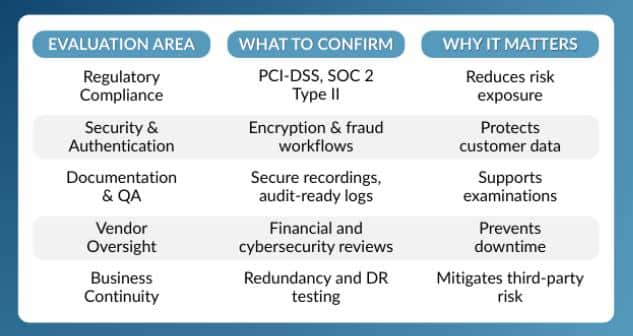
Outsourcing is a regulatory decision as much as an operational one. Outsourced call center compliance in banking should operate within the same framework as your internal teams because every interaction impacts your company's risk profile.
A qualified partner will have verified adherence to standards such as PCI compliant call center services, SOC 2 Type II, and ISO 27001. Security practices should be embedded into infrastructure, processes, as well as agent training. Authentication procedures need to align with your internal policies, including multi-factor verification and clear fraud escalation workflows. Agents should be trained to recognize suspicious behavior and act quickly.
Documentation and audit readiness are another critical factor. Secure call recordings, QA review, and audit-ready reporting provide transparency during regulatory examinations. Vendor risk management requires ongoing monitoring throughout the partnership.
Business continuity planning is essential. Well-tested recovery plans ensure service stays up and running, which protects customer confidence and keeps your business in good standing during unexpected disruptions.
Once risk and regulatory safeguards are in place, the next priority is ensuring the technology ecosystem supports secure, connected customer interactions.
Technology Integration and Omnichannel Support
Modern day customers are going to interact with financial organizations across multiple channels, and a seamless experience should be provided. Effective technology integration ensures these interactions feel connected, so customers don't have to repeat themselves, and issues get resolved faster.
Strong outsourcing partnerships rely on integrating systems, so agents can have real-time access to customer day. This allows them to handle requests more effectively and with more confidence.
Omnichannel support for financial institutions operates on a unified platform to provide smoother transitions between channels. Customers can start a conversation on chat and continue it over the phone without losing context. AI-driven tools further enhance efficiency by:
- Routing inquiries based on intent
- Flagging high-risk interactions
- Assisting agents with real-time guidance
- Automating routine tasks
Real-time reporting dashboards give teams insight into overall productivity. This transparency helps teams make better decisions and stay accountable.
Having this data in a single profile means call centers can improve the overall customer experience.
Technology integration and AI efficiency are important, but delivering consistent service that reflects your brand's values is another critical step.
Protecting Brand Experience and Service Quality
Outsourcing doesn't mean you give up control over your brand. The right partner will feel like an extension of your company, representing your values and voice at every customer touch point. Protecting your brand starts with ensuring that every interaction reflects the professionalism and empathy your customers expect.
Key elements of brand protection and service quality include:
- Customized agent training
- Agents get in-depth instruction on your financial products, including rate structures, loan requirements, and escalation policies.
- Tone, professionalism, and empathy standards
- Every conversation is guided by clarity and compassion, particularly in high-stakes scenarios such as fraud disputes, loan denials, or financial hardships.
- Quality assurance programs
- Structured processes that cover compliance scoring, soft skill evaluations, call calibration sessions, and continuous feedback loops.
- Shared KPIs and SLA alignment
- Collaborative performance tracking includes CSAT, FCR, AHT, and escalation rates. Clear SLA definitions prevent misunderstandings and uphold standards.
- Monitoring retention and performance trends
- Tracking customer satisfaction alongside retention metrics provides a holistic view of success and highlights areas for improvement.
These practices show that your outsourcing partner can help you maintain a high-quality, reliable customer experience.
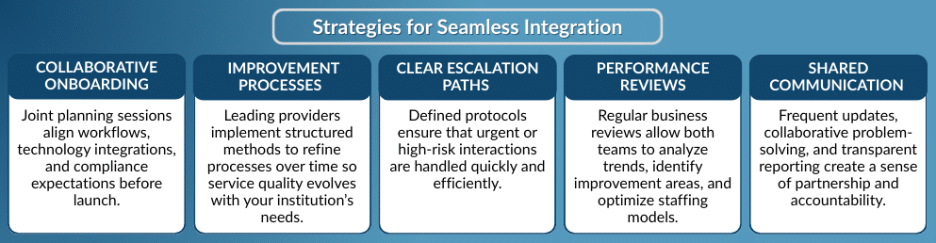
Creating a Seamless Extension of Your Internal Team
The best outsourcing relationships will feel collaborative, not transactional. Joint onboarding sessions establish clear expectations before operations begin. Clear escalation protocols protect high-risk interactions, while ongoing performance reviews help teams identify trends and adjust workflows as needed.
Leading providers embed continuous improvement into every interaction, so your outsourced team evolves alongside your company's needs. This helps ensure the quality of every customer experience is maintained.
Evaluating ROI and Determining Fit
Before committing to bank call center outsourcing, you need to have a clear view of financial and operational impact. A fully loaded cost comparison is great for exploring benefits, recruiting, and technology investments. It's easy to underestimate the hidden costs of in-house operations, so comparing these costs to outsourcing fees provides a clear picture of potential savings while also identifying if the move will be cost-effective in the long run.
As stated previously, outsourcing ROI goes beyond operational costs. It can create value by improving customer retention, providing revenue growth opportunities, elevating compliance and risk management, and enhancing customer satisfaction.
Operational readiness is just as important as financial ROI. You might be ready to outsource if internal teams are struggling with high demand, strained compliance oversight, or outdated technology systems. Organizations can determine whether outsourcing aligns with strategic objectives and meaningfully improves operational efficiency by having a structured evaluation process that looks at operational factors and cost.
The right moment to outsource is often when internal systems are under pressure, and growth objectives are limited by operational constraints. Being thorough with your evaluation will ensure that outsourcing is a strategic move, rather than a reactive one.
Questions to Ask a Potential Outsourcing Partner
Selecting the right outsourcing partner is a critical decision that can determine the success of your customer experience strategy. Leadership should focus on questions that reveal a partner's ability to protect data, maintain compliance, and deliver high-quality service. Four main areas of inquiry are:
- Certifications and compliance controls: Verify PCI-DSS, SOC 2, and other relevant certifications. Ask how often audits occur and request proof of compliance.
- Data protection protocols: Understand encryption standards, access controls, monitoring procedures, and incident escalation protocols to ensure your customer data is secure.
- Agent training and regulatory expertise: Review the curriculum for initial and ongoing training and ask about the frequency of regulatory refreshers to ensure agents are always up to date.
- Incident response and escalation: Examine documentation, communication timelines, and remediation procedures. Understanding how quickly and effectively a partner responds to issues is crucial for risk management.
It is also recommended that you ask for case studies to get a better understanding of how their workflows play out in the real world.
Asking these questions will help you see if the potential outsourcing provider can deliver operational excellence and strategic value.
Metrics That Matter Most
Data-driven oversight is necessary to measure whether outsourcing achieves its intended objectives. While financial calculations set the baseline, operational and customer focused metrics show the real impact. Key metrics include:
- Cost per contact: Tracks operational efficiency and identifies areas where processes can be streamlined.
- Average handle time (AHT): Measures productivity without sacrificing service quality, helping balance speed and satisfaction.
- First call resolution (FCR): Indicates how effectively issues are addressed on the first interaction, reducing repeat calls and enhancing customer experience.
- Customer satisfaction (CSAT): Reflects overall perception of service quality and identifies areas for improvement.
- Revenue protection indicators: Monitor churn rate, dispute resolution outcomes, and fraud mitigation performance.
Transparent and regular tracking of these metrics ensure that outsourced operations deliver measurable value while aligning with strategic goals. Outsourcing bank call center functions is a great way to drive growth and improve the customer experience. A trusted partner will provide scalable solutions tailored to your organization's needs.
For banks looking to maximize ROI and improve operational performance, ROI CX Solutions brings the expertise and resources needed to make call center outsourcing a strategic advantage.