

How to Evaluate SMS Capabilities When Choosing a BPO Partner
SMS is now a core customer support channel, making enterprise-grade SMS capabilities a critical factor when selecting a BPO partner. Leading BPO SMS services deliver secure, compliant, two-way, agent-assisted messaging that integrates seamlessly with voice, email, and CRM systems to create a true omnichannel experience. With high customer opt-in rates and rapid response times, SMS reduces call volume, improves efficiency, and aligns with modern customer communication preferences. Enterprises should evaluate SMS outsourcing partners on scalability, platform ownership, automation and AI readiness, data security, regulatory compliance, and transparent performance reporting. ROI CX Solutions helps organizations deploy scalable, compliant, and fully integrated SMS programs that strengthen customer experience, optimize operations, and drive measurable CX and business growth.
Read time: 7 minutes
Table of Contents
SMS is now a core customer support channel, and enterprises must evaluate BPO SMS services based on scalability, compliance, and omnichannel integration. The right partner will provide secure, agent-assisted SMS that reduces call volume and improves CX. ROI CX Solutions helps businesses deploy enterprise-grade SMS programs that drive measurable CX and operational growth.
Why SMS Capabilities Matter in BPO Selection
A recent survey revealed 82% of people check their notifications within 5 minutes of receiving a text. The same survey also discovered that 84% of people have opted in to receive text messages from a business. This shows that SMS is one of the fastest and most preferred ways customers choose to engage with brands.
Customers expect fast, convenient, and non-disruptive interactions, and text messaging delivers all three. It's great for a wide variety of age groups and flexible enough to support things like quick status updates all the way to complex customer support conversations.
SMS has become a critical component of the modern customer experience, which is why it should be a major consideration for enterprises exploring SMS contact center outsourcing. Some BPOs may only provide basic automations while others deliver fully integrated, agent assisted programs.
When evaluating SMS customer support outsourcing, companies need to be able to determine whether the BPO's contact center SMS solutions are enterprise-grade, scalable, compliant, and aligned with CX goals.
So, what should decision-makers be evaluating when SMS is part of the outsourcing strategy?
SMS Is No Longer a "Nice to Have" Channel
The rise of SMS in customer service is a response to how people communicate today. Phone calls require time, focus, and immediate availability. Email can feel slow and impersonal. SMS sits in the sweet spot between the two, allowing customers to engage quickly and on their own terms.
Consider that 90% of people will reply to an SMS message within 30 minutes of receiving it, and 55% of people would rather use SMS over Facebook Messenger or WhatsApp. This shows that not utilizing SMS is a huge, missed opportunity.
Shifting toward text-based communications has turned SMS into a core pillar of service delivery. In modern omnichannel BPO services, SMS is an integral part of how customer journeys are designed and managed. Customers may start with a text, escalate to a call, and follow up via email.
This is why SMS maturity often reflects overall BPO sophistication. Providers that struggle with SMS integration will most likely struggle with omnichannel execution as well. BPOs that provide high-performing call center SMS services typically have the technology and processes to support enterprise-scale customer experiences.
Core SMS Capabilities Every Enterprise BPO Should Offer
As stated previously, not all SMS offerings are created equal. While many providers claim to offer text messaging support, the capabilities and CX they provide can vary significantly.
Evaluating BPO SMS services requires looking beyond surface-level features and understanding how SMS functions within the provider's operating model.
Two-Way, Agent-Assisted SMS (Not Just Notifications)
One of the most common pitfalls in outsourced SMS customer service is overreliance on one-way messaging. While outbound alerts do provide value, enterprise SMS programs must support two-way, agent assisted conversations.
Live agents can manage SMS interactions in real time, respond naturally, and resolve issues without forcing customers to switch channels. SMS platforms must also be able to support asynchronous conversations. Customers may respond minutes or even hours later, and the conversation should effortlessly resume with full context intact.
Clear ownership of conversations is critical. A mature text messaging customer support BPO will have workflows that ensure SMS threads don't get lost. Without this structure, response times suffer, and customer trust erodes.
Omnichannel Integration
SMS should never operate in a silo. Enterprise-grade contact center SMS solutions integrate seamlessly with voice, email, chat, and more.
Agents should have access to customer history, regardless of where the interaction originated. Customers will often switch between SMS and voice; the agent handling the call should already understand the issue.
This level of coordination is a defining feature of a true BPO omnichannel contact center. SMS becomes part of a cohesive customer journey instead of a disconnected tool with limited visibility.
Platform Ownership, Flexibility, and Integration
Behind every SMS interaction is a technology stack that will determine how flexible, scalable, and cost effective the program will be over time. Understanding who owns and manages that technology is critical. Platform ownership directly affects how well SMS adapts as customer expectations evolve.
To properly assess these factors, enterprises should closely evaluate two areas: how the SMS platform is owned and managed, and how deeply it integrates with existing CRM and contact center technologies.
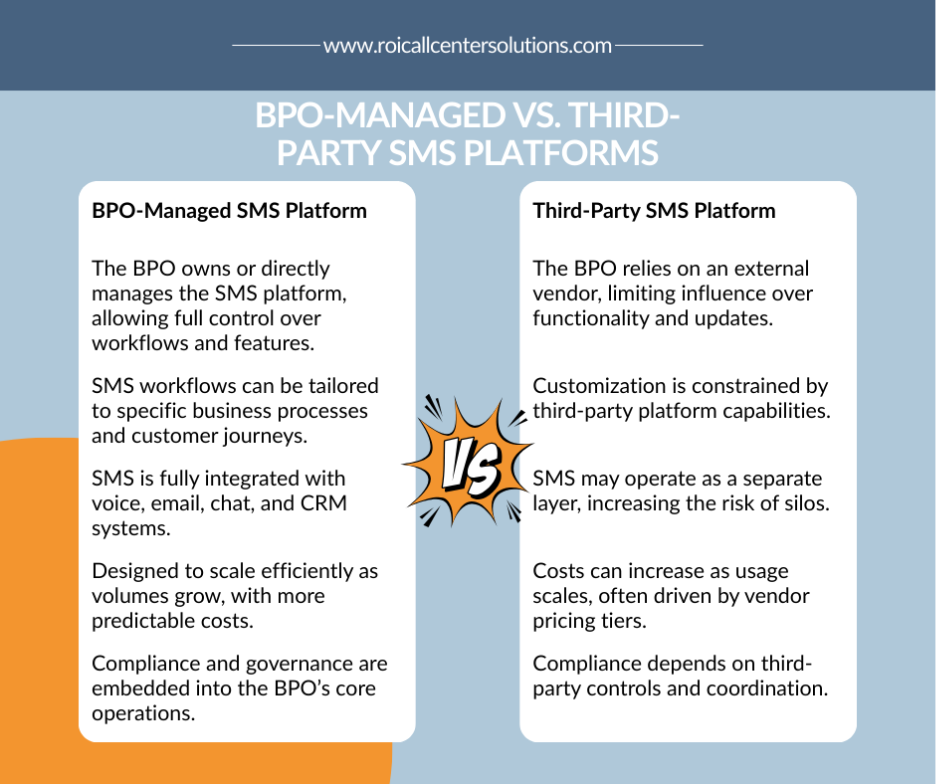
BPO-Managed vs. Third-Party SMS Platforms
Some BPOs own or fully manage their SMS platforms, while others rely heavily on third-party tools that are layered into their contact center environment. This distinction has real implications.
When a BPO controls its SMS infrastructure, it can:
- Customize workflows
- Enhance reporting
- Scale more efficiently
Heavy dependence on unmanaged third-party tools, however, can introduce risk. Customization and updates may be out of the BPO's control, and long-term costs can increase as volumes grow. In some cases, the BPO is simply reselling a generic solution rather than delivering true enterprise contact center SMS capabilities.
CRM and Contact Center Technology Integration
SMS is most effective when it is integrated with CRM and contact center systems. Enterprises should look for native or near native integrations with platforms like Salesforce or Zendesk.
Agents should also have real-time access to customer data while handling SMS interactions, without having to switch systems or manually enter information. At the same time, SMS data should flow back into CRM and analytics platforms to support CX optimization.
Without this level of integration, outsourced SMS customer service becomes fragmented and difficult to measure.
Compliance, Security, and Enterprise Risk Considerations
SMS introduces unique regulatory and security challenges, especially for large organizations operating across industries or regions. Any BPO offering SMS customer support outsourcing must demonstrate a clear and proactive approach to risk management. SMS is governed by strict consent and messaging regulations, and missteps can cause significant legal and financial damage. Enterprises also need assurance that sensitive customer data shared via text is protected regardless of volume or geography.
SMS Compliance Responsibilities
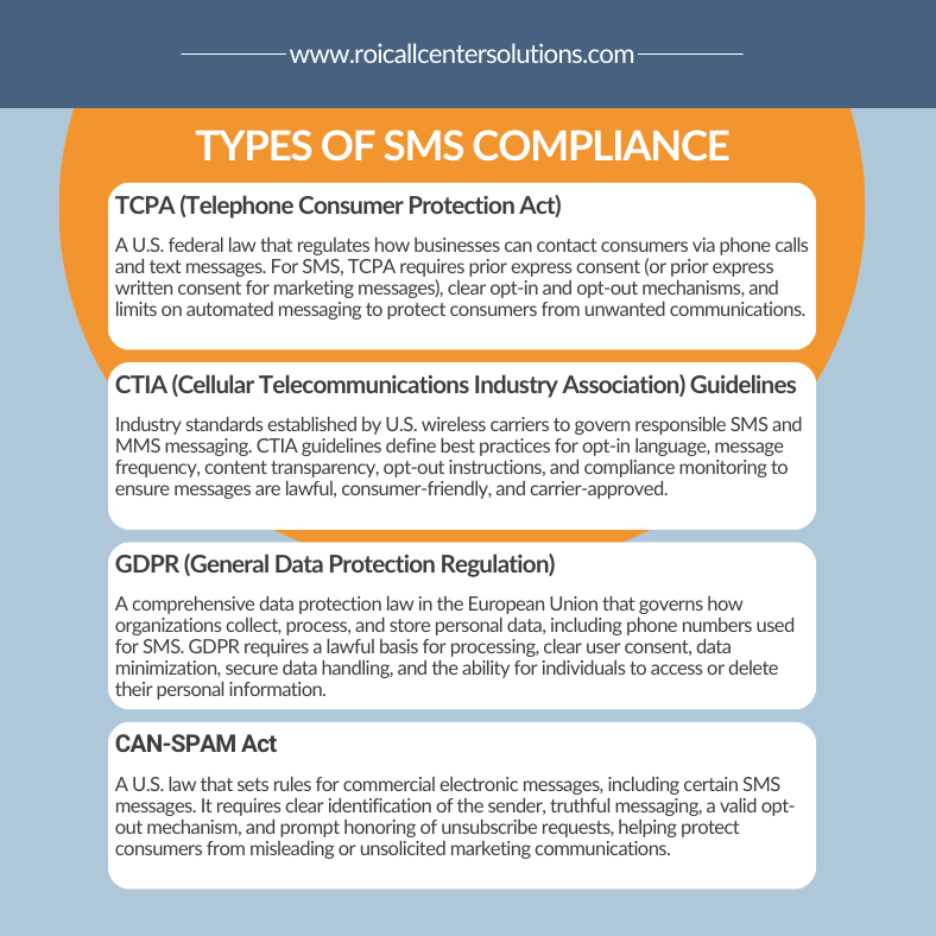
Regulations govern how businesses communicate via text including consent, opt-in, and opt-out requirements. When SMS is delivered at enterprise scale, even small compliance gaps can create significant exposure, which is why organizations must fully understand how compliance is handled within the BPO relationship.
A strong provider will operate under a clearly defined governance framework that embeds compliance into their everyday operations. Consent management should be built directly into SMS workflows because this ensures customers preferences are respected throughout the lifecycle of the interaction.
Visibility is just as important. A mature BPO will maintain comprehensive message records and provide reporting that supports audits and regular inquiries without disruption. This level of operational discipline reduces risk while still allowing enterprises to confidently scale their SMS programs.
Data Security and Privacy Controls
SMS interactions can include sensitive information like account details or even personal identifiers. As a result, call center SMS services must be supported by robust security controls that meet enterprise and regulatory standards.
Enterprises should look at a few things like:
- Encryption protocols
- Access controls
- Authentication requirements
- Data retention policies
- Ongoing monitoring practices
It is also important to understand how SMS data is stored and how long it remains available in the system.
Industry specific requirements must be addressed explicitly. A capable BPO will design SMS workflows that can balance efficiency with security and compliance. This will help protect customer trust while still providing an outstanding experience.
Scalability, Automation, and Future-Readiness
One of the strongest advantages of SMS is its ability to scale efficiently without sacrificing quality. When implemented correctly, SMS can absorb large interaction volumes while maintaining fast response times. This makes SMS a great option for enterprises that want to grow support capacity without dramatically increasing costs.
It is this efficiency that makes scalability a key driver behind SMS contact center outsourcing decisions. Enterprises need to view SMS as a long-term capacity management strategy that supports growth. A BPO's ability to scale SMS reliably is a strong indicator of its maturity.
Automation and AI-Assisted SMS Capabilities
Automation plays an important role in managing high-volume, low-complexity interactions like basic account inquiries. AI-assisted SMS can handle these exchanges quickly and consistently, so human agents can focus on conversations that require more empathy or problem-solving.
That being said, automation should be used thoughtfully. The most effective BPO SMS services use automation as an entry point, so customers can move to a live agent whenever an issue becomes more complex. Poorly designed automation will create issues that undermine the benefits SMS is meant to provide.
Human-in-the-loop models strike the right balance by combining speed with accountability. They allow automation to manage volume while human agents can resolve issues when needed. This keeps SMS interactions efficient without feeling impersonal.
Scaling SMS Without Scaling Headcount
Compared to voice support, SMS allows agents to manage multiple conversations simultaneously. This has a positive effect on productivity and will reduce idle time. This capability makes SMS a powerful tool for shortening resolution times and controlling cost per interaction.
For enterprises that deal with things like seasonal spikes or product launches, SMS provides a level of flexibility that traditional channels can't match. Volumes can increase or decrease quickly without the long hiring and training process associated with phone-based support. Global and multilingual SMS support further expands reach so organizations can effortlessly serve a broader audience.
SMS delivered as part of omnichannel BPO services allows enterprises to adapt in real-time as customer needs and business conditions change.
Measuring Performance and ROI from SMS Programs
To justify investment and guide ongoing optimization, enterprises need visibility into how SMS is performing. Clear reporting and analytics are non-negotiable because SMS is a core service channel. Without reliable management, you can't understand what is working and where improvements are needed.
Effective measurement also enables smarter decision-making over time. Having performance data readily available helps enterprises make necessary adjustments with confidence.
Key Metrics Enterprises Should Expect
At a foundational level, SMS performance should be measured using average response time (AVR), first call resolution (FCR), and customer satisfaction indicators such as CSAT or NPS. These metrics provide insight into how quickly and effectively customer needs are being addressed through text-based interactions.
Voice deflection rates are especially valuable because they help quantify how well SMS is reducing demand on phone channels. Analyzing these alongside call volumes and handle times will show the operational impact of SMS beyond the channel itself.
Cost per interaction is another critical metric. Enterprises should compare SMS performance against voice and other digital channels to understand relative efficiency. In many cases, outsourced SMS customer service delivers lower costs while making a positive impact on customer satisfaction, making it a compelling component of the overall support mix.
Reporting Transparency from Your BPO
One of the most important things to look for in a BPO provider is transparency in reporting. It is essential for building trust and driving continuous improvement. Enterprises should have access to real-time dashboards that provide visibility into SMS performance as it happens, instead of just relying on static monthly summaries.
Reporting should also be flexible enough to align with business priorities, so leaders can view performance by volume, outcome, or customer segment. SMS data should not exist in isolation. Performance insights should roll up into a CX view that is unified across the BPO omnichannel contact center. This allows for more informed decisions and a better understanding of how SMS supports enterprise-wide experience and goals.
Key Questions to Ask a BPO About SMS During Vendor Evaluation
Evaluating SMS capabilities requires so much more than just confirming a BPO "offers texting". The real goal is to understand how SMS fits into the provider's long-term CX strategy. These questions help uncover whether the BPO is delivering enterprise-grade SMS or simply layering text messaging onto the legacy processes.
How is SMS integrated into your overall contact center strategy?
This question reveals whether SMS is treated as a core channel or a standalone add-on. A mature BPO should be able to articulate how SMS supports customer journeys across a variety of digital touchpoints.
For enterprises in industries like retail or logistics, this integration is critical for managing high volumes or transactional interactions. In regulated environments like healthcare or financial services, it shows whether SMS is governed the same as other channels. A provider that struggles to explain how SMS fits into its broader strategy maybe have some limited omnichannel capabilities.
Who owns compliance and risk management?
SMS carries distinct regulatory and legal considerations, and ambiguity around ownership creates risk. This question will help clarify where accountability sits and how compliance is enforced.
For industries that have strict regulations, like financial services or healthcare, the answer should include clear governance structures and proactive oversight. Even in industries that are less regulated, strong compliance ownership reflects discipline and reduces risk as SMS volumes grow.
What platforms and tools power your SMS capabilities?
Understanding the underlying technology provides insight into scalability and long-term cost. This question will help enterprises determine if the BPO controls its SMS platform or relies entirely on third-party tools that often limit customization and visibility.
For enterprises with complex CRMs or custom workflows, platform flexibility is especially important. A thoughtful answer indicates that the BPO can adapt SMS to fit existing systems rather than forcing processes to conform to the technology.
How do you scale SMS during volume surges?
This question is particularly relevant for industries with predictable spikes, such as retail, travel, utilities, or public services. It helps assess whether the BPO has designed SMS as a true capacity management tool rather than a static channel.
A strong response will show how SMS absorbs volume efficiently without negatively impacting the customer experience. It also shows whether the BPO can support growth without excessive cost or strain.
How do you measure success and optimize performance over time?
SMS programs should not be stagnated. This question uncovers how performance is monitored, insights are applied, and if the BPO views SMS as a continuous improvement opportunity.
Enterprises need to look for answers that connect SMS metrics to broader CX and business outcomes. Providers that emphasize transparency and alignment with enterprise goals are more likely to deliver consistent, long-term results.
Together, these questions provide insight into the realities of execution and long-term value. They help enterprises find BPOs that have built SMS into the foundation of their customer experience operations. Decision makers will be able to assess whether a provider is equipped to support enterprise needs today and evolve alongside them tomorrow.
Choosing a BPO with Enterprise-Grade SMS Capabilities
SMS is a strategic differentiator in providing next-level customer service. Selecting the right partner for text messaging customer support BPO services is about so much more than convenience.
The most effective providers have SMS as part of a connected CX ecosystem, and they invest in integration, compliance, analytics, and scalability. The right provider will be focused on building future-ready programs that adapt as customer expectations and business needs evolve.
ROI CX Solutions helps enterprises design and deliver SMS programs that go beyond the basics. We integrate SMS seamlessly into broader contact center operations to help you get stronger customer relationships.
Connect with ROI CX Solutions to learn how enterprise-grade SMS fits into your CX strategy.