
Fully Automated Customer Support Fails, but Human-in-the-Loop Fixes It
Fully automated customer support promises efficiency, but in practice it often breaks down when handling complex, nuanced, or emotional customer interactions. Over-reliance on AI leads to hidden costs like repeat contacts, escalations, and declining customer satisfaction. A human-in-the-loop customer support approach solves this by combining AI efficiency with human empathy, creating a more effective hybrid customer support model. By balancing automation with the right level of human support, businesses can improve both operational performance and overall customer experience.
Read Time: 7 minutes
Table of Contents
In the race to modernize customer experience, organizations rushed toward automation with the goal of getting faster and cheaper support. Artificial intelligence promised to help transform operations and reduce costs; and for a moment, it seemed like fully automated support was the future.
While AI has unlocked new opportunities for efficiency, it also created new issues as companies began to rely on it too heavily. Things like chatbot loops and unresolved customer issues began to make the cracks in automation-first strategies hard to ignore.
With declining satisfaction and a growing demand for something more balanced, organizations turned to human in the loop customer support. Rather than replacing people, this hybrid customer support model blends AI with human expertise.
In this blog, we will explore why AI customer service problems still occur and how a human-in-the-loop approach enabled through customer support outsourcing can fix what automation alone cannot.
The Promise of Fully Automated Customer Support
AI implementation seems like a dream come true for most businesses. Executives often think it will be an easy fix for most of their problems. When it comes to customer experience, the appeal is even stronger. On paper, it checks every box: efficiency, consistency, and availability.
At its core, automation promises three major advantages:
- Cost reduction: AI-powered systems can handle high volumes of inquiries without the need for large support teams.
- 24/7 availability: Customers can get answers anytime, without waiting in queues or relying on business hours.
- Scalability: Businesses can manage spikes in demand without sacrificing response time or service levels.
These benefits are one of the reasons chatbots, intelligent IVRs, and self-service tools are becoming so popular. As organizations started to invest more in automation-first strategies to resolve customer issues, a gap began to grow between expectations and reality.
Many companies assumed that automation would be able to go beyond being a basic support tool and end up replacing human agents entirely. However, while automation does improve operational efficiency, it struggles with the complexity of real customer interactions. That is where even the most promising automation strategies begin to fall short.
Where Automation Breaks Down in Real Customer Interactions
AI is a great tool, but it does have its limitations, especially when applied to real-world customer scenarios.
One of the most significant automated customer support challenges is AI's inability to fully understand context. While chatbots can process keywords and follow predefined logic, they fail to grasp the deeper meaning behind a customer's issue. A study by TeamDynamix had almost half of their respondents say their chat technology struggles with identifying intent. This can be especially problematic in situations involving:
- Billing discrepancies
- Technical troubleshooting
- Account concerns
- Complex problem resolution
These situations require answers as well as understanding that can only come from humans.
These chatbot limitations in customer service make it difficult for AI to deliver that level of support. Issues that fall outside of predefined parameters usually end up being met with irrelevant answers or getting stuck in a loop.
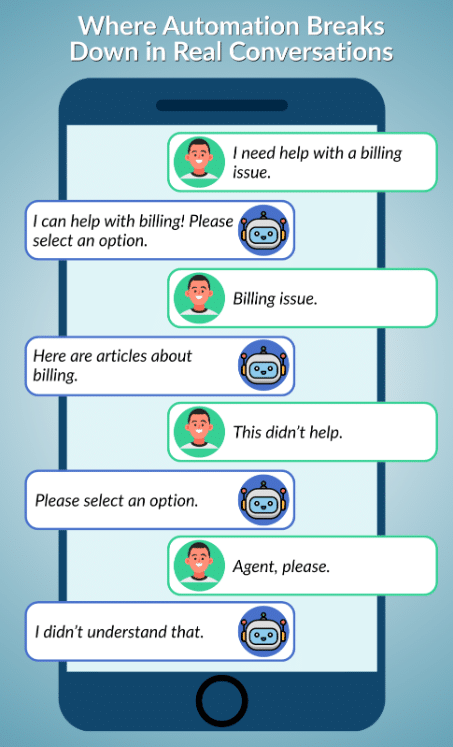
As these breakdowns become more frequent, it's easier to see the true hidden costs of over-automation.
The Hidden Costs of Over-Automation
Automation is usually justified as a way to cut costs, but over time it can introduce expenses that are less visible, but harder to control.
The hidden costs surface in how work gets done day to day:
- Cost of rework: The same issue gets handled multiple times because it wasn't fully resolved the first time. This looks like duplicate tickets, repeat contacts, and unnecessary volume that quietly increases operational costs.
- Cost of escalation: Interactions are handed off to human agents only after automation fails. By this point, inquiries are more complex, urgent, and require more expertise to resolve.
- Cost of inefficiency: Teams spend less time delivering proactive support and more time correcting errors and piecing together context from failed automated touchpoints.
Companies also pay the price in how customers perceive the experience. This is reflected in lower CSAT and NPS scores despite lower operational costs. Every failed interaction also chips away at your credibility. Customers feel like they aren't being heard and may even think your organization doesn't care enough to provide human support. That perception can be difficult and expensive to reverse.
Ultimately, the main issue is relying too heavily on automation in the wrong moments. Without the inclusion of human support, even the most advanced systems create more problems than they solve.
Why Customers Still Want Human Support
A large portion of customers still prefer to work with human agents over AI. A Five9 survey had 75% of respondents say they like humans over automation for support issues, and 83% of adults surveyed by answerconnect said they prefer human agents as well.
Human agents bring something AI cannot replicate, empathy. They can better understand emotions and adapt their responses based on the situation. Their ability to take ownership of complex issues is crucial to providing meaningful customer experiences.
This level of empathy and understanding is important in high-stakes industries like financial services, healthcare, and technology support. In these environments, customers need reassurance and accountability.
Even in lower-stakes interactions, customers expect it to be easy to get connected to human support when automation just isn't working for them.
This is one of the key AI customer service problems, not that AI exists, but that it often replaces humans instead of supporting them.
What "Human-in-the-Loop" Actually Means in a BPO Environment
Human in the loop customer support is when human expertise is integrated into automated systems in a way that enhances the customer experience. Technology's role is to assist humans rather than replace them.
In a BPO customer service solutions environment, this involves:
- AI handling repetitive, high-volume tasks
- Human agents stepping in for complex interactions
- Continuous feedback loops where humans improve AI performance over time
This approach transforms automation into a collaborative tool. It gets rid of the debate about which is better, humans or AI, and shifts the conversation to be about how they can work together in a hybrid customer support model.
A great feature of this model is that it evolves as AI systems learn. This creates a continuous improvement cycle that benefits the customer and the business.
Examples of Human-in-the-Loop in Action
Human-in-the-loop (HITL) works best when it's invisible to the customer but intentional in design. Instead of being a system that switches between AI and humans randomly, it should be a process that makes each step feel effortless and purposeful. When it's executed properly, customers will have a smoother experience with more effective support.
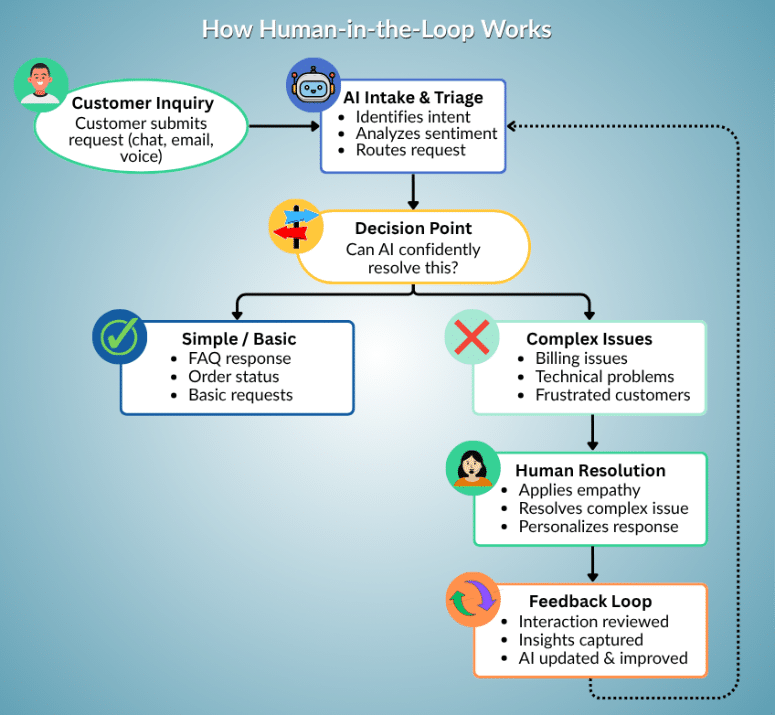
Here is what it can look like in practice:
- AI-powered triage with human resolution: AI categorizes and prioritizes incoming requests based on intent or urgency. Simple issues are resolved automatically while more complex cases are routed to human agents.
- Chatbot handling and human escalation: Chatbots take care of basic inquiries like FAQs, but when an issue becomes more complex, the issue is handed off to a live agent. The key difference in a strong HITL model is that context carries over, so customers don't have to repeat themselves.
- Real-time AI assist for agents: During live interactions, AI assists agents by working in the background to provide teams with any knowledge or suggestions that can help navigate conversations more effectively.
- Human QA improving AI performance: Quality assurance teams regularly review AI interactions to identify gaps and errors. These analytics and insights are used to train the system for continuous improvement to help AI get smarter over time.
- Hybrid voice and AI workflows in contact centers: AI focuses on call routing, authentication, and transcription, while human agents manage the actual conversations. After the interaction, AI summarizes the call and logs key details.
Together, these examples show how a hybrid customer support model combines the efficiency of automation with the adaptability of human support.
The Business Impact of a Human-in-the-Loop Approach
One of the main reasons organizations are beginning to adopt the human-in-the-loop model is to improve customer experience. However, another benefit of this model is how it drives measurable business outcomes.
The first major benefit is improved first contact resolution (FCR). Issues can be resolved faster when AI handles intake and routing while human agents step in as needed. This reduces repeat contacts and creates a more reliable customer journey. That's not all. According to an article from Zendesk, citing the SQM Group, every 1% in FCR can reduce operating costs by 1%. This shows that resolving problems the first time is better for customers and your business.
This approach also helps companies see improved customer satisfaction (CSAT) and retention. Customers get the answers they need delivered with empathy. That combination is great for building trust and increases the likelihood that customers will stay and recommend the brand.
From an operational standpoint, this model improves efficiency without sacrificing quality. Letting AI handle basic tasks while humans focus on high-value interactions means businesses can scale support more intelligently. Pairing this with customer support outsourcing and flexible BPO customer service solutions elevates this operation as well.
Data quality and optimization also benefit from this because AI can help track and analyze larger sets of data. This helps provide organizations with more accurate insights into customer behavior and emerging issues. It helps organizations take a more proactive approach to customer experience and system refinement.
A human-in-the-loop approach allows organizations to improve customer experience with AI in a way that delivers its promise.
How BPO Providers Enable Smarter Human-in-the-Loop Support
A human-in-the-loop model is only as effective as the strategy and execution behind it. A good BPO partner, like ROI CX Solutions, can help design a smarter support ecosystem where AI and human expertise blend together.
Experienced providers bring:
- Skilled agents that can handle complex interactions with professionalism and empathy.
- BPO providers invest in training agents to manage nuanced conversations that AI alone cannot handle effectively
- Integrated technology stacks that connect AI tools with human workflows.
- Leading providers ensure AI systems like chatbots and IVRs are fully connected to human support channels. This helps provide agents with the context they need to properly help customers.
- Scalability to adjust support levels based on demand.
- BPO partners provide the flexibility to scale human support up or down as needed. Organizations get consistent services levels without the risk of overstaffing or overwhelming internal teams.
- Operational insights to continuously improve performance.
- With visibility across both AI and human interactions, BPO providers can identify trends and recommend ways to optimize systems. These insights strengthen the overall contact center automation strategy.
BPO customer service solutions enable companies to build support models that are adaptable and customer focused.
While BPO providers bring the structure, success ultimately comes down to how well businesses balance automation with human support.
Finding the Right Balance Between Automation and Human Support
The conversation around AI vs human customer support often misses the point. It is not about choosing one over the other; it's about how they can work together. The organizations that get this right are the ones that treat automation as a layer that enhances how support is delivered.
The first step is understanding that not all interactions are created equally. Some are more predictable and repeatable, which is great for automation. Others are more complex and emotional, which will require human judgement. A strong hybrid customer support model is built on clearly defining that line.
That means identifying where AI adds the most value:
- FAQs and routine inquiries
- Order tracking, account updates, and simple transactions
- Initial intake, routing, and categorizing requests
It's also important to define where human support should lead:
- Complex problem-solving and multi-step issues
- Situations involving heightened emotions
- High-risk interactions involving sensitive data
One of the biggest automated customer support challenges is poor escalation. To avoid this, there should be careful orchestration between AI and humans. Escalation should work as a continuation instead of just a handoff.
Balancing automation and the human touch also requires continuous optimization as customer and business needs evolve. Organizations need to regularly look at resolution rates, escalation patterns, and customer feedback, to refine where automation is used and where human support should step in.
The right balance will have automation in place to make support faster and scalable, while human involvement ensures it remains empathetic and effective.
Conclusion: Automation Alone Isn't the Future, Hybrid Support Is
Fully automated customer support promised a revolution, but in practice it has revealed its limitations. AI can enhance efficiency and scalability but will never replace the human elements that define great customer experiences.
The solution is to adopt a human in the loop customer support approach because it helps businesses overcome AI customer service problems and move beyond the constraints of chatbot limitations in customer service.
The right strategy in place supported by a BPO will help organizations create a system that works to improve efficiency and CX.
Evaluate your current model and get in touch with ROI CX Solutions to explore how a human in the loop approach can help you deliver better outcomes for your customers and your business.