
Compliance & Security in Healthcare Contact Centers: From HIPAA to SOC 2 and ISO 27001
Healthcare organizations need call center partners who actively protect patient data, meet HIPAA, SOC 2 Type II, and ISO 27001 standards, and build compliance into every workflow in daily operations. ROI CX Solutions delivers secure, scalable, and patient-focused outsourced support that protects PHI and strengthens trust.
Read Time: 13 minutes
Table of Contents:
Why Compliance Is the Foundation of Healthcare Outsourcing
The healthcare industry pays the highest price of any industry for cyber-attacks with the average break in 2023 costing around 10.93 million. With so much at stake, outsourcing operations to a call center that lacks the right compliance infrastructure is too big of a risk.
Your healthcare organization should outsource with a partner that is not only a truly HIPPA compliant call center but also meets SOC 2 Type II call center vendor standards and has the ISO 27001 healthcare BPO certification. In this blog, we are going to explore healthcare call center compliance, how to evaluate vendors, and show why a multilayered approach to PHI data security in call centers is now non-negotiable.
Understanding Key Healthcare Compliance Standards
Healthcare organizations that are seeking out an outsourced healthcare contact center will often encounter overlapping compliance frameworks. It is true that they share common security priorities; however, each standard serves a different purpose and applies in different ways. Together, HIPPA, SOC 2 Type II, and ISO 27001 create a complex model for healthcare call center compliance and risk mitigation.
HIPAA – The Core of Patient Privacy
The first compliance standard that an outsourcing partner should meet is the Health Insurance Portability and Accountability Act, also known as HIPAA. This regulation covers the privacy and security of Protected Health Information (PHI). For any healthcare call center compliance program, HIPAA is non-negotiable.
HIPAA defines how PHI must be collected, accessed, transmitted, and stored. It mandates administrative, physical, and technical safeguards.
Outsourced contact centers will need a Business Associate Agreement (BAA) for HIPAAs compliance. The BAA is used to bind the call center to the healthcare organization's privacy responsibilities. A HIPAA compliant call center will have to do the following:
- Train staff on PHI handling
- Restrict data access to only what is necessary
- Maintain strict identity validation and verification processes
A HIPAA-compliant contact center ensures every patient interaction is handled securely and confidently. Agents help make this happen by verifying identities, protecting sensitive data, and maintaining the integrity of each system they touch.
Compromised compliance goes far beyond just fines or corrective measures. Legal repercussions and losing patient trust can affect an organization for years to come.
SOC 2 Type II – Auditing Vendor Controls
While HIPAA governs healthcare-specific privacy requirements, SOC 2 Type II focuses on the operational security controls of an organization. Essentially, it evaluates whether a company has strong systems in place to protect sensitive data.
SOC 2 audits assess controls across five Trust Services Criteria:
- Security: Protection against unauthorized access and system misuse
- Availability: Systems remain accessible to support patient needs.
- Processing Integrity: Transactions and workflows are performed accurately.
- Confidentiality: Sensitive information is protected from unauthorized disclosure.
- Privacy: Personal and patient data is collected, used, retained, and disposed of appropriately.
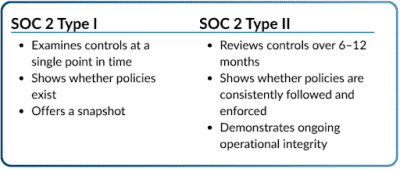
A SOC 2 Type II call center vendor show that their security protocols are documented and functioning correctly in practice. Contact centers handle high volumes of PHI across multiple channels, and any inconsistency in security practices introduces risk. Fortunately, SOC 2 Type II can help reduce that risk by confirming:
- Access to systems is based on role and regularly reviewed.
- Data is encrypted during transmission and at rest.
- Audit logs track all PHI access and system changes.
- Incident response plans are periodically tested.
- Monitoring systems actively detect unusual behavior.
- Business continuity and disaster recovery plans exist and work.
This provides healthcare executives with the transparency needed to understand the outsourcing partner's security, without having to perform ongoing audits. This also helps to ensure both the healthcare organization and the call center meet regulatory expectations.
Simply put, SOC 2 Type II is a verification layer that your healthcare organization can use to confirm that an outsourcing partner is operating securely all day, every day.
ISO 27001 – Global Standard for Information Security
HIPAA and SOC 2 define what healthcare organizations and vendors must protect; ISO 27001 defines how to build and maintain a secure environment. ISO 27001 is an international standard for establishing a comprehensive Information Security Management System (ISMS).
If you're seeking a call center partner, an ISO 27001 certified vendor is a major indicator that security is a systematic and evolving discipline that is engrained into their daily operations.
The ISO 27001 stands out because it focuses more on risk assessment and improvement cycles, ensuring that data protection strategies change as threats evolve. This risk-based approach is particularly critical for contact centers that manage PHI at scale because even small process lapses can introduce meaningful exposure.
The ISO 27001 certification also extends beyond digital systems to include:
- Physical security: secured workstations, restricted facility access.
- Third-party risk management: validating the security of any integrated vendors.
- Human risk mitigation: background checks, required training, and ongoing testing.
- Incident response planning: structured plans for detection, escalation, and resolution.
The ISO 27001 is not just a one and done achievement because it actually requires annual surveillance audits and full recertification every three years. It is a commitment to ongoing improvement and accountability.
The ISO 27001 helps you stay prepared for the risks you can see and the ones you can't yet.
What Compliance Looks Like in a Healthcare Call Center
In healthcare contact centers, compliance should be in every workflow and patient interaction. A HIPAA compliant call center should have a secure, technical infrastructure. That might include:
- Encrypted data transmission
- Multi-factor authentication
- Role-based access controls
- Locked-down workstations
These safeguards should apply equally in on-site and remote operations, which is why strong device and network monitoring are essential parts of the framework.
Data handling practices also define healthcare center compliance. This could look like PHI masking, secure system integration, and controlled access to things like copying, printing, and downloading. This protects patient privacy throughout all interactions.
Agent training and awareness are equally important. Even the best technology can be undermined by human error, so continuous training is a must. Call center teams should have regular HIPAA refreshers, phishing and social engineering simulations, and breach response training. This makes compliance part of the normal routine, rather than just a basic checklist.
Call recording and monitoring are used to support quality assurance and coaching. However, they must be handled in a way that protects PHI. This can be done via selective or masked recording to follow compliance without sacrificing service improvement.
Lastly, strong healthcare BPO compliance needs visible governance and accountability. This will include:
- Incident response plans
- Audit trails
- Real-time security reporting
- Third party validation of controls
- i.e. SOC 2 Type II reports or ISO 27001 certification
PHI security in contact centers should be a culture, and when done well, a compliant outsourcing partner becomes an extension of your own standard of care.
How to Evaluate a HIPAA-Compliant Call Center Partner
Selecting the right HIPAA compliant call center partner for your organization will require structured evaluation and clear evidence. You should look for documented compliance maturity, operational discipline, and a security-first culture. Here is what you need to look for.
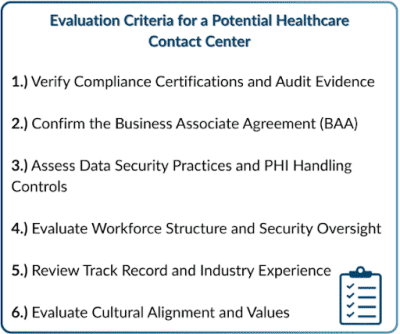
- Verify Compliance Certifications and Audit Evidence
Request documentation rather than just relying on their claims. A qualified healthcare BPO partner will be able to provide:
- SOC 2 Type II report that shows ongoing effectiveness.
- ISO 27001 certification
- Proof of HIPAA compliance frameworks and internal policy enforcement
- Annual or ongoing third-party security audit summaries
It's a red flag if a vendor is hesitant to show these.
- Confirm the Business Associate Agreement (BAA)
A BAA is legally required for any PHI processing. Check that it has:
- Each party's responsibilities for protecting PHI
- Breach notification timelines
- Liability and remediation expectations.
You can get a free downloadable HIPAA BAA template from The HIPAA Journal.
- Assess Data Security Practices and PHI Handling Controls
Healthcare organizations should have a clear view of how data moves through a vendor's organization and how PHI is handled from start to finish. What this means is that data should stay encrypted regardless of if it is stored or transmitted, access is limited to authorized roles, and all exchanges occur through secure systems. Information should also only be retained as long as it is needed and disposed of safely once it is not. PHI should be masked when fully visibility is unnecessary, and every step should follow the same, documented procedures.
- Evaluate Workforce Structure and Security Oversight
A strong evaluation of workforce structure and security oversight starts with understanding how the call center manages its people and environment. Whether the vendor uses onshore, nearshore, offshore, or hybrid staffing, ask about:
- Background checks and identity verification for agents
- Secure workstation configuration
- Live monitoring, quality review, and compliance auditing practices
This will give you insight into their security standards beyond IT into everyday human interaction.
- Review Track Record and Industry Experience
An outsourcing provider should be able to prove their track record specifically with healthcare clients and their ability to manage PHI. Ask them for case studies and look for a long-standing record of patient engagement support, minimal security incidents, and transparent response procedures. You can even ask them for references from current healthcare partners. A vendor with deep experience can help reduce onboarding friction and strengthen your confidence in the provider.
- Evaluate Cultural Alignment and Values
Lastly, you should never underestimate how well a company's culture and values will integrate with yours. Compliance works better when it is a shared priority so try to make sure the vendor:
- Treats security and quality as core pillars
- Invests in continuous education, monitoring, and improvement
- Communicates clearly and proactively about any changes or risks
A partner who values compliance as much as you do is a partner you want.
Beyond Compliance – Turning Security into a Competitive Advantage
Compliance is the baseline. Meeting HIPAA, SOC 2, and ISO 27001 requirements does keep you and your patients protected, but it also can provide opportunity. A call center that handles PHI safely is building trust with patients, payers, and partners.
Your patients are going to feel more comfortable and will interact with your company more when they feel like their data is protected. Payers and providers see a compliant, well-audited vendor as a reliable partner. Good security is a signal that your operations are professional and trustworthy.
Strong compliance will also make it easier to scale. Why? Solid PHI data security in call centers helps the provider safely expand service volumes, adopt new technologies, or even integrate AI-assisted solutions without compromising patient privacy. Different features such as real-time monitoring, zero-trust networks, and automated security checks help catch problems before they even happen.
Finally, security can help your brand stand out. Vendors that confidently show their HIPAA, SOC2, and ISO call center requirements exemplify dedication to patient privacy. It's a major plus for healthcare organizations that are looking for a partner they can trust.
At the end of the day, strong compliance is great for helping your business grow.
Key Takeaways for Healthcare Decision-Makers
Compliance is a way to protect patient data as well as build patient trust. HIPAA safeguards privacy, SOC 2 Type II shows security is enforced over time, and ISO 27001 provides a global, risk-based framework. These all together ensure that PHI stays safe while providing high-quality patient support.
When you are looking for a partner, go with one that lives and breathes compliance. They should protect data at every step while still delivering outstanding patient support.
ROI CX Solutions provides HIPAA-compliant call centers that meet SOC 2 Type II and ISO 27001 standards to help health organizations reduce risk and elevate patient support. Protect your patients and your reputation; contact us today.