

How Outsourced Subscription Continuity Reduces Churn and Protects Revenue
Outsourced subscription continuity reduces churn and protects revenue by proactively recovering failed payments, engaging at-risk subscribers before they cancel, and bringing specialized retention expertise that most in-house teams lack. Instead of treating continuity as a support task, partners like ROI CX Solutions manage it as a revenue protection strategy—using scalable staffing, data-driven insights, and structured billing recovery processes to reduce both voluntary and involuntary churn, stabilize recurring revenue, and strengthen long-term profitability.
Read time: 9 minutes
Table of Contents
Outsourced subscription continuity helps subscription businesses reduce churn and protect recurring revenue by bringing specialized retention expertise, proactive billing recovery, and scalable support to one of the most overlooked revenue functions. By treating continuity as a revenue protection strategy rather than a support cost, businesses gain more predictable revenue, clearer churn insights, and stronger long-term growth through partners like ROI CX Solutions.
Why Subscription Churn Is One of the Biggest Revenue Leaks for Growing Businesses
Organizations that have subscription services need to understand that growth is slowing down not because of slowing acquisition, but because of accelerating churn. While new customer growth gets the spotlight, churn is in the background, steadily eroding revenue that has already been earned.
Subscription churn is more than just cancellations. In the context of subscription continuity, churn includes:
- Billing failures
- Failed renewals
- Customer disengagement
- Voluntary and involuntary account losses
As subscriber volume and operational complexity increase, these issues are increasingly harder to track and manage, especially for in-house teams.
What makes churn particularly dangerous is how often it is misunderstood. Many organizations measure churn as a single metric without separating voluntary cancellations from preventable, involuntary losses. This lack of visibility hides a critical truth: a meaningful portion of churn can be reduced through better continuity processes.
| Churn Type | What It Means | Common Causes | Real-World Examples | How It’s Addressed |
|---|---|---|---|---|
| Voluntary Churn | The customer actively decides to cancel their subscription. | Perceived lack of value, pricing concerns, poor experience, and changing needs. | A customer cancels after a price increase; a subscriber leaves because they no longer use the service; a customer switches to a competitor. | Retention conversations, save offers, improved onboarding, and clearer value communication. |
| Involuntary Churn | The subscription ends due to a payment or billing issue rather than customer intent. | Expired credit cards, failed payments, insufficient funds, and billing errors. | A renewal fails because a card expired; a payment is declined while the customer is still using the service; a bank blocks a transaction. | Payment recovery workflows, account updater tools, proactive billing outreach, and subscription billing support outsourcing. |
Think of subscription continuity as a protection strategy. Managed intentionally, it becomes one of the most effective ways to stabilize recurring revenue and support sustainable growth. Understanding the true cost of churn is the first step. Recognizing where revenue loss actually occurs is what helps businesses stop it.
The Hidden Costs Executives Often Miss
Subscription churn rarely shows up as an obvious line item on a financial report. Instead, its true cost is spread across the organization, quietly eroding profitability in ways that are easy to underestimate. When a subscriber leaves, the immediate revenue loss is just the beginning. The larger impact comes from the lifetime value that will never be realized such as future renewals, upgrades, and cross-sell opportunities.
An increase in churn only adds stress to the internal team because they have to work harder and spend more to replace lost revenue. This creates a cycle where businesses invest heavily in acquiring new customers, while failing to protect the recurring revenue they've already earned.
The operational strain is another hidden consequence. Finance, support, and product teams all have more work that comes from lost customers. These reactive efforts pull resources away from strategic initiatives and slow the organization's ability to innovate.
Risk also affects day-to-day operations because high rates of unresolved billing issues can damage relationships with payment processors and merchant banks. Over time these risks compound, further destabilizing revenue and operational confidence.
These hidden costs reveal that churn is not just a retention issue; it is an enterprise-wide performance problem. In many organizations, these impacts persist because in-house subscription continuity programs are not designed to intervene early enough to stop it.
Where In-House Subscription Continuity Programs Typically Break Down
As subscription businesses grow, continuity is typically treated as a secondary responsibility rather than a dedicated function. Without specialized ownership, in-house continuity programs struggle to keep pace with the operational demands of retention and billing recovery.
Common breakdown points include:
- Continuity being grouped into general customer support instead of being managed as a retention-focused practice
- Skill gaps between agents handling routine support inquiries and those equipped to manage sensitive conversations
- Staffing challenges driven by turnover, long training cycles, and inconsistent coverage during critical billing and renewal periods
- Limited scalability when volume spikes occur around renewals, promotions, pricing changes, or payment processing issues.
These challenges create pressure, and force teams into reactive workflows. As these gaps widen, the burden of maintaining subscription continuity falls on already stretched teams. This sets the stage for the broader operational strain internal teams experience next.
The Operational Strain on Internal Teams
Subscription continuity is a silent burden for internal teams. This might look like:
- Support handling billing questions, cancellations, and general inquiries
- Finance tracks failed payments and reconciles accounts
- Product teams review churn-related feedback
Without a dedicated focus on retention, these efforts are scattered and reactive.
This causes customers to have inconsistent experiences. As subscriber volumes grow, these gaps become more noticeable, and internal teams fail to balance continuity with other priorities.
Even with talented staff, maintaining consistency and visibility is challenging. Reporting is often incomplete, workflows are disrupted ruing peak billing and renewal periods, and churn trends become more difficult to measure.
Subscription continuity requires specialization. Internal teams can take care of day-to-day operations, but preventing churn and protecting revenue at scale will require a dedicated approach. That is where outsourced subscription continuity provides a clear advantage because it makes retention a strategic driver of revenue.
How Outsourced Subscription Continuity Reduces Churn
Outsourced subscription continuity brings focus and expertise that in-house teams can't replicate. This specialization from an outsourced partner helps to provide a consistent experience that protects revenue and keeps subscribers active.
Proactive engagement is one of the biggest advantages of outsourcing because agents are trained to reach out when early signs of churn appear. Using retention-focused scripting, these teams guide subscribers toward resolution while preserving trust and loyalty. Research shows that proactive intervention can reduce involuntary churn by up to 17% , highlighting the value of specialized continuity programs.
Outsourced teams also provide scalability and flexibility. Subscription businesses experience peaks in billing and renewal periods that can overwhelm in-house support. Specialist continuity partners scale staffing to match demand, maintaining responsiveness and service quality when it matters most. This ensures subscribers have a seamless experience across all channels.
Another key benefit is data-driven insight. A BPO for subscription businesses will track trends in churn, payment issues, and customer behavior so companies can address problems before they lead to cancellations. Even small improvements in retention have a disproportionate impact on revenue and growth.
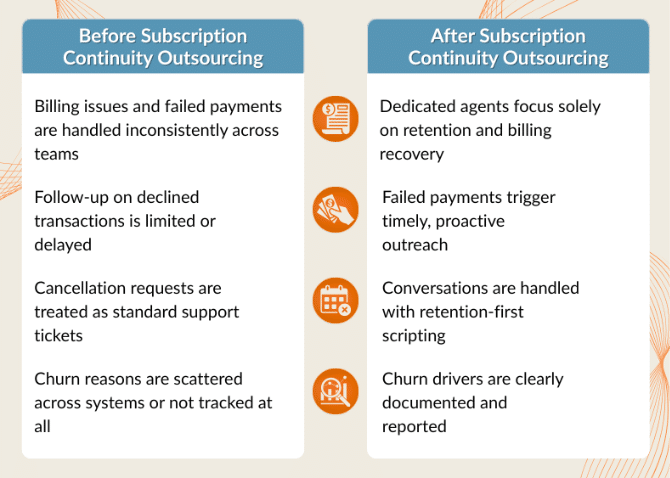
Subscription continuity outsourcing transforms what is often a reactive, scattered function into a coordinated effort that helps with subscription churn reduction and supports growth.
Proactive Retention and Billing Recovery
Most subscription churn happens because something breaks in the process. Proactive retention and billing recovery work to catch those issues before they turn into cancellations.
Instead of waiting for a subscriber to hit "cancel," continuity teams step in earlier. When a payment fails or an account shows signs of risk, agents are able to reach out to resolve the issue immediately. These conversations are designed to be helpful, not aggressive, and focused on keeping the subscription active without damaging the relationship.
Billing recovery plays a particularly important role. Almost 70% of churn is involuntary and caused by payment failure. Outsourced continuity teams reduce lost revenue by fixing payment problems quickly and consistently, rather than letting accounts lapse silently.
The purpose of proactive retention and billing recovery is simple: protect revenue that should not be lost in the first place. This consistency is what unlocks the broader financial and strategic benefits of outsourcing subscription continuity.
The Financial and Strategic Benefits of Outsourcing Subscription Continuity
Outsourcing subscription continuity gives businesses a predictable way to protect recurring revenue while reducing the operational burden on internal teams. Organizations gain structure and visibility around one of their most important revenue drivers.
From a financial perspective, outsourcing replaces fixed internal costs with a more flexible operating model. Subscription continuity outsourcing allows coverage to scale with demand while maintaining consistent service quality.
Key financial and strategic benefits include:
- More predictable costs because continuity support scales with subscription volume
- Better protection of recurring revenue through consistent handling of failed payments, renewal questions, and cancellation requests
- More reliable revenue forecasts as churn becomes more stable and easier to track over time
- Less pressure on internal teams by removing time-consuming retention and billing recovery work from support, finance, and product teams
- Clearer insight into why customers churn using reporting and analysis that identify patterns and improvement opportunities
Outsourcing turns subscription continuity into a protection function. With dedicated and flexible staffing, businesses can better support customers. For executives, these operational and financial improvements translate directly into clearer ROI.
Executive-Level ROI Considerations
Even a small reduction in churn can feel like striking gold because every retained customer is one you don't have to fight for, and the impact often outpaces costly new acquisition efforts. Research shows that increasing customer retention by just 5% can increase profits anywhere from 25% to 95%, depending on the industry and business model. This dramatic effect comes from a combination of lower acquisition costs and stronger customer lifetime value.
Outsourcing subscription continuity takes the burden of retention management off internal teams, so they are free to work on other initiatives that help drive company growth. This shift makes revenue streams more predictable, strengthening financial planning and investor confidence.
With these benefits in view, the next step is evaluating when outsourcing subscription continuity makes sense.
When It Makes Sense to Outsource Subscription Continuity
Not every business needs to outsource subscription continuity immediately, but certain signs indicate it may be time to consider a parter. Four indicators it is time to outsource are:
- Rising churn despite strong acquisition: Losing customers faster than you gain them signals gaps in retention processes.
- Increasing payment failures: Missed or failed payments can quickly erode revenue if not managed proactively.
- Overloaded support teams: When your staff is stretched thin, early intervention for at-risk subscribers often falls through the cracks.
- Limited retention reporting: Without clear insights into churn trends, it's hard to identify opportunities for improvement.
Outsourcing is great for complementing teams, not replacing them. Internal teams still have ownership of strategy and customer experience, while outsourced partners handle day-to-day continuity operations. It is a collaborative effort where two teams work together, so subscribers get timely professional engagement, and internal teams focus on other high-value initiatives.
What to Look for in a Subscription Continuity BPO Partner
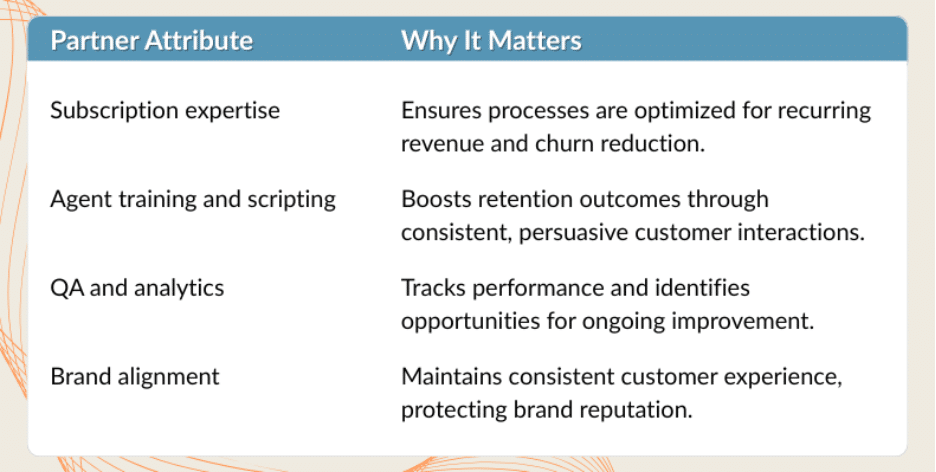
Choosing the right partner is crucial because the wrong provider can hurt more than help. Look for BPO providers that have proven experience supporting subscription and recurring revenue retention services, particularly those that understand the nuances of retention, payment recovery, and the customer experience. Providers like ROI CX Solutions specialize in subscription continuity and design their programs specifically to protect lifetime value, not just resolve individual calls.
The right partner will invest heavily in retention-focused training and scripting. Agents should be equipped to handle objections, identify opportunities, and engage subscribers in a way that reinforces trust and brand loyalty. At ROI CX Solutions, agents are trained to operate as retention specialists, combining empathy and data to drive measurable outcomes.
Strong quality assurance, analytics, and reporting capabilities are equally essential. The best providers deliver insight. The right provider will emphasize data-driven performance management, giving leadership clear visibility into ROI.
Lastly, flexibility matters. Your continuity partner should feel like an extension of your internal team. They need to align with your brand's voice, CX standards, and long-term growth goals. Providers that prioritize this alignment will ensure that continuity operations support the customer experience you have worked so hard to build. Choosing the right partner will make outsourcing a strategic advantage that strengthens retention.
Conclusion – Subscription Continuity as a Revenue Protection Strategy
Subscription continuity should never be treated as a cost center or an afterthought. You need to start thinking about it as a revenue protection strategy that directly influences growth and customer lifetime value. Every failed payment recovered, every cancellation conversation handled well, and every retained subscriber compounds over time.
Through outsourced subscription management, businesses gain access to trained agents, proven processes, and data-driven insights that are difficult to recreate internally. Subscription retention outsourcing and subscription billing support outsourcing help reduce churn while improving the customer experience.
In an increasingly competitive subscription economy, protecting what you've already earned is just as important as acquiring what comes next. Outsourcing subscription customer support through a trusted BPO will help your organization treat continuity as a strategic function.
Outsourced customer support for subscription businesses reduces subscription churn, recovers revenue, and protects long-term growth. If you're ready to strengthen recurring revenue and turn subscription continuity into a competitive advantage, connect with one of our experts today.