
How to Scale Customer Support with AI and Automation – Without Sacrificing Customer Experience
Scaling customer support is increasingly difficult as companies grow, but AI-powered automation enables them to handle higher volumes without sacrificing customer experience. By combining AI-driven self-service, intelligent routing, agent assist tools, and human expertise, organizations can reduce costs, improve consistency, and maintain quality at scale. Successful support models use automation to manage routine, high-volume interactions while empowering agents to focus on complex, high-value conversations. When supported by the right systems—or an AI-enabled BPO partner—AI-driven customer support becomes a competitive advantage rather than an operational burden.
Read time: 6 minutes
Table of Contents
Scaling customer support is not just operational; it's strategic. AI-powered enterprise automation allows organizations to grow without compromising the customer experience. Combining intelligent automation with human expertise helps companies cut costs and provide consistent interactions at scale. Top businesses are leveraging AI-enabled customer support to transform operations into a competitive advantage.
Why Customer Support Becomes Harder to Scale as Companies Grow
According to Zendesk, over half of customers will switch to a competitor after just one bad customer service experience. For growing companies, that statistic carries some serious weight because every issue is a direct threat to loyalty and reputation.
As an organization grows, providing consistently great service becomes a challenge. One reason for this is because as customer inquiries and expectations increase, traditional hiring-based models struggle to keep up. But how do you scale customer support quickly without driving costs out of control or compromising the customer experience?
This challenge is pushing many organizations to rethink how customer support scales. Forward thinking brands are turning to enterprise customer support automation to effortlessly handle demand. The same report from Zendesk reveals that two-thirds of business leaders have seen improvements after investing in customer service AI. Strategically implementing these tools makes it possible to scale customer service without adding headcount.
In this blog, we will explore how companies are using scalable customer support solutions, AI contact center solutions, and AI-enabled BPO partnerships to scale efficiently while still protecting the human experience customers remember.
How AI and Automation Enable Scalable Support
It's no secret that AI has moved far beyond simple chatbots and rigid scripts. AI customer support tools today combine machine learning, natural language processing, and automation to support both customers and agents in real-time. This means organizations can handle growing volumes of customer interactions without increasing staff or costs. AI can take care of high-frequency, low-complexity inquires which removes some of the workload from agents while also improving consistency across channels.
Where AI Delivers the Most Impact
Customer support interactions will benefit from AI depending on where you apply it. AI is great for high-volume tasks that traditionally consume agent time. A few examples would be:
- Handling FAQs
- Order status requests
- Troubleshooting
These interactions are usually predictable, rule-based, and repeat across thousands of customers. AI-powered self-service helps customers get quick answers without having to wait in a queue. For organizations that are trying to scale their customer support, this alone can remove a significant amount of burden.
AI also is great for analyzing language, sentiment, and context, to better understand why the customer is reaching out. Using that information, it can route the interaction toward the best resolution path, whether that is to a helpful landing page, or escalating to an agent. This can help improve FCR rates and ensure high-value interactions reach experienced agents quickly.
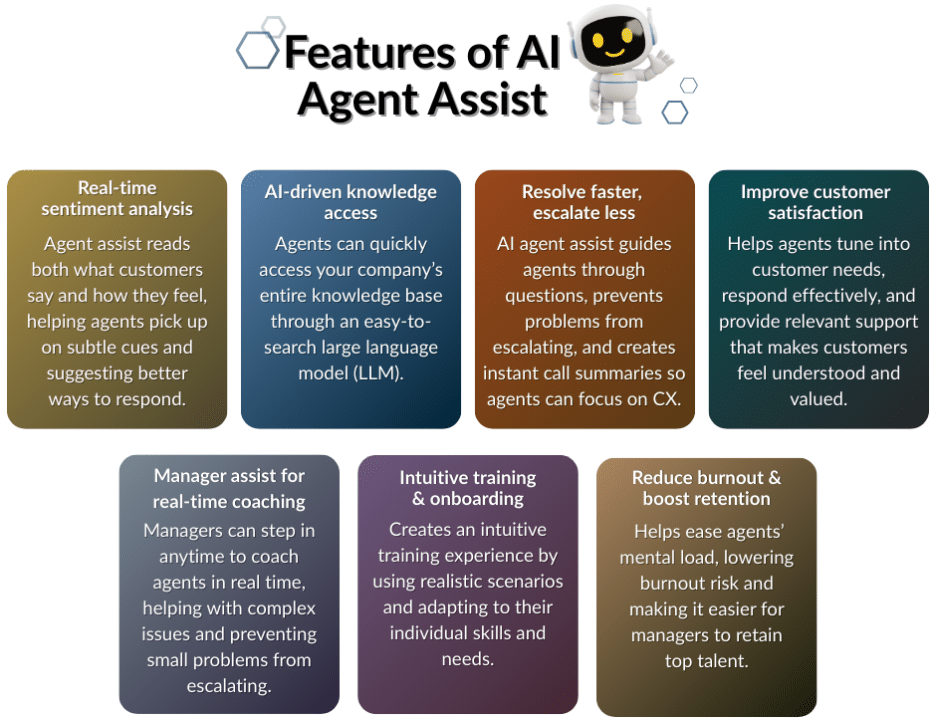
Another high-impact area is agent assist. AI tools can help agents by providing different sources and responses during customer interactions. This delivers customers with a more consistent experience, while also letting agents resolve issues faster and with greater confidence. As teams scale, agent assist becomes essential for maintaining quality without extending onboarding timelines or increasing training costs.
Automation as a Support Multiplier—not a Replacement
One of the greatest misconceptions in customer service is that automation is designed to replace human agents. The reality is that most organizations use automation to amplify human capability, not eliminate it.
Some tasks that are commonly automated to reduce handle time and manual effort are:
- Data entry
- Ticket categorization
- Workflows
Agents can spend less time navigating systems and more time engaging with customers, so organizations can handle higher volumes without sacrificing CX.
Customer support automation also helps agents focus on more complex interactions that require empathy and better problem-solving. These moments are what will shape customer perception and loyalty and are precisely where human agents deliver the most value. AI handles routine work in the background, so agents can provide personalized support.
Scaling Without Sacrificing Customer Experience
A major concern when it comes to scaling support is that customer experience will suffer. It's a valid fear because often rapid growth coincides with longer wait times and inconsistent answers.
Automation and AI offer a solution when an organization applies them thoughtfully. Automated customer support should be paired with human oversight to ensure routine tasks are handled effectively. AI can take care of high-volume inquiries, suggest responses, and route tickets intelligently, but human agents are needed to address complex issues where nuance matters. The combination of AI efficiency with human insight results in organizations that scale support while protecting the integrity of the customer experience.
Providing consistent experiences for customers is another critical factor. Scaling with standardized processes and technology is needed to maintain this consistency. AI-driven platforms and integrated CRMs provide the backbone for delivering the same level of consistency regardless of how large the support operation grows.
As support operations scale, efficiency alone is not enough. Maintaining consistency, automated or human, should still reflect the brand customers recognize.
Maintaining Quality and Brand Voice
AI deployed in customer support should reflect the company's tone, policies, and customer philosophy. This starts by training AI on brand-approved language, so automated responses feel consistent with the company's identity. AI needs to convey the brand personality while also providing accurate and helpful guidance.
Quality assurance solutions are also strengthened by AI. Systems can monitor and flag inconsistencies, compliance risks, and even provide coaching opportunities for agents. AI supported QA insights help companies that are scaling maintain a high standard or service across every interaction.
Consistent experiences are crucial for maintaining customer trust and satisfaction. AI aligned with human agents and integrated into an omnichannel support strategy ensures that no matter how the customer reaches out, the interaction is the same.
Together, these practices allow organizations to scale support operations while safeguarding the elements that define their customer experience.
The Systems and Infrastructure Required to Scale
Scaling customer support teams requires the right systems and infrastructure to support growth without introducing friction. Even the most advanced automation can become difficult to manage without a strong foundation.
At the center of scalable support operations are omnichannel platforms fully integrated with CRM systems. Customers want consistent experiences, and agents need a unified view of those interactions. AI and human agents working together helps make sure:
- Context is preserved
- Handoffs are smoother
- Resolution times improve
CRM integration also ensures that customer experience automation is being informed by real customer data, to provide more personalized and accurate responses at scale.
Real-time reporting and performance visibility are equally important. As automation takes on a greater role in support operations, leaders need clear insight into what is working and what isn't. A few metrics that need to be available in real time, and not weeks after the fact, are:
- First Call Resolution (FCR)
- Average Handle Time (AHT)
- Customer Satisfaction Scores (CSAT)
AI-driven analytics let organizations monitor performance continuously to optimize both automated and human workflows before issues impact the customer experience.
Flexibility is the final requirement for scalable infrastructure. Support demand is rarely predictable. Scalable systems must allow organizations to ramp up or down quickly. AI and automation tools provide the agility needed to change without sacrificing service quality.
When AI-Enabled BPO Partnerships Make Sense
For many organizations, the decision to adopt AI in customer support is easy, but the path to execution is not as straightforward. Internal teams that attempt to incorporate AI capabilities on their own may face challenges with cost, complexity, and implementation time, which can limit the impact. This is where AI-enabled BPO partnerships turn into a strategic advantage.
Building AI-driven support in-house introduces multiple challenges. Without dedicated resources and processes, AI initiatives can stall or fail to scale. Many organizations discover that what works in a pilot environment breaks down under real-world volume and complexity.
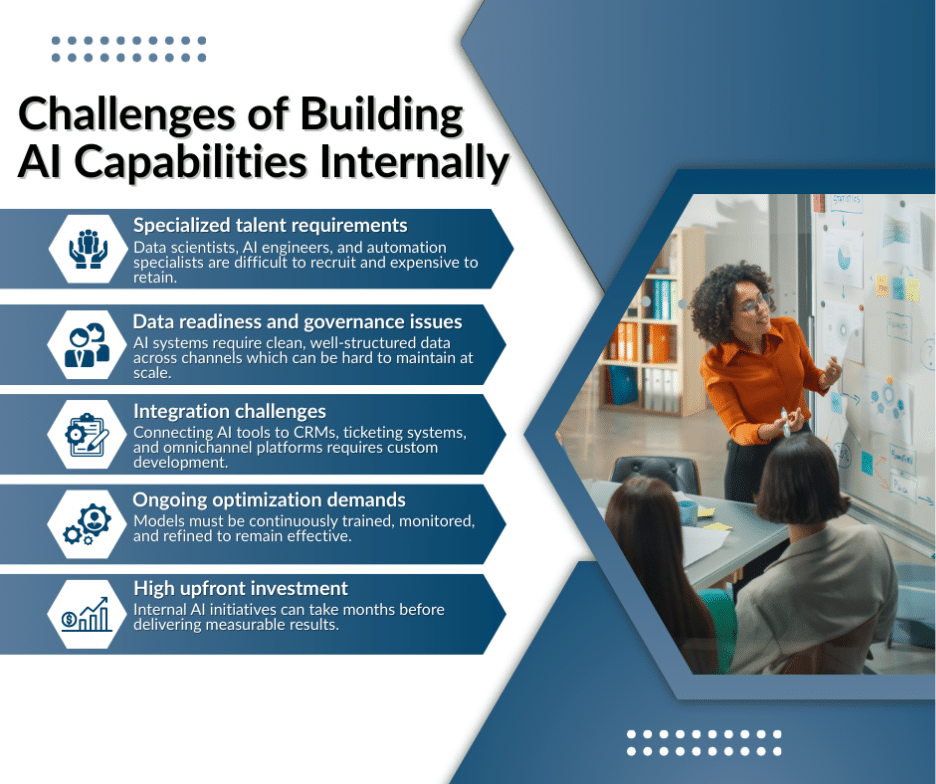
Internal AI initiatives are far more complex than they initially appear, especially if an organization is trying to scale quickly and not disrupt existing operations. What often starts as a strategic investment turns into a resource-intensive effort with delayed returns. That's why many organizations look for a lower-risk path to scalable, AI-powered customer support.
A BPO with AI expertise can help accelerate results by getting rid of the complexity and risk that can slow internal AI initiatives. Organizations gain immediate access to proven AI contact center solutions as well as teams that have experience balancing automation with human support. This approach allows companies to scale customer support quickly using strategies that have already been optimized for the real world.
AI-enabled BPO partnerships are also great for scaling customer support without long implementation times or rigid staffing models. Automation takes care of routine interactions and volume spikes, while agents flex as demand changes, which helps organizations maintain service quality no matter what comes their way. This flexibility means a company can effortlessly scale without slowing momentum or overcommitting resources.
What Executives Should Look for in an AI-Driven Support Partner
Choosing the right AI-driven support partner is a strategic decision with long-term implications for customer experience and operational performance. Executives should evaluate partners through a lens that goes beyond technology alone.
When assessing potential partners, leaders should prioritize the following:
- Proven AI + human integration
- Look for partners that demonstrate how AI supports agents. AI should manage high-volume, repetitive interactions and support agents in real time, while human expertise remains central to complex or high-stakes conversations.
- Security, compliance, and governance
- AI-driven support environments typically handle sensitive customer data across a variety of channels. A qualified partner must operate with strict security and compliance frameworks.
- Transparent performance metrics and reporting
- Executives need visibility into how AI is performing. The right partner will provide clear reports on efficiency, customer satisfaction, automation effectiveness, and agent productivity.
These capabilities create the foundation of a sustainable, AI-driven support model.
To move beyond surface-level claims, leadership teams should also ask prospective partners questions that will reveal operational maturity. Here are the top five we recommend starting with:
- How do you determine which interactions are automated versus routed to agents?
- How is AI trained, monitored, and refined over time?
- What metrics will be used to measure efficiency and customer experience?
- How quickly can support scale during unexpected volume spikes?
- How do you ensure consistent brand voice across channels and agents?
An AI-driven support partner should ultimately act and feel like an extension of the organization. The right partnership will enable executives to scale customer support with confidence.
Scaling Smarter Is a Competitive Advantage
How you choose to scale customer support is a defining business strategy. Organizations that recognize AI-enabled support as a powerful growth driver are the ones who will succeed. Thoughtfully implementing AI and automation turn customer support into a competitive differentiator rather than a necessary expense.
The brands that scale best use AI-powered customer support to raise the standard as volume increases. Automation handles routine tasks and interactions; agents can focus on meaningful conversations, and customers receive better service across every channel. The natural result is a better customer experience that creates loyalty.
Now is the time to modernize support operations. At ROI CX Solutions, we help organizations scale smarter by creating the perfect blend of AI, automation, and human expertise. Let's scale smarter together.