

How do outsourced technical support teams contribute to operational efficiency?
Outsourced technical support boosts operational efficiency by reducing costs, eliminating bottlenecks, and freeing internal teams for strategic work. Third-party providers improve key metrics like first call resolution, average resolution time, and SLA adherence through standardized workflows and AI-powered automation. Built-in scalability, 24/7 coverage, and distributed teams ensure consistent, reliable support at any volume, turning technical support into a competitive advantage.
Read Time: 6 minutes
Table of Contents
- What Is Outsourced Technical Support?
- Why Technical Support Impacts Operational Efficiency
- Cost Efficiency and Resource Optimization
- Faster Response Times With 24/7 Coverage
- Scalability Without Operational Bottlenecks
- Access to Expertise, Technology, and Best Practices
- Standardization, Automation, and Process Efficiency
- Risk Reduction and Business Continuity
- Addressing Common Concerns
- Conclusion: Turning Support Into an Efficiency Driver
Every minute your team spends dealing with preventable technical issues is a minute lost to growth. Outsourced technical support helps companies reclaim that time by turning reactive support into a proactive function that improves overall operational efficiency.
Shifting day-to-day support to specialized teams creates a more consistent experience for employees and customers. Companies get more efficient support that can scale.
What Is Outsourced Technical Support?
Outsourced technical support is when a company lets a third party take over IT support. While it does handle basic help desk services, modern outsourced technical support can cover anything from routine troubleshooting to complex technical support issues.
These services are structured in three tiers, ensuring that issues are handled based on their complexity.
- Tier 1 Support (Frontline Support): The first point of contact for users, handling common issues like password resets and general inquiries. The goal at this level is high FCR rates.
- Tier 2 Support (Technical Support Specialists): Takes care of more complex issues that require deeper technical knowledge or system access. This might include software troubleshooting, system errors, and configuration issues that cannot be fixed at the Tier 1 level.
- Tier 3 Support (Advanced/Expert Support): The highest level of support involving highly specialized experts like developers. Tier 3 addresses critical issues like system outages or product-level defects.
Outsourced technical support can also be delivered through fully external models or hybrid models, where internal IT teams control critical functions while outsourced teams manage the day-to-day.
Understanding how this structured approach functions is key to seeing the broader impact because the way technical support is delivered plays a key role in shaping operational efficiency.
Why Technical Support Impacts Operational Efficiency
Operational efficiency refers to an organization's ability to provide products or services in a cost-effective and timely manner. In IT support, this looks like metrics such as cost per tick, resolution speed, and output. Inefficient technical support ripples through the company, creating a negative impact.
Poor support slows and frustrates internal teams as well as customers. Common inefficiencies include:
- Backlogged tickets, which delay problem resolution and reduce productivity.
- Inconsistent handling, causing repeat requests and wasted effort.
- Internal IT overload, where teams spend more time reacting than innovating.
Outsourcing technical support helps companies remove these bottlenecks, so internal teams can thrive.
Core Metrics That Improve With Outsourcing
When you are looking at the impact of outsourced technical support on operational efficiency, performance metrics are the way to go. These directly reflect how effectively your company is maintaining productivity across the business. The top four you should look at are:
- First Call Resolution (FCR): This measures how often issues are resolved during the first interaction. Higher FCR rates reduce the need for follow-ups, minimize escalations, and eliminate redundant work.
- Average Resolution Time (ART): The speed at which issues are completely resolved has a direct impact on productivity. Long resolution times can frustrate both employees and customers
- Ticket Backlog: An increasing backlog is a clear sign of inefficiency. Tickets piling up slow down response times and impact service quality.
- SLA Adherence: Service Level Agreements create clear expectations for response and resolution times. Consistently meeting or exceeding SLAs ensures predictable performance while building trust with employees and customers.
The real value lies in how these metrics work together to create a more efficient support system, ensuring consistency at scale. Improved support performance ultimately leads to lower costs and more efficient operations.
Cost Efficiency and Resource Optimization
One of the most compelling reasons for IT support outsourcing is the potential for cost savings IT support. Outsourcing reduces the amount of infrastructure and labor costs needed. External providers come with specialized tools, processes, and experienced staff, reducing the hidden costs associated with internal support teams.
Predictable pricing models further enhance budgeting and financial planning. Companies can forecast support expenses accurately and avoid the unexpected costs that come with staffing during high demand periods.
Equally important is the preservation of quality. Many outsourced providers operate under strict SLAs and have highly skilled agents to ensure cost reductions don't come at the expense of performance. With the right oversight, companies can achieve both savings and excellence in support delivery.
Refocusing Internal Teams on Strategic Work
Delegating day-to-day tasks to an outsourcing team will help internal IT departments focus on innovation and growth initiatives. Outsource the busy work and let your team focus on things like enhancing systems and developing new technologies.
Leadership teams also benefit from outsourcing. Executive teams can stop worrying about managing support operations and focus more on growth strategies. With outsourced technical support handling routine tickets, companies improve productivity and empower their internal teams to focus on initiatives that contribute to growth.
Faster Response Times With 24/7 Coverage
If your company has customers worldwide, then you understand that issues don't wait for business hours, so neither should your support. Delays in technical support quickly escalate into lost productivity and revenue.
24/7 technical support provides customers and employees with assistance at the moment the issue arises, regardless of time or location. Businesses that adopt IT support outsourcing gain access to always-on service designed for speed and consistency.
Outsourced providers will typically operate using global delivery models, with distributed teams across multiple regions. This approach is great because it means internal teams don't have to work crazy hours, while ensuring every support request is handled.
Beyond availability, outsourced teams are structured to prioritize rapid response and resolution. These teams are great at significantly reducing wait times and resolving issues quickly.
Impact on Customer Experience
A study from Nextivia found that just over 30% of customers will hang up after being left on hold for 5 minutes or less. Customer experience improvement starts with responsiveness. Providing instant help to your clients shows that you value them and their time. Outsourced technical support plays a critical role in delivering that experience at scale.
Immediate assistance also reduces the amount of time customers spend trouble shooting issues on their own so they can stay focused on their goals. For B2B organizations, this can have a direct impact on client satisfaction.
Additionally, consistent availability gets rid of unpredictability because customers know that support is always available.
From a business perspective, this turns support into a competitive advantage. A company that can provide reliable, fast service is better positioned to retain customers and stand out.
Delivering fast, always-on support is great, but its true value becomes even clearer when combined with the scalability and flexibility outsourced teams provide.
Scalability Without Operational Bottlenecks
Volume increases happen throughout the year, and it's easy for internal IT teams to get stretched to their limits. The hiring process from start to finish takes up a lot of time and resources. Trying to expand your team to handle higher volumes of work is complicated and can even cause slower response times and operational bottlenecks.
Scalable support teams offered through outsourced technical support solve this challenge by providing immediate access to trained professionals. Businesses can easily adjust the number of staff they need up or down. For example:
- Seasonal spikes: Retailer or software companies launching holiday promotions or new features can temporarily scale support without long-term hiring commitments.
- Product launches: New software releases often generate a surge in technical questions and tickets. Outsourced teams ensure that every customer gets fast assistance without overwhelming internal IT staff.
- Business growth: As a company expands, outsourced support can grow alongside it, maintaining operational efficiency without adding overhead.
Scalable teams also provide flexibility in the opposite direction because when demand decreases, companies can easily scale down. Therefore, operational efficiency is maintained at all times, and businesses can better allocate resources.
Scalability helps with resource and cost management as well as service quality. During high-volume periods, customers benefit from consistent support, while internal teams can stay focused on other strategic initiatives.
Outsourcing also provides businesses with immediate access to resources that further improve operational efficiency.
Access to Expertise, Technology, and Best Practices
Outsourced technical support providers offer access to support team expertise across a wide range of systems and industries. This means companies can leverage a depth of knowledge that would be costly and time-consuming to maintain internally. This expertise extends across multiple platforms and software applications so even unusual issues can be addressed quickly.
Many providers use technical support automation and advanced analytics to streamline workflows. This is great because support teams can use technology like AI-powered ticket routing, automated knowledge base suggestions, and real-time performance dashboards, all without organizations having to heavily invest in technology infrastructure.
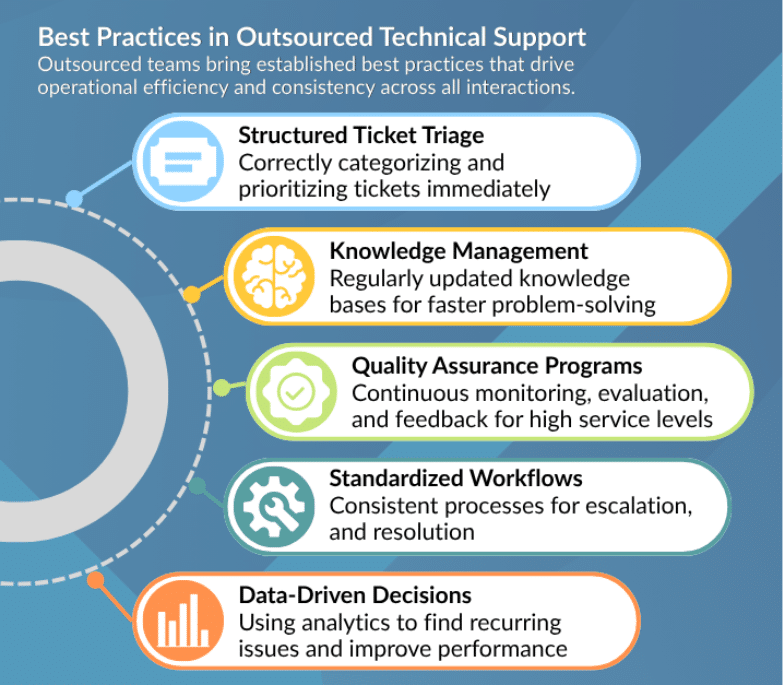
All of this shows that outsourced technical support teams resolve issues faster and help organizations implement more efficient processes.
Standardization, Automation, and Process Efficiency
Access to expertise and advanced tools is an awesome benefit, but there should also be a focus on how outsourced technical support is structured and automated. Standardization and process automation ensure that every ticket is handled the right way every time, which is great for improving customer satisfaction and operational efficiency.
Standardization begins with defining clear workflows for common support tasks. Implementing Standard Operating Procedures (SOPs) helps outsourced teams follow the same process, regardless of the agent or time of day. This reduces variability in responses and improves issue resolution rates.
Automation helps improve efficiency by taking over time-consuming tasks. Examples include:
- Automated ticket routing: AI and workflow engines direct tickets to the right agent based on issue type, priority, and agent expertise.
- Knowledge base suggestions: Automated prompts provide agents with relevant solutions.
- Prioritization and escalation triggers: Critical tickets are automatically flagged and escalated to senior support.
- Reporting and analytics: Automated dashboards track key KPIs and provide actionable insights for improvement.
Standardization and automation also create a foundation for scalability and risk mitigation. Consistent processes help both internal and external teams onboard quickly, reducing the risk of errors during high-demand periods. These systems also provide a framework for integrating advanced tools that improve efficiency and free human agents to focus on high-value tasks.
Risk Reduction and Business Continuity
Even the most optimized support function can become a liability if it's vulnerable to disruption.
Outsourced technical support helps mitigate these risks by introducing built-in resilience at every level. Most providers use distributed teams across multiple locations, so coverage continues even if one region experiences disruption. This diversity reduces dependency on any single team which creates a more reliable support environment.
In addition, outsourced teams are typically cross trained across systems, clients, and support tiers. This means knowledge isn't siloed within a few key individuals. If one agent is unavailable, another can step in without losing service quality. This is crucial for maintaining consistent performance, especially during high-pressure situations.
Another advantage is the ability to maintain business continuity support during periods of change. Regardless of what the company is dealing with, outsourced support provides a steady operational backbone.
Security and compliance play a major role in risk reduction. Reputable outsourcing providers invest heavily in secure systems and compliance frameworks like HIPAA, SOC 2, and PCI. This protects sensitive information and reduces the risks associated with data breaches or regulatory failures.
Ultimately, outsourcing makes technical support a source of stability. This helps businesses provide consistent service regardless of internal or external disruptions.
Even with these built-in safeguards, businesses often want clarity around control, quality, and security when outsourcing support.
Addressing Common Concerns
While the benefits of IT support outsourcing are clear, you might be worried about the potential drawbacks. These concerns can be handled with proper planning:
- Loss of control: SLAs, reporting dashboards, and governance frameworks allow businesses to maintain oversight.
- Quality concerns: Robust QA programs and KPIs ensure consistent service is provided.
- Communication challenges: Structured workflows and regular updates keep internal teams aligned with outsourced agents.
- Data security: Compliance with standards like HIPAA, SOC 2, and PCI means that sensitive data is protected.
Proactively addressing these issues will help your company confidently leverage outsourced technical support without having to compromise quality.
Conclusion: Turning Support Into an Efficiency Driver
Outsourced technical support is great for improving operational efficiency. It makes it easier to scale and provide a more consistent customer experience, meaning the impact is immediate and long-term.
Leveraging this support helps companies remove bottle necks while empowering their teams to focus on innovation and growth. Outsourcing turns technical support into a competitive advantage.
For organizations looking to take the next step, partnering with an experienced provider makes all the difference. ROI CX Solutions provides tailored outsourced technical support designed to align with your business goals. Connect with one of our experts today.