
AI vs Human Agents: What Should You Automate in Customer Service?
Businesses can balance AI and human agents in customer service by adopting a hybrid support model that automates for efficiency and values the emotional intelligence of live agents, rather than choosing one over the other.
Read Time: 6 minutes
Table of Contents
AI is taking the world by storm, saving individuals an hour of daily activities and enhancing the customer experience through automated support. Customers want personalized journeys and are happy to engage with automated functions that drive convenience and speed. But brands and customers agree that artificial intelligence isn’t the end-all-be-all.
Customer experience leaders balance automation with human connection to achieve the operational and CX goals that make businesses and customers happy.
Learn how to build your own AI-powered customer service strategy with the call center automation best practices in today’s blog.
The AI vs human debate is the wrong question
Before you build your strategy, consider the roles of AI tools and human support teams in your customer service model. The AI vs human customer service debate has never been more heated, but an effective customer service automation strategy doesn’t make you choose between the two. It acknowledges the harms of relying too much on either option and provides a solution that incorporates the best of both.
Where automation-only strategies fall short
Understand these pitfalls to avoid the common risks of over-automation.
Poor CX: While AI can handle more tasks than ever before, customers still crave human interactions, particularly in sensitive or complex situations. Over-automation delays connection and delivers impersonal support.
Brand damage: AI requires expert, contextually aware interpretation and application. Without human supervision, data breaches and biases, compliance violations, and service inaccuracies increase, damaging customer trust and brand reputation.
Technical issues: Every system experiences technical failures, but over-reliance on AI tools leads to a loss of human skill and widened service gaps during downtime. Integration failures decrease efficiency and raise response times, customer dissatisfaction, and agent overwhelm.
Humans in the loop
On the flip side, human-only support falls behind the rising tide of AI assisted customer service. Without the tools to scale operations, quality lags behind as teams struggle to keep up with rising demand and customer expectations.
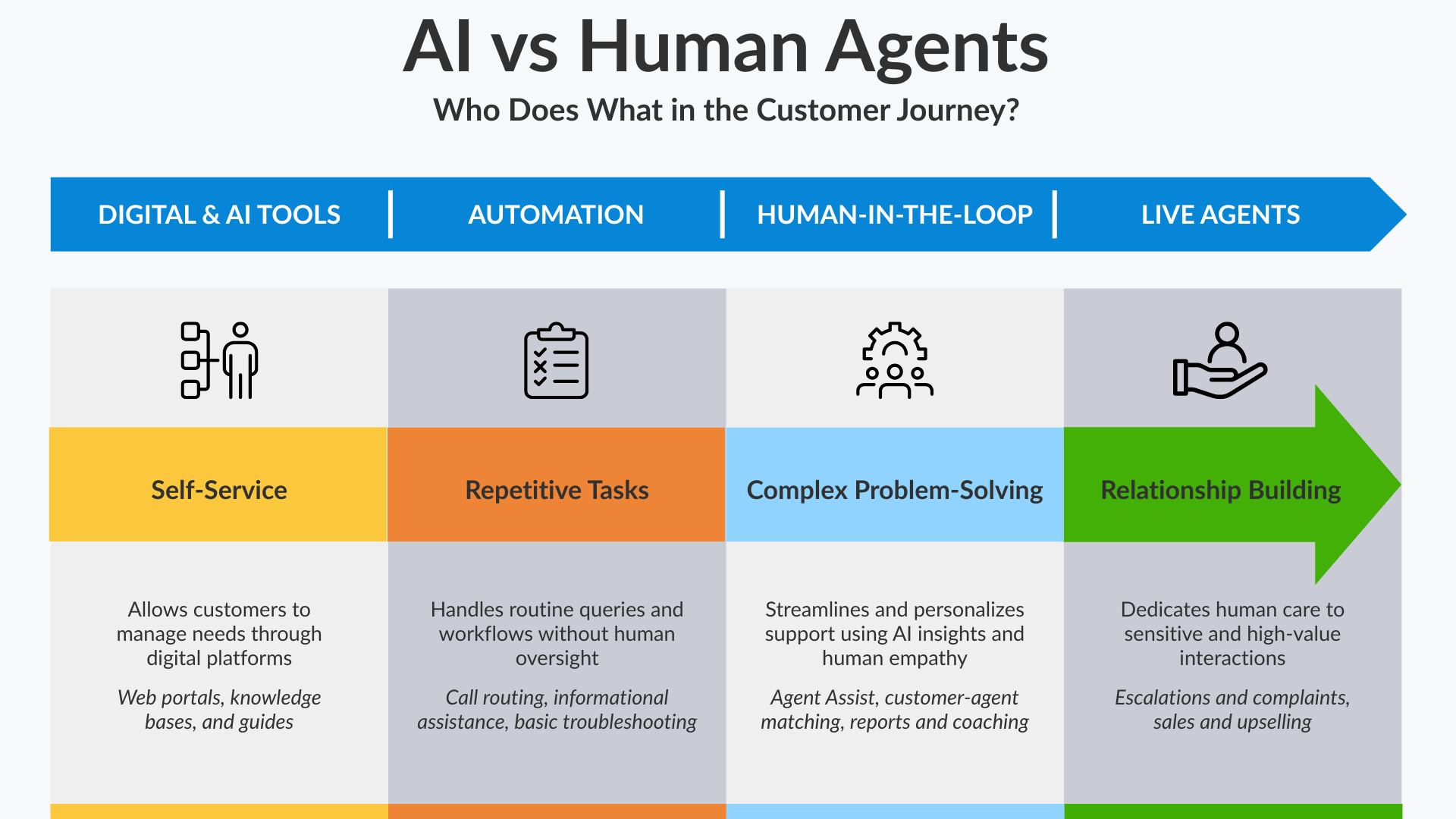
And so, the answer to the “AI vs human” debate is to accept that AI is here to stay — and humans are, too. Reframe “AI or humans” to “AI and humans” to find that sweet spot of smart, fast, intuitive, and effective care. A hybrid customer service model is the optimal support strategy, hitting these key points of AI and human support:
- Automated workflows, processes, first-point-of-contact interactions, and data gathering
- Data interpretation and application into advanced strategies
- Personalization at scale
- Customer-agent matching
- Human interaction for complex and emotional issues
- Human oversight of automated processes
What today’s customers actually expect
Understanding customer expectations is key to knowing when to use AI in customer service. It guides you toward operational changes that are not only worth the investment but that also will provide significant financial and intangible returns.
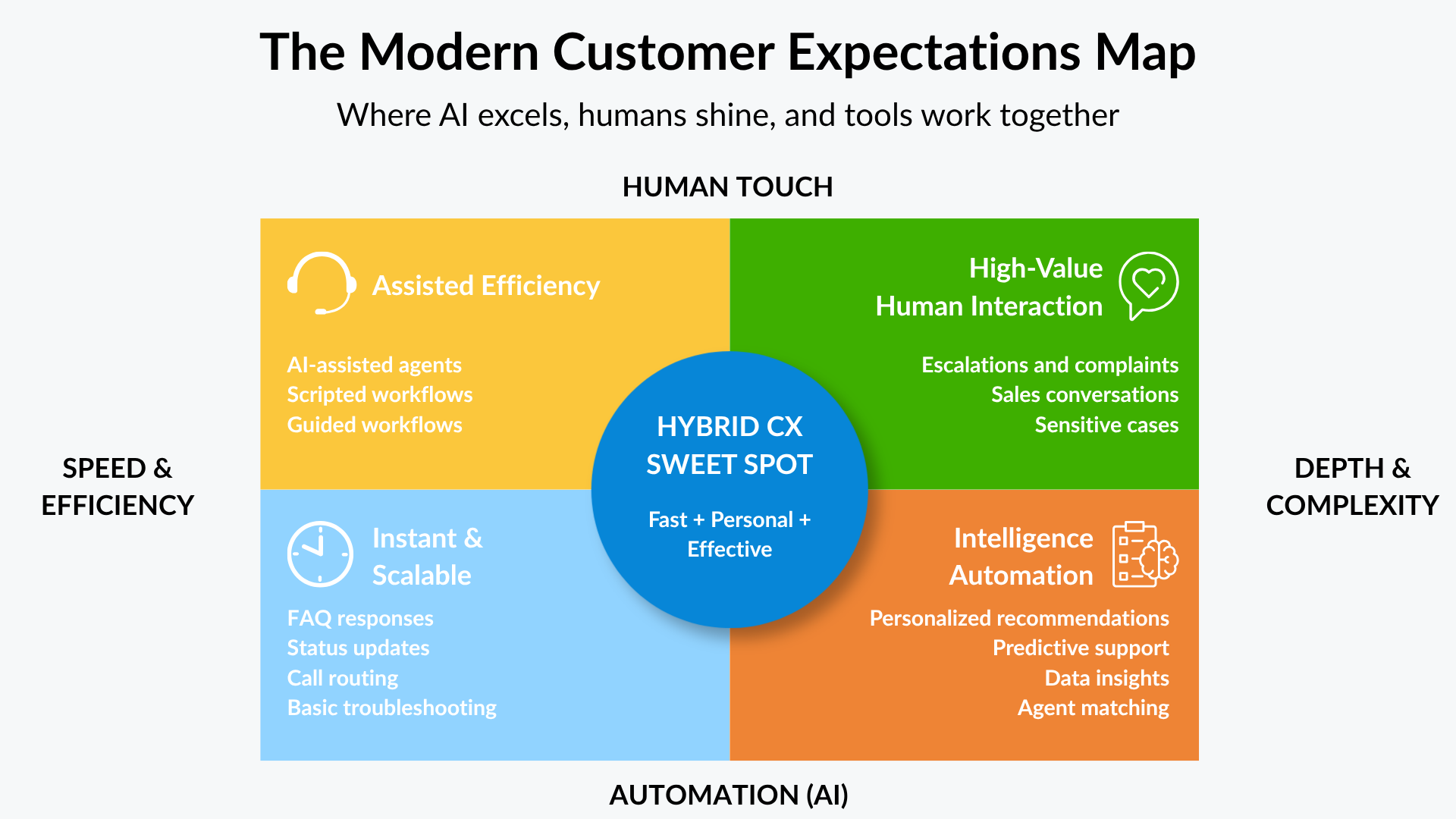
Ensure your AI and human-in-the-loop solutions stand out by prioritizing these core qualities customers expect in a business that is both technologically advanced and expertly led by humans:
- Speed and convenience (AI advantage)
- Empathy and problem-solving (human advantage)
- Consistency across channels (AI advantage)
- Personalization driven by data and human judgment (AI and human advantage)
What you should automate in a call center
Now that you’ve set the stage for a hybrid customer service model that meets customer and efficiency goals, start planning the steps to implement one. Determine what to automate in call center by aligning expectations with the methods and tools that meet them.
Define automation-friendly tasks
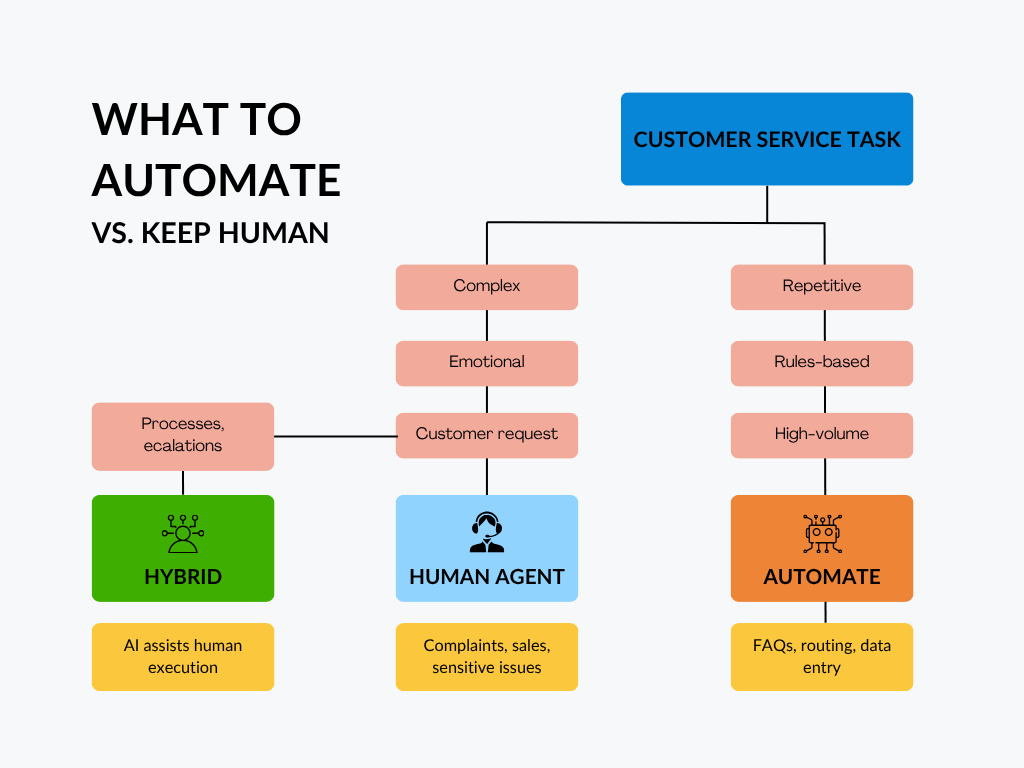
First, target tasks that are easily automated with contact center AI tools. An automation-friendly task is something that can be performed using an automation tool or software. Tasks suitable for automation have these characteristics:
- Repetitive
- Consistently completed
- Simple or “routine”
- Rules-based
- Follow a workflow
- High-volume
These types of tasks are ideal to automate because they enable algorithms to follow logical, pre-defined steps to simultaneously complete thousands of requests around the clock, with low likelihood for error, ultimately, increasing efficiency without any CX tradeoffs.
Best use cases for AI in customer service
The best uses for AI in customer service are ones that boost operational efficiency, agent productivity, and customer satisfaction. These AI tools are built to effectively meet specific customer needs. This manages interaction volume, enabling live agents to focus on requests that require dedicated attention or specialized expertise.
These automation-friendly call center tasks can be completed by AI tools with minimal human intervention:
- Call routing and triage
- FAQ management
- Informational assistance
- Data entry
- Ticket classification and prioritization
- Post-call summaries
- Basic troubleshooting
- Status updates
Successful AI implementation of these tasks will reduce queues, responses, and handling times while making significant waves in service capacity and satisfaction as customers receive targeted assistance in record time.
What should always stay human
Contact center automation thrives with clear rules and defined pathways, but it falls short when it comes to emotional nuance and complex human context.
An end-to-end customer experience must balance AI and human support to feel natural, empathetic, and efficient. While advanced AI tools can handle complex queries, removing the human touch in key touchpoints increases frustration, negatively impacting customer experience.
In short, loyalty demands trust, and live agents are key to building and maintaining it.
So strike a balance between AI and human support in your AI customer experience strategy. Define automation capabilities and live agent responsibilities, spelling out what tasks your agents should always handle and when they should step up when automation has done its job.
High-value interactions that require human agents
As representatives of your brand, live agents should dedicate their attention where they most effectively meet customer and business success goals. This translates to dedicated care where customers need and value it the most, and it leads to meaningful action that drives business growth.
Ultimately, it means prioritizing high-value interactions, or situations where human support encourages customers to make a purchase or advocate for your business. High-value interactions include these situations:
- Complex problem resolution
- Escalations and complaints
- Sales conversations and upselling
- Sensitive scenarios (healthcare concerns, financial concerns and billing issues)
When it comes to human vs chatbot customer service, think of it as a partnership or a workflow between the roles. Chatbots can attempt to resolve an issue or route these interactions to appropriate teams who can take over with confidence.
How to build the right AI + human balance
Successfully incorporating AI and live agents into your support strategy takes the right vision, accurate planning, and a powerful infrastructure that can handle your needs. Partner with a BPO expert to customize your plan stress-free, or follow these steps to build a customer service automation strategy that drives results and preserves the irreplaceable human touch.
1. Set the right goals.
Automated and human assistance impact front-facing service quality and internal workflow efficiency. Determine which key performance indicators (KPIs) you’ll track to evaluate the performance of each and to gather insights into their influence on your desired outcomes. This should then inform coaching initiatives and push your team toward continuous improvement.
We suggest these key metrics:
- Service levels
- Average Handling Time (AHT)
- Average Speed of Answer (ASA)
- First-Call Resolution (FCR)
- Customer Satisfaction (CSAT)
- Net Promoter Score (NPS)
- Churn rate
Implement advanced technology that can customize reports according to agent, team, and process to get a clear picture of performance, tool, and process improvements over time.
2. Automate appropriate tasks.
Every modern CX strategy should include these automation tools to meet rising customer expectations with personalized, scalable, ‘round-the-clock care.
- Chatbots
- Automatic Call Distribution
- Agent-customer matching
- FAQs and self-service
- Customer feedback collection
- Process alerts
- Performance summaries and reports
- Live agent assistance
3. Regularly assess performance and adapt.
Automated reports streamline performance evaluation, and AI tools can even provide coaching insights. But your management team should also incorporate these insights into their strategic planning. Continuously optimize your efforts, tools, and strategy based on performance data for data-driven improvement.
4. Build a scalable team.
Automation carries a lot of weight in times of high seasonal demand or business growth. Its ability to handle routine queries allows agents to focus on pressing issues, empowering AI-led scalability — but support strategies can’t rely on automation alone for sufficient coverage or ramping needs.
5. Outsource as a strategic advantage.
Business Process Outsourcing experts leverage global talent for your brand, working with you to forecast demand and onboard the precise number of agents you need to handle fluctuations in volume.
Beyond cost-efficiency, enhanced CX, and scalability gains, outsourcing positions you as a leader in AI-powered, human-led customer care. The right partner works on your timeline, trains agents to your branding, and implements industry-leading technology to optimize your AI-human agent approach, achieving immediate and long-term results.
A simple framework for deciding what to automate
Boiled down, artificial and emotional intelligence are both must-have features of modern customer support. They each provide valuable insights into identifying customer expectations and critical methods to meeting them. Together, they empower you to level up your service in a constantly changing business landscape.
Follow these simple principles — or work with an outsourcing partner — to balance AI in customer support vs human agents in high-value touchpoints for enriched end-to-end engagement.
- Rule 1: Repetitive + low complexity → automate
- Rule 2: High emotion or complexity → human
- Rule 3: Hybrid scenarios → AI assist + human execution
FAQs about AI vs Human Agents
What is an AI Voice Agent?
An AI voice agent is a software system that uses Generative AI to understand and respond to spoken language with human-like accuracy.
What are AI agents?
AI agents are software programs designed to simulate interactions with customers. They use Natural Language Processing and Machine Learning to understand and respond to human language. AI agents complete tasks to resolve repetitive, rules-based customer queries with minimal human intervention.
What are human agents?
Human agents are the people behind omnichannel customer support interactions. They handle complex questions with empathetic, brand-aligned care.
What are the advantages of AI agents?
The advantages of AI agents include reduced queues, increased efficiency, more data-driven insights, and 24/7 omnichannel support. AI agents handle repetitive queries, allowing live agents to provide dedicated care that builds customer trust and loyalty.
What are the advantages of human agents?
The advantages of human agents include empathetic, contextual responses and problem-solving skills, particularly for complex requests or high-stress situations. Human agents provide the dedicated live assistance many customers still want from organizations.
What is the hybrid support model?
The hybrid support model leverages AI and human agents to optimize efficiency without sacrificing customer experience. It automates low-risk, high-volume work so human agents can handle escalations and complex cases with empathy, building trust and improving retention.
What is the AI vs human customer service debate?
The AI vs human customer service debate refers to the question of how contact centers use advanced technology and human agents in their support solutions. While certain AI tools can handle complex interactions across the customer journey, they still require human oversight for the irreplaceable human touch customers still want in advanced customer care.