

The Differences Between Insourcing vs Outsourcing Explained
Introduction
As businesses navigate changing customer demands, workforce needs, and market conditions, deciding how to allocate internal and external resources becomes increasingly important. Insourcing vs. outsourcing is a strategic decision that can influence operating costs, service quality, scalability, employee performance, and long-term growth. This guide explores the key differences between insourcing and outsourcing so you can determine which approach best aligns with your business goals.
Read Time: 9 minutes
Key Takeaways
- Insourcing offers greater control and brand alignment, while outsourcing provides flexibility, scalability, and specialized expertise.
- The right choice depends on your business needs, not just cost. Consider timelines, operational capabilities, security, quality, scalability, employee impact, and long-term strategic goals when comparing insourcing and outsourcing.
- A hybrid approach can deliver the best of both models. Keep critical or strategic functions in-house while outsourcing specialized, repetitive, or scalable processes to optimize resources, expertise, and performance.
Table of Contents
Developing an operational framework that propels your business forward in all market conditions requires knowing how to leverage internal and external expertise for each business process. The question of insourcing vs outsourcing allows decision-makers to learn effective resource allocation that optimizes the costs and skills of in-house or external teams — all while addressing urgent needs and setting you up for long-term success.
Defining the framework
Companies of all sizes, with all needs, will face successes and challenges with each operational model. This makes determining proper fit a decision of careful planning, keen strategy, and contextual awareness. This guide walks you through what to know about both for optimized operational efficiency and resource management.
To familiarize yourself with insourcing and outsourcing, consider these departments most commonly insourced or outsourced:
- Product manufacturing
- Customer service
- IT
- Marketing
- HR and recruitment
The key to choosing the right framework is determining where your current strengths lie, and how external solutions can address any weak spots.
What is insourcing?
Before you get too deep into gap analysis, learn what exactly goes into each framework.
Insourcing is when companies use internal employees and resources to complete specific tasks or projects. This involves investing funds into internal talent development, often building departments or divisions dedicated to the work and to cultivating internal expertise.
Depending on brand initiatives and priorities, insourced teams can drive costs or act as core pillars of a business model.
What is outsourcing?
Outsourcing, or business process outsourcing (BPO), is when a company contracts with a third-party provider to handle certain business functions. BPO providers leverage a global talent pool in established work-from-home or in-office setups to reduce labor and operational costs while optimizing efficiency, employee productivity, and service capability, coverage, and quality.
Companies often entrust administrative or repetitive tasks to outsourced teams, but the right vendor can also deliver proactive initiatives such as sales and customer engagement while securely handling sensitive data and processes.
Comparative analysis
Understanding the critical differences between insourcing vs outsourcing will help executives determine the best model for your business. Compare the following aspects of each framework to make an accurate cost-benefit analysis of each strategy for your unique business needs.
Cost structure and capital expenditure
Insourcing and outsourcing both present opportunities to cut or optimize costs. Each model incurs initial and ongoing costs, but the levels of expenditure differ. Brands should take into account the effect of performance and scalability on long-term financial expectations. Insourcing and outsourcing directly impact operational success and business revenue, also at different levels and on varying timelines.
Determine cost effectiveness by evaluating where and how the two operational frameworks drive or cut expenditure. Identify which investments are necessary or which accommodations could leverage significant cost savings or revenue generation for your brand.
| Insourcing Costs | Outsourcing Costs |
| Rent, utilities, equipment, facilities maintenance and management | Eliminated costs of obtaining, managing, or growing office space |
| HR, recruitment, and training | Flexible solutions for urgent ramps or seasonal needs |
| Salaries and benefits | Low labor and management rates, depending on sourcing location and agent count. Potential higher costs for language requirements or skilled specialists |
| Attrition | Reduced attrition, with turnover costs absorbed by vendor. Potential high costs of urgent onboarding |
| Technology integration, implementation, and maintenance | Flexible costs of integrations and implementation, sometimes waived by provider |
| Security or compliance | Built into a provider’s operational model; extra costs for specialized requirements |
Quality control and performance monitoring
Performance tracking is cornerstone to any structural overhaul or new initiative. Efficiency gains alone mean nothing if more time is spent correcting the mistakes or failures of a project. Insourcing and outsourcing track performance and quality in distinct ways:
- Insourced teams designate a Quality Assurance analyst or team, granting the company direct insight into results and oversight of performance management.
- Outsourced teams leverage QA technology, often automatic, to score every interaction.
- Automatically generated reports provide deep insights into performance and customer sentiments, customizable per agent and issue.
- Managers leverage data for continuous coaching and improvement efforts.
Security and data privacy considerations
Opening operations and customer data to a third party is always a risk, making many organizational leaders hesitant to outsource. Without the proper frameworks or certifications, outsourcing can put your company at risk for non-compliance and associated fees, legal ramifications, or reputational damage.
For these reasons, many companies choose the insourcing advantages of greater control over data and established security processes.
Still, the right partner prioritizes security and data privacy, taking the burden off of internal teams. Look for vendors that follow these guidelines:
- Secure frameworks with advanced encryption and network protection
- Highly regulated access controls
- Multi-layer protection
- Regular audits with clearly documented trails
- Proactive risk prevention and management
- Regulatory compliance certifications and continuous education
Strategic evaluation
Now that you understand the basic structural differences of insourcing and outsourcing, it’s time to start applying it to your needs. Ensure you’re moving in the right direction for your company by evaluating the factors above within your constraints using these guidelines and tips.
When to choose insourcing
Insourcing is no small investment, but along those lines, it also grants leaders a direct role over operations, which can suit certain management styles and preferences as well as long-term company goals.
In short, insourcing is appropriate for companies that prioritize control, quality, and long-term capability rather than initial cost-savings.
Consider insourcing if your situation aligns with these values:
- Closely integrating with other core internal teams and operations
- Maintaining company communication style and customer relationship approach
- Protecting core competencies and proprietary technology
- Enhancing employee retention
- Building internal expertise
- Facilitating ongoing collaboration for strategic projects
When to choose outsourcing
Outsourcing is famous for reducing costs, but the right partner offers additional benefits of outsourcing beyond costs to position your business for unprecedented success and greater customer engagement.
Choose outsourcing over insourcing if your situation aligns with these priorities:
- Reducing internal overwhelm and promoting focus on core competencies
- Leveraging specialized expertise in onshore, nearshore, or offshore locations
- Flexibly scaling operations for seasonality
- Meeting urgent ramp needs
- Reducing initial and long-term costs
- Enhancing customer experience
- Accessing advanced technology and IT support
- Accessing advanced data insights
- Expanding service coverage and capabilities
Matching work to the right location
The logic behind smartshoring is that customer interactions will naturally have varying degrees of value and complexity, and as such, should be handled with the unique approach they deserve.
Questions to decide what’s best for your business
Leaders involved in their businesses understand the current standings of operations, including capabilities and limitations, and use that information to identify opportunities for reinvention, innovation, growth, or external partnerships. Asking yourself and leaders across teams these key questions to determine what’s best for your business.
- What challenges can be solved with internal resources?
- This addresses internal overwhelm while dedicating in-house expertise to core competencies.
- What gaps require external insight?
- This identifies operational roadblocks to target in your outsourcing search.
- What is our timeline?
- Non-urgent timelines may offer more leeway to developing insourced setups.
- Can we give up control?
- Outsourcing maintains your oversight through regular communication and performance reviews, but if these efforts aren’t enough, you may not be ready to outsource.
- What goals can internal teams meet within the next year? Five?
- Overwhelmed teams and inefficient processes slow operations down, forcing reactive strategies that inhibit progress. Successful models plan for the future, from the ground up.
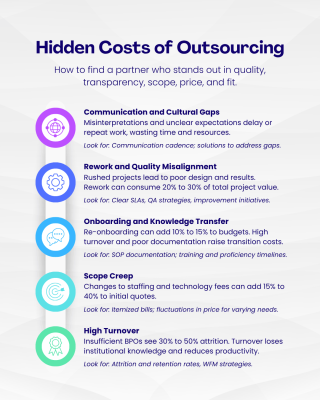
Leaders should also keep in mind back-sourcing, or the cost of bringing outsourced tasks back in-house, usually due to insufficient performance or return on investment. Outsourced solutions for short-term projects or quick fixes may not be sustainable long-term and may add to the costs to insourcing.
Operational impact
Operations — team size, roles and responsibilities, equipment, resources, initial and ongoing training, salaries and other expenditures — should be designed for the most pressing urgent and long-term goals you’ve identified in your evaluation stage. Consider how insourced and outsourced teams affect operational success and return on investment to inform your decision.
Potential impacts of insourcing on operations can include the following:
- Greater quality control
- Deeper brand alignment
- Reputational gains and customer trust
- Ease of communication and collaboration across teams
- Enhanced deployment of new initiatives
- Reduced costs of attrition
- Higher costs of expansion, including training and onboarding
- Longer, more expensive ramp-up timelines
- Overwhelm in business growth
- Decreased service quality and capacity in surges or periods of understaffing
Insourcing success depends on how well-situated your team is to meet target service levels. If properly staffed, they can excel. However, unexpected surges or even anticipated seasonality are notoriously difficult and expensive for internal teams to handle alone.
This, of course, is where outsourcing shines. Consider these potential impacts of outsourcing on operations:
- Faster recruitment, hiring, and onboarding
- Proactive demand forecasting and workforce management
- Flexible operational scaling
- Faster speed-to-proficiency with streamlined training and learning
- Higher service quality from dedicated experts
- Proactive CX enrichment for better customer relationships and satisfaction
- Maintained high service levels throughout seasonality
- Automatic QA and performance reports
- Reduced attrition and associated costs
Insourcing vs outsourcing in logistics and supply chain
Logistics and supply chain are critical for producing, storing, and sending goods to customers. Third-party logistics (3PL) is when a company contracts an external party with expertise in storing and transporting materials to handle the heavy lifting for the company.
Insourcing logistics and supply chain is ideal for businesses prioritizing the skill or craftsmanship of internal employees, with the space to store and pack items in store. This grants greater control over quality and optimizes costs of shipping for demand volume that fits internal resources. Higher upfront costs of insourced logistics can be a financial burden to small businesses with limited budgets, especially as demand outgrows capabilities.
As such, periods of growth or surges prompt a brand to turn elsewhere. Third-party logistics suppliers pack and ship items as they are sold, handling returns and managing inventory so the business can focus on core competencies such as product development, customer engagement, marketing, or new initiatives.
Impact on employee morale and company culture
Any operational change will affect existing employee morale and may potentially impact greater company culture — especially if the change involves employee displacement or downsizing. But impact doesn’t have to be negative. Factors such as changes to workloads, responsibilities, compensation, team size, training, and cross-team communication and collaboration can present opportunities to meet your team’s needs.
Consider these potential impacts of insourcing and outsourcing on employee morale and company culture.
| Impact | Insourcing | Outsourcing |
| Team structure | Greater investment in internal talent and development | Potential downsizing; better assignment of responsibilities to core competencies |
| Strategic initiatives | Deeper development of departments with higher need for return on investment | External experts can handle areas outside of scope of internal employees |
| Operational agility | Increased responsiveness to changing requirements within team’s capabilities | Flexible scalability proactively optimizes costs and expertise |
| Workload | Greater sense of ownership, driving innovation | Enables greater focus on key responsibilities or client-facing work |
| Quality | Enhanced quality control | Relieved burden of QA |
| Communication | Smoother collaboration across in-office teams already aligned in brand culture | Cross-team communication, regular reports, and standardized coaching empowers effective collaboration |
Insourcing and outsourcing allow businesses to review their internal resource management and make necessary changes to enhance operational efficiency and meet performance goals on different timelines, in different ways.
Evaluate your business situation and ask key questions to determine if outsourcing is right for you to optimize costs, talent, and resources for greater business, employee, and customer impact.
FAQs
What are the benefits of insourcing vs outsourcing?
The benefits of insourcing vs outsourcing depend on business goals, values, and budget of the company. Insourcing advantages include greater control and deeper brand knowledge while benefits of outsourcing include significant cost savings, access to specialized skills, and increased operational efficiency.
Is insourcing cheaper than outsourcing?
The costs of insourcing and outsourcing depend on the type of work, project scope, and long-term goals.
Outsourcing can be cheaper for specialized or administrative tasks and urgent short-term needs, with a host of opportunities to cut costs for long-term scalability. Low labor costs of outsourcing can hide extra expenses of urgent or specialized needs, depending on the business process outsourcing (BPO) provider.
Insourcing can be more cost-effective for developing core business operations, with more limited expenditure flexibility. Full costs of insourcing can be 30% to 40% higher than initial estimates due to benefits, infrastructure, recruitment, and training.
What are the main risks of outsourcing?
The main risks of outsourcing are operational misalignment, inadequate quality control and performance, insufficient security measures, and regulatory non-compliance. The right partner has extensive experience in your field and communicates their strategies, and outlines clear performance expectations in your contract.
Mitigate these main risks of outsourcing by looking for a BPO provider who follows these best practices:
- Aligns expectations in thorough project planning and contract negotiation
- Leverages secure technology, encrypted frameworks, and strict access controls
- Is HIPAA, TCPA, PCI DSS, and GDPR compliant
- Prioritizes brand knowledge, cultural training, and continuous agent coaching
Can a company do both insourcing and outsourcing simultaneously?
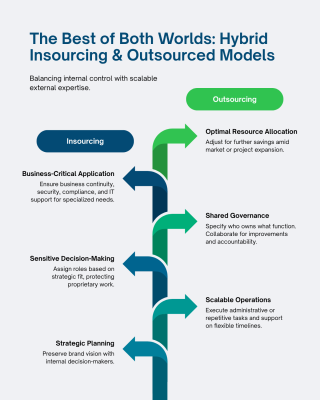
Yes, a company can insource and outsource simultaneously. A hybrid or co-sourcing model can balance control, costs, and flexibility for businesses seeking to optimize efficiency in certain tasks while cultivating internal talent in core competencies.
Which model provides better long-term ROI?
Neither insourcing or outsourcing nor universally provides better long-term ROI. Long-term ROI for each depends on how brands measure cost savings, scalability, strategic alignment, performance, and the value of in-house or external expertise for specific tasks.
Outsourcing provides significant cost savings and opportunities for growth while insourcing keeps critical functions in-house for better internal talent development and collaboration.