

The Real Cost of Chat Support Outsourcing and How to Evaluate Providers
Introduction
It starts with a growing chat queue. More customers are reaching out, response times slipping, and your team is overwhelmed and unable to keep up. Hiring more agents seems like the obvious solution, but recruiting, training, scheduling, and providing coverage around the clock makes things more expensive and complicated.
That’s when chat support outsourcing starts to make sense. However, the decision should be focused on how you can add capacity without losing your brand voice or operational control.
This guide will break down everything you need to consider and be aware of when you are considering chat support outsourcing including dedicated vs. shared agents, pricing models, AI-human workflows, vendor evaluation, and what realistic implementation can look like.
Read Time: 16 minutes
Key Takeaways
- Chat support outsourcing helps companies expand coverage without taking on the full cost and complexity of building a larger internal team.
- The choice between dedicated and shared agents is a key consideration because it directly affects product knowledge, brand consistency, and quality.
- Outsourcing costs vary based on staffing model, location, volume, language, and complexity.
- The right outsourcing provider should meet your standards for security, compliance, QA, and SLAs.
- A structured 30/60/90-day ramp helps scale support without disrupting the customer experience.
Table of Contents
What Chat Support Outsourcing Actually Means (And What It Doesn’t)
Simply put, chat support outsourcing involves transferring some, or all, of your customer conversations to an external team that operates on your company’s behalf. However, enterprise-level outsourcing is so much more than just putting another company’s agents behind your chat widget.
A capable partner will integrate with your customer service operation and will understand your culture, products, and ultimately will feel like an extension of your team. A modern outsourced chat operation may include human agents, AI-powered tools, automation, and internal teams working together. The objective is to create a workflow in which every interaction is handled by the resource best equipped to resolve it.
The Dedicated-Agent Model vs the Call-Center-Add-On Model
When evaluating live chat support outsourcing, there are two very different approaches. The first one involves adding chat capabilities to an existing contact center operation and the second is building a dedicated chat team around your brand.
A call center add-on model typically adds chat functionality to an existing phone or contact center platform. It is a practical way to expand into chat, but the technology itself does not guarantee specialized staffing, deep product knowledge, or a consistent brand experience.
A dedicated agent model goes further because dedicated chat agents work specifically on your account and no one else’s. These teams become more familiar with your products, systems, policies, customers, and brand voice. That context is great for providing a more consistent brand experience.
AI can strengthen either model. AI agents, for example, can handle routine interactions like FAQs, while AI agent assist tools provide human agents real-time knowledge, response suggestions, and customer context during more complex conversations. AI-powered training also helps agents practice scenarios and identify knowledge gaps before they affect the customer experience.
The main goal here is to evaluate people and technology together. Adding chat technology gives you another channel, a dedicated team provides the people to manage it, and AI can then help both work faster.
What Outsourced Chat Teams Handle Day to Day
It depends on the program, but many outsourced teams can handle much more than just basic FAQs. A few common responsibilities include:
- Sales and pre-purchase conversations
- Product and account questions
- Order and shipping support
- Billing and payment inquiries
- Technical triage
- Appointment and reservation requests
- Lead qualification
- Customer retention conversations
- Escalation management
- Feedback collection
- After-hours and overflow support
For eCommerce companies, chat can be directly in the path to purchase. An agent answering a product question may be supporting a customer service interaction that turns into a purchase. This makes live chat outsourcing for eCommerce valuable when the team is trained to understand both support and sales objectives.
When Chat Support Outsourcing Makes Sense (And When It Doesn’t)
Outsourcing isn’t automatically the right answer for your organization. For some companies expanding the in-house team or even taking a hybrid approach may make more sense.
The right decision will come down to what your operation truly needs. Ask yourself:
- Are chat volumes outspacing your staff?
- Do you need coverage across more hours or time zones?
- Are rising labor costs making each interaction more expensive?
- Would outsourcing introduce unnecessary complexity?
The answers to these questions will help you determine whether it’s time to bring in an external partner or whether your current model is still the better fit.
Signals It’s Time to Outsource
Usually the decision to outsource isn’t caused by just one bad month or a single staffing challenge. It’s more often a pattern of service levels slipping or your internal team spending too much time on work processes that could be handled more efficiently. If you are seeing several of the signs below at once, it may be time to consider an outsourced chat team.
- You’re missing chat SLAs: If customers regularly wait too long for a first response, your staffing model may no longer meet demand.
- Volume is unpredictable: Product launches, promotions, holidays, and seasonal peaks can create demand that is difficult to handle with a fixed internal team.
- You need extended coverage: Hiring enough internal employees to cover nights, weekends, and holidays can create a much larger staffing commitment than the actual after-hours volume needs.
- You’re trying to expand into new markets: Outsourcing can provide access to multilingual teams and broader coverage without requiring your company to build new support operations.
- Cost per interaction is climbing: If internal employees are spending significant amounts of time answering the same questions, outsourcing some of that workload can help internal teams focus on more complex tasks.
- Support is affecting revenue: Customers that abandon purchases because they can’t get answers when they are ready to buy turn chat into a revenue opportunity and a potential reason to rethink how support is staffed.
Your decision to outsource should be less about cost reduction, although that is a major benefit, and more about building a support operation that can keep up with your business.
When to Stay In-House or Hybrid
There are a few situations where keeping your in-house team is going to make more sense than outsourcing. For instance, a low-volume operation may not have enough work to justify a dedicated outsourced team. Highly sensitive or specialized issues may also require internal employees with access to proprietary systems or institutional knowledge. Early stage companies may struggle with outsourcing as well because they might have rapidly changing products or processes that still need refining.
A hybrid approach can solve many of these problems. With this model, your internal team takes care of complex conversations while an outsourced team manages first-line support, after-hours coverage, routine questions, or sales conversations.
Where AI and Human Support Fit Together
AI can also become part of an outsourced chat support model without replacing human agents. Many providers use AI-human workflows which let AI handle basic interactions while human agents step in when a conversation needs empathy, troubleshooting, or a more nuanced response.
For example, AI can help identify customer intent, suggest responses, summarize conversations, or route chats to the right agent. The human agent remains responsible for the interaction, with AI working in the background to make the conversation more efficient and consistent.
The human-in-the-loop approach can be especially useful for companies that want to increase chat capacity without turning customer support into a fully automated experience. An outsourced partner can help design the workflow around which interactions should be automated, which should be assisted by AI, and which should always go to a human.
Dedicated vs Shared Chat Agents, The Decision That Determines Everything Else
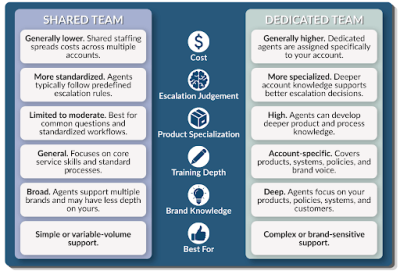
A big decision that comes with outsourcing is choosing between shared or dedicated agents. If you are unfamiliar with those terms, basically shared agents work for your brand as well as others and dedicated work for your brand only. The choice affects costs, flexibility, product knowledge, brand consistency, and the overall customer experience.
To know which one will be best for your particular organization, you need to understand how they work and their benefits.
How shared/pooled chat agents work
Shared teams serve multiple client accounts. When a customer starts a chat, the conversation is routed to whichever qualified agent is available. This model is good for organizations with low or highly variable customer volume. However, the tradeoff is specialization.
An agent supporting four, five, or even six different brands regularly has to switch between products, policies, and escalation rules throughout the day. This causes cognitive overhead and can make brand consistency more difficult. Sure, the agent may know the basic answer, but might in turn lack the depth of knowledge required to confidently handle a more nuanced question.
Shared teams can be a good option if the work you are looking to outsource is more straightforward and standardized.
How a dedicated team model works
A dedicated team is built around one brand. Agents are trained on that company’s products, systems, policies, customer profiles, tones, and escalation procedures. They become familiar with the questions customers commonly ask as well as the questions that require judgement. Dedicated teams are going to be a better choice for organizations that have more complex customer interactions.
A dedicated model also makes ongoing improvement easier because the same agents are handling your customer consistently so QA findings can be connected to training, SOP updates, and knowledge-base improvements.
Keeping Brand Voice Consistent in Written Support
Brand voice is easy to underestimate in chat. Think about it, on the phone tone is carried through vocal inflection. Agents can sound reassuring, enthusiastic, apologetic, or empathetic even when using relatively simple language.
Chat removes much of that context. A sentence can be technically correct and still feel cold, dismissive, overly formal, or completely off brand. It’s because of this that outsource live chat support programs need to have channel specific training.
Why Text-Based Support is Harder to Keep On-Brand Than Voice
Written customer support leaves very little room for tone to be interpreted generously. A phone call makes it easier for agents to convey warmth, empathy, and personality. But in chat, customers only see the words on the screen and tone can be easily misinterpreted. The difference between simply telling a customer that something isn’t possible and acknowledging the limitation while helping them find an alternative may seem small, but it can completely change how the interaction feels.
For high-value brands, those small differences matter across thousands of conversations. Brand voice should consistently communicate the personality, empathy, and service standards customers associate with an organization.
Text support also creates a consistency challenge. Different agents naturally have different writing styles. Without clear guidelines and ongoing quality monitoring, those differences become very noticeable to customers.
This becomes even more important when chat support is outsourced. Customers shouldn’t feel like they’re interacting with a different company simply because they reached out through chat. The outsourced team needs to understand what to say and how your brand would say it.
Training, tone guides, and QA loops that make it work
Strong programs combine brand voice guidelines, response examples, product and policy training, scenario-based coaching, and ongoing QA reviews. These help supervisors identify patterns in conversations and coach agents when responses are technically accurate but don’t meet the brand’s communication standards.
Your provider should also have access to:
- Brand voice guidelines
- Approved terminology
- Product documentation
- FAQs
- Escalation rules
- Do-not-say language
- Examples of excellent conversations
- Examples of unacceptable conversations
Outsourced providers should continuously be monitoring how well agents are meeting these standards.
At ROI CX Solutions, for example, we combine dedicated teams with ongoing training, quality assurance, technology, and performance optimization. We strive to know your brand so well that our team feels almost like an extension of yours.
Training should give agents the right knowledge and guidance to help them communicate within the boundaries of your brand.
What Chat Support Outsourcing Costs
There is no universal rate for outsourced chat support and the price you pay will typically depend on a few other factors than just an agent’s hourly rate.
Your live chat outsourcing cost will vary based on the delivery model, geography, volume, coverage hours, language requirements, technical complexity, compliance needs, AI and automation strategy, and level of management included. Understanding those variables is important when comparing providers because the lowest quoted rate doesn’t always represent the lowest overall cost.
Recent industry pricing guides provide a useful directional benchmark.
| Delivery Model | Typical Hourly Range* |
| Offshore | $8-$15/hour |
| Nearshore | $15-$22/hour |
| Onshore | $25-$35/hour |
*These are market reference ranges, not guaranteed quotes. Actual pricing varies by provider, scope, staffing needs, and service complexity.
Pricing Models Explained
Once you have a sense of market rates, it’s time to look at how you will actually be charged. Outsourced chat providers typically use one of four pricing structures and the right model depends on how predictable your volume is, how much control you need over staffing, and whether you’re paying primarily for capacity or outcomes.
- Per-Agent Hour: With hourly pricing, you pay for the time agents are staffed on your program. This model is straightforward and works well when you need flexible coverage that can increase or decrease with demand. For example, a business might staff additional agents during peak shopping periods without committing to those hours year round. The tradeoff is that your total monthly cost can fluctuate with staffing needs, so you will want to understand the minimum hours, overtime rates, and whether time spent on training or administrative work is billable.
- Per FTE or Dedicated Seat: With per FTE pricing, you are paying for a dedicated amount of agent capacity rather than a specific number of chats. An FTE, or full-time equivalent, generally represents one full-time agent working the hours defined in your agreement. Industry pricing guides currently put dedicated chat seats at roughly $1,200-$3,500 per agent per month, and this can change based on geography, service level, and scope. This is a good fit for organizations that have steady chat volume, complex products, or strict brand requirements.
- Per Chat or Ticket: With per-interaction pricing, you pay for each chat or ticket handled. Current market benchmarks generally fall around $2-$8 per contact, although high-volume interactions may fall below that range while complex support can cost more. This model can make costs easier to align with demand, however the definition of a “chat” matters. Also make sure the pricing structure doesn’t encourage agents to close conversations quickly rather than resolve them properly.
- Outcome-Based Pricing: Outcome-based models tie some or all of the provider’s compensation to measurable results, such as sales, conversions, appointments, or successful resolutions. Unlike hourly or per-chat pricing, there isn’t a reliable industry-wide benchmark for the model because pricing will depend on the outcome being measured. That makes the contract especially important and both sides should agree on how outcomes are defined, measured, and reported before the program launches.
Enterprise buyers should choose a pricing model that matches their volume, staffing needs, and business objectives without creating incentives that work against the quality or customer experience.
What Drives the Range
Two companies can outsource the same number of chats and receive very different quotes. That is because providers are pricing not only the number of conversations, but also the people, coverage, technology, and operational requirements needed to handle those conversations.
There are a few factors that can have a significant impact on your chat support outsourcing pricing:
- Dedicated vs shared staffing: Dedicated agents will typically cost more because they are assigned specifically to your account. SHared teams can spread agent capacity across multiple clients, lowering the cost but potentially reducing specialization.
- Location: Onshore, nearshore, and offshore teams have different labor costs. Geography should be evaluated alongside language skills, quality, coverage, and performance.
- Coverage hours: Support during business hours requires fewer staffing resources than evenings, weekends, holidays, or 24/7 coverage. Around-the-clock support also requires additional staffing to account for schedules, time off, and coverage gaps.
- Language requirements: Multilingual chat support can increase costs because it may require specialized agents, additional recruiting, or separate language coverage.
- Compliance and security: Programs involving payment information, protected health information, or other sensitive data may require additional security controls, training, technology, and oversight.
- Volume and concurrency: A program handling thousands of chats per month has different staffing requirements than one handling a few hundred. The number of conversations agents must manage simultaneously also affects capacity.
- Technology and integrations: CRM integration, chat platforms, AI tools, reporting systems, and other technology requirements can add to the overall cost. However, AI can also reduce costs by helping agents handle more conversations, automate routine inquiries, surface answers faster, and reduce training and QA workloads.
- AI and Automation: The financial impact of AI will depend on how it is deployed. An AI chatbot that handles basic tasks can reduce the number of human-assisted chat required, while AI agent assist improves agent productivity without removing the empathy from the interaction. AI-powered training and QA can also reduce the operational cost of supporting agents.
These contingencies are why comparing providers based solely on their advertised hourly rate can be misleading. A lower labor rate may not account for management, technology, or the additional oversight your internal team has to provide. Likewise, a provider with higher upfront technology or labor costs may deliver a lower cost per resolution if AI and automation improve agent productivity.
During your evaluation of live chat outsourcing costs, look at the full operating model and consider what you will actually need to pay to deliver a quality customer interaction. That means evaluating not just the hourly rate, but also how the provider uses AI to influence staffing, productivity, and ultimately the cost of each resolved interaction.
How to Evaluate a Chat Support Outsourcing Partner
Now that you have a better understanding of how to evaluate pricing, there are other considerations that need to be factored into your decision. You want a partner that fits your current operating model and can represent your brand accurately.
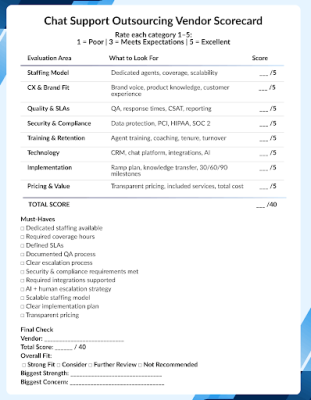
A strong evaluation process looks at both operational capabilities and customer experience. The following scorecard and questions can help narrow the field and create a more consistent RFP process.
Vendor Scorecard Criteria
A strong chat support outsourcing partner should be evaluated beyond just price. You should first start with the staffing model and determine whether agents are dedicated or shared, how coverage is structured, and how quickly the provider is able to scale.
Next, look at quality and customer experience. Look into how conversations are monitored, how agents are coached, and which metrics the provider tracks. KPIs such as response time, resolution rate, CSAT, QA scores, and escalation rates give you a better understanding of performance than an advertised service level.
Security and compliance should also be evaluated based on the type of information your agents will handle. Depending on your industry, that may include PCI requirements for payment related conversations, HIPAA safeguards when protected health information is involved, and SOC 2 reporting. Some organizations may meet the requirements for multiple compliance standards. For instance, ROI CX Solutions meets the standards for PCI compliance, HIPAA, SOC 2, and ISO 27001. Ask what controls are in place for access, encryption, data retention, and auditing.
Finally, evaluate the operational foundation behind the service. This includes agent training and retention, technology and CRM integrations, reporting, implementation timelines, and the provider’s ability to support your growth.
Questions to Ask in a Vendor Call or RFP
The best questions to ask a vendor will reveal how the operation actually works rather than simply confirming that a provider offers chat support. Below we have outlined specific questions to ask and their importance.
- Will our agents be dedicated or shared? This is one of the most important questions to ask because the staffing model directly affects product knowledge, brand consistency, and agent availability. If customer experience is a priority, you need to understand who will be handling your conversations and how much of their time is dedicated to your account.
- How do you train agents on our products, policies, and brand voice? Chat agents are representing your company and generic customer service training isn’t enough. Look for structured knowledge transfer processes, brand voice training, readiness testing, and ongoing coaching.
- How do you measure chat quality and performance? A provider should be able to clearly explain how it tracks metrics such as response time, resolution rate, CSAT, QA scores, and escalations. This helps you determine whether the provider has a real performance management process or is simply promising good service.
- What happens when an agent can’t resolve an issue? Even well-trained agents will encounter questions that require internal expertise. Ask how escalations are identified, who receives them, how quickly they’re handled, and how the provider prevents customers from getting stuck between teams.
- How do you protect customer information in chat conversations? Chat can involve sensitive customer and payment information making security control essential. Ask about encryption, monitoring, and any PCI, HIPAA, or SOC 2 requirements relevant to your business.
- How do you handle unexpected increases in chat volume? One reason you may be outsourcing is to have more flexibility when it comes to staffing, so it’s important to ask a provider how they handle it. Ask how quickly additional agents can be added, how overflow is handled, and what happens when volume exceeds the original forecast.
- Where does AI fit into the chat workflow? AI can handle basic tasks and assist agents, but you should understand where human intervention begins.
- What does implementation look like in the first 30, 60, and 90 days? A vague implementation plan is a red flag. Clarity for implementation will map out what you can expect and set clear guidelines for the partnership. Make sure you ask about things like knowledge transfer, training, and testing.
- How is pricing structured and what is included? Beyond hourly rate, the provider should disclose whether training, technology, or other operational expenses are included so you can compare providers based on total cost.
The right provider for your organization will be able to deliver a consistent experience for your customers and meet your performance standards.
Put your vendor evaluation into practice. Use our Chat Support Outsourcing vendor Scorecard to compare providers across staffing, CX, security, technology, pricing, and more.
Ramp Timeline and Implementation
Choosing a chat support outsourcing partner is only the beginning. The transition from an in-house operation to a dedicated outsourced team requires careful planning, especially when agents will be directly interacting with customers and working inside your existing systems.
A strong provider should be able to explain exactly how it will move from initial discovery to a fully operational team. The timeline is going to vary based on things like team size, integrations, and training requirements, so a 30/60/90-day framework is great for providing a useful starting point for setting expectations and measuring progress.
30/60/90-day Framework for Setting Up a Dedicated Chat Team
A structured ramp up plan helps prevent the most common implementation problem which is moving an outsourced team into live customer interactions before the people, processes, and technology are ready.
| Timeline | Focus | Key Milestones |
| Days 1-30 | Build the foundation | Knowledge transfer, Agent selection, Product and brand training, SOPs, System setup, SLA and KPI alignment |
| Days 31-60 | Train and test | Scenario-based training, QA calibration, Integration testing, Escalation testing, Soft launch, Performance review |
| Days 61-90 | Ramp and optimize | Increase live volume, Adjust staffing, Monitor KPIs, Refine SOPs, Ongoing coaching, Identify automation opportunities |
By day 30 the team should understand your products, processes, brand, and systems. By day 60 agents should be tested and the team should be handling a controlled volume of live conversations. By day 90 the team should be fully operating with established SLAs, reporting, QA, and continuous improvement processes.
After the team is trained and the foundation is in place, the next step is making sure the processes, knowledge, and technology they rely on are built to support a seamless transition.
Knowledge Transfer, SOP Creation, and Integration with Existing Chat/CRM tools
The quality of the transition depends heavily on what the provider learns before agents begin handling live conversations. Knowledge transfer should go beyond product information and include the details agents need to make decisions confidently. This means you need to be documenting:
- Products and services
- Policies
- Common customer questions
- Troubleshooting procedures
- Account processes
- Escalation criteria
- Refund or cancellation policies
- Brand voice expectations
Your internal team needs to identify where agents have authority to resolve an issue independently and where they need to involve another department.
Those processes should then be turned into clear standard operating procedures (SOPs).Good SOPs give agents a consistent framework for handling common situations without forcing every interaction into a rigid script. They should be consistently updated as products, policies, and customer needs change.
Technology integration is another critical part of implementation because nothing is worse than finally getting to the launch day only to realize your systems can’t work with each other. To avoid technical issues with implementation, make sure your outsourcing provider has access to your existing chat platform, CRM, knowledge base, or other customer-facing tools.
The biggest implementation risk is moving too quickly and creating operational disruption. A structured ramp up plan, thorough knowledge transfer, documented SOPs, and tested integrations give both your internal team and outsourcing partner a much better chance of getting the transition right.
Chat Support Outsourcing Should Be an Operational Strategy
Your decision to outsource should not be based on finding the cheapest agent available. You should work to find a support model that can deliver the right experience at the right cost.
For some organizations, that might look like a shared team handling simple, predictable interactions. For others, it means a dedicated team operating as part of the internal customer experience organization. Companies with global customers might benefit from using a hybrid model that combines onshore, nearshore, and offshore coverage, also known as smartshoring.
ROI CX Solutions provides outsourced live chat support designed around matching the model to business needs. Our approach balances human support with technology to help businesses manage customer conversations while gathering insights from those interactions.
Explore live chat support services to see how a dedicated outsourced team can fit into your customer experience strategy.
FAQs
What is chat support outsourcing?
Chat support outsourcing is the practice of having an external team manage customer conversations through live chat on a company’s behalf. Outsourced teams handle sales inquiries, account support, technical questions, escalations, and other customer interactions.
How much does chat support outsourcing cost?
Chat support outsourcing costs will vary based on factors like staffing model, location, coverage, language, volume, and complexity. Typical market rates can range from $8-$15 per hour offshore to $25-$35 per hour onshore.
What’s the difference between dedicated and shared chat agents?
Dedicated chat agents work for one, single brand and because of this develop deeper product knowledge and can provide a more consistent experience for customers. Shared agents support multiple brands, which can reduce costs but may limit specialization.
How long does it take to ramp an outsourced chat team?
A typical dedicated chat team can be ramped using a 30/60/90 day implementation framework. The first 30 days typically focus on training and set up, the next 30 on controlled production, and the final 30 on optimization and scaling.
Can outsourced chat agents really sound like our brand?
Absolutely, with dedicated agents, comprehensive brand training, detailed tone guidelines, and ongoing quality assurance.The more deeply agents are trained on your brand and products, the more naturally they can represent your organization.
Is chat support outsourcing worth it for a mid-size company?
It can be when growing chat volume, coverage needs, or seasonal demand make maintaining an in-house team too expensive. A hybrid model is also a great way for mid-sized companies to outsource routine or overflow support while keeping complex interaction in-house.
What should be in a chat support outsourcing vendor scorecard?
A vendor scorecard should evaluate staffing models, agent quality, training, QA, SLAs, security, compliance, escalation processes, agent retention, scalability, technology integrations, reporting, and brand alignment.
How does AI fit into outsourced chat support?
AI becomes an advantage when it is used to handle repetitive questions, knowledge retrieval, triage, and assisting agents. Human agents will take care of complex or sensitive interactions. Strong programs also establish governance around when AI can act independently and when conversations must be escalated to a person.
What industries use chat support outsourcing most?
Chat support outsourcing is commonly used across eCommerce, retail, finance, healthcare, technology, hospitality, insurance, and other customer facing industries. The model is particularly useful for companies with high or variable chat volumes and customers who expect fast responses.
What’s the biggest risk with outsourcing chat support?
The biggest risk is losing consistency in customer experience during or after the transition. Strong training, dedicated agents, clear escalation processes, and structured implementation can significantly reduce that risk.