
AI Agent Assist vs. Agentic AI: What’s the Difference?
AI agent assist and agentic AI are often used interchangeably, but they’re fundamentally different: AI agent assist supports human agents in real time by surfacing live transcription, knowledge base answers, and next-best-action suggestions, while the human stays in control of the interaction. Agentic AI, by contrast, operates independently, resolving customer issues end-to-end without human oversight, handling tasks like password resets or order status checks while escalating to a human when needed. Agent assist is best for complex interactions requiring empathy and judgment, while agentic AI excels at high-volume, repetitive tasks; most contact centers benefit from using both together rather than choosing one over the other.
Read Time: 6 minutes
Table of Contents
In a day and age where technology rules all, "agent assist," "AI agents," and "agentic AI" are being used interchangeably. The reality is they describe fundamentally different approaches to automation in the contact center and confusing them can lead to expensive missteps.
This confusion directly impacts budget allocation, deployment, and creates a frustrating customer experience which is why the distinction between AI agent assist vs agentic AI is so important.
On one side, you have tools that work to support human agents in real time. On the other hand, you have systems that can act independently to resolve customer issues from start to finish.
If you are exploring contact center AI tools or AI in call center outsourcing, this breakdown will help you understand what each approach is and which one is right for your organization.
What Is AI Agent Assist?
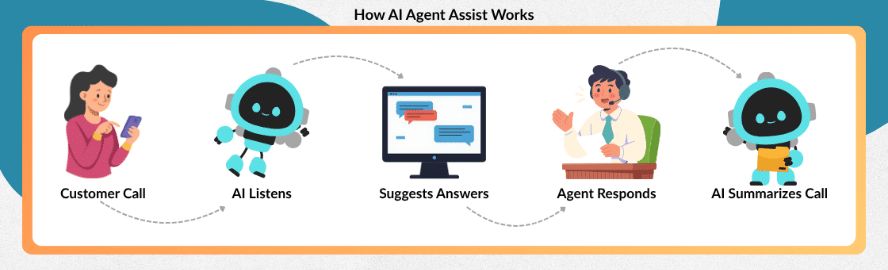
AI agent assist software refers to the tools that support human agents during live customer interactions. These tools work to enhance the agent's performance by providing guidance and instant information retrieval. At its core, AI agent assist is reactive because it listens, analyzes, and makes suggestions while keeping the human agent at the center of the interaction.
In most contact centers it works in the background to surface insights that help agents respond faster and more accurately. Some core capabilities of it include:
- Live transcription of customer conversations
- Real-time knowledge base retrieval
- Suggested responses or next-best-action prompts
- Automated call summarization and notes
- Sentiment detection and escalation alerts
In practice, AI agent assist is usually the first step organizations take when adopting contact center AI tools because of how easily it can integrate into existing workflows. It's great for environments where human judgement and empathy are still essential to the customer experience.
What AI Agent Assist Does Well
AI agent assist delivers meaningful impact where consistency and compliance matter most. One of the biggest advantages comes from its ability to reduce handle time. It can surface relevant answers instantly which removes the need for agents to search across multiple systems while the customer is waiting. So instead of being put on hold for minutes at time, conversations move forward without interruption.
It also improves consistency because every agent is supported by the same real-time guidance. Customers receive similar answers regardless of who they speak with or how experienced that agent is. Your customers get a consistent experience, which can be a major challenge in scaled service environments.
Another key strength is its role in strengthening compliance and quality control. AI agent assist software can detect risky or non-compliant language and prompt agents when specific steps need to be followed. This is great for highly regulated industries like healthcare or finance.
Lastly, it speeds up the onboarding process because new agents are supported in real time during live interactions. Instead of relying on memorization, they learn through guided execution.
AI agent assist strengthens human performance in real time, however the next evolution in contact center AI moves beyond support into full autonomy with agentic AI.
What Is Agentic AI?
The main focus of AI agent assist is to support humans whereas agentic AI contact center systems replace manual execution for structured tasks. Agentic AI refers to autonomous systems that can set goals, make decisions, and complete tasks with minimal or no human oversight.
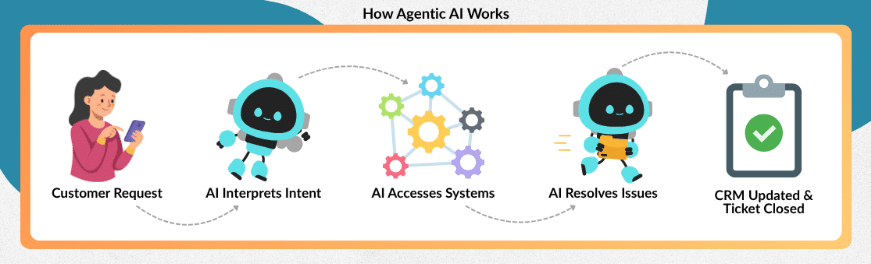
In an agentic AI customer service model, the AI executes actions. It can interpret intent, determine the correct workflow, interact with a variety of systems, and complete the full resolution loop.
Agentic AI is not better than AI agent assist because it is a completely different operational model.
What Agentic AI Does Well
Agentic AI contact center systems shine in environments with structured, repeatable tasks that are clearly defined. Their value comes from removing manual effort entirely rather than assisting it.
A major strength of Agentic AI is its ability to resolve high-volume Tier 1 inquiries without human involvement. Requests like password resets, order status checks, or appointment confirmations can be handled automatically from start to finish. This is great because human agents have more time to focus on more complex interactions.
Since these systems are autonomous, they can handle spikes in demand without requiring more agents or training, which improves operational scalability. These systems are a major asset for businesses that are dealing with seasonal surges or rapidly growing contact volumes.
Another benefit of agentic AI is that it can execute multi-step workflows across systems. It can interact with CRMs, billing platforms, scheduling tools, and internal data bases simultaneously. This creates a seamless experience where the system understands inquiries and the intent behind them and carries out the necessary steps to resolve them.
Agentic systems are designed to escalate intelligently when needed. If a situation becomes too complex, the AI can hand it off to a human agent while also providing full context as well as suggested next steps. This ensures that customers are never lost in automation loops and always get the right level of support they need.
Side-by-Side: The Key Differences
While both AI agent assist and agentic AI are designed to improve efficiency and enhance customer outcomes, they function in different ways inside the contact center. The biggest distinction comes down to how each technology participates in the customer journey. Understanding these differences will help you evaluate which solution aligns best with your company's operational goals and AI readiness.
- Who's in control: With AI agent assist, the human agent remains fully in control of the interaction at all times. The technology provides necessary information and provides recommendations, but ultimately the agent determines which actions to take and how to respond. In contrast, agentic AI makes decisions and completes tasks independently.
- When it activates: AI agent assist activates during human-handled customer interactions. It works alongside agents to elevate conversations as they are happening. Agentic AI, however, can start working the moment a customer initiates contact.
- What it can do: These systems have different purposes and thus have vastly different capabilities. AI agent assist is designed to suggest, surface, summarize, and guide. These functions help agents find answers and improve response quality. Agentic AI goes further by acting and escalating interactions when necessary. It performs the execution rather than just supporting it.
- Best for: As previously mentioned, AI agent assist is great for situations where human empathy and judgement is needed at the forefront. Agentic AI is best suited for repetitive, high-volume tasks like billing inquiries, or order tracking.
- Deployment lift: For most organizations, AI agent assist represents a lower entry point into contact center AI tools because it has an easier time integrating into preexisting systems. Agentic AI typically needs a more advanced deployment strategy. It is because of this that implementation can be more complex but also deliver larger automation gains when it is executed well.
These technologies are not direct competitors. In fact, many modern contact centers use both.
How to Know Which One Your Business Needs Right Now
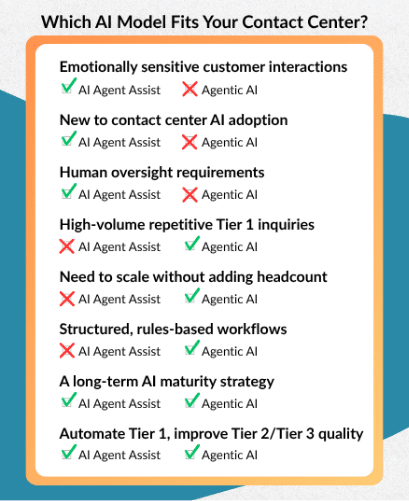
Choosing between AI agent assist and agentic AI starts with understanding where friction is in your customer experience. The right solution will depend on the complexity of your interactions, the level of human judgment required, your operational readiness, and how aggressively you want to automate.
Some businesses benefit most from augmenting human agents, while others gain ROI from AI in call centers by automating repetitive workflows.
You should also consider customer expectations and trust when evaluating automation strategies. Gartner reports that 54% of customers trust human agents more than AI for recommendations. For brands operating in relationship-driven environments, maintaining a strong human element can still be a competitive advantage.
The most important thing to remember is that successful AI adoption should apply the right level of automation to the right interaction type. Businesses are far more likely to improve efficiency without sacrificing customer experience if they align their AI strategy with operational reality.
How ROI CX Solutions Can Help
As your organization evaluates AI contact center tools for outsourcing, the challenge becomes alignment.
ROI CX Solutions helps businesses identify where they sit on the AI maturity curve and implement solutions that match reality. Through a combination of AI Agent Assist, AI and Technology Services, and Human-in-the-Loop models, we help organizations:
- Improve agent performance with real-time AI support
- Identify where automation will reduce cost and friction
- Design escalation paths that preserve customer experience quality
- Deploy agentic Ai safely with proper guardrails and oversight
- Balance automation with human empathy in complex service environments
Our focus is on how we can help you apply the right level of intelligence to the right part of the customer journey. We find the most value comes from strategically combining AI agent assist and agentic AI.
Final Thoughts
The main difference between AI agent assist vs agentic AI is augmentation versus autonomy. AI agent assist works with human agents to help with decision making during live interactions. Agentic AI operates independently to execute and complete tasks from start to finish.
Both are powerful and necessary in a modern CX strategy, but they solve different problems. In the end, the most successful strategy will be one that combines them to create systems where humans and AI work together. Connect with ROI CX Solutions to explore the right AI roadmap for your organization.