

Choose the Right Government Call Center Services Partner for Federal, State, and Local Agencies
Introduction
Government agencies are under more pressure than ever before to deliver better citizen experiences while working with tighter budgets, staffing constraints, and growing service demands. In fact, the latest American Customer Satisfaction Index (ASCI) Federal Government Study shows that federal call center satisfaction fell to 63 out of 100 in 2026, which is lower than it was in 2025.
Government call center services are a great way to add experienced, dedicated support capacity without building and managing an entirely new internal operation. The right outsourcing partner can take care of citizen inquiries, intake, scheduling, and administrative workflows while allowing agency employees to focus on work that requires government authority and specialization.
This guide explains what to look for when evaluating government contact center outsourcing, what it costs, and how to determine whether a dedicated BPO partner is the right fit.
Read Time: 14 minutes
Key Takeaways
- Federal citizen satisfaction hit a 19-year high in 2025, yet the call-center channel still trails digital contact is the weak link to fix.
- Compliance (FedRAMP, SOC 2, Section 508, US-based agents) is the real decision gate, not price alone.
- A dedicated-agent model serves public-sector mission alignment and continuity better than shared-pool agents.
- Cost and ROI (cost-per-contact, FCR, speed-of-answer) are the buyer’s top unanswered questions and answer them directly.
Table of Contents
What government call center services cover
Government call center services help federal, state, and local agencies manage communication with citizens while supporting the administrative work behind public programs. These services extend beyond answering phone calls because they can include application intake, appointment scheduling, benefit inquiries, municipal service requests, and back-office processing.
Outsourcing these responsibilities allows agencies to gain additional operational support without needing to manage every interaction internally. A qualified BPO partner can provide trained agents, established workflows, quality monitoring, and transparent reporting to help agencies maintain consistent service.
Inbound citizen support, 311, benefits and claims intake, and back-office BPO
The scope of support depends on the agency’s needs, but most government contact center operations include a combination of the following:
- Inbound citizen support: Agents answer questions about public services, eligibility requirements, applications, payments, deadlines, and agency procedures. They provide consistent information, resolve routine inquiries, and escalate complex issues to the appropriate department.
- 311 and municipal services: Support teams handle non-emergency community inquiries, route service requests, provide information about local programs, and direct residents to the appropriate municipal departments. This helps local governments manage incoming requests without overwhelming internal staff.
- Benefits and claims intake: Agents collect application information, guide citizens through intake requirements, verify submitted details against approved procedures, and provide status updates. They can also identify incomplete information and route cases requiring eligibility decisions to authorized government employees.
- Appointment scheduling: Contact center teams manage appointments for public offices, inspections, consultations, and other government services. They can also handle rescheduling, cancellations, reminders, and general scheduling inquiries.
- Omnichannel support: Citizens can receive assistance through phone, email, live chat, and other approved communication channels. Centralizing these interactions helps agencies maintain consistent information and service standards.
- Back-office processing: Beyond direct citizen communication, government BPO services can support data entry, document processing, records management, application review preparation, and other administrative tasks. Moving routine processing work to an external team can give agency employees more time to focus on complex cases.
The distinction between customer support and government decision-making is crucial. An outsourced agent can collect information, explain established procedures, and follow approved workflows. However, decisions involving eligibility determinations, legal interpretation, enforcement, or other delegated government authority must remain with appropriately authorized personnel.
Ultimately, government call center outsourcing allows agencies to distribute operational responsibilities more effectively. Internal teams retain oversight of public programs, while dedicated support teams help manage the volume of everyday interactions and administrative work.
Why agencies outsource citizen contact operations
Maintaining consistent citizen support comes down to having enough people, resources, and infrastructure to meet demand. It’s no secret though that hiring constraints, budget limitations, seasonal fluctuations, and outdated technology can make that difficult.
Building an internal contact means agencies have to manage recruitment, training, scheduling, quality assurance, technology, and ongoing supervision. When contact volumes increase or staffing falls short, these responsibilities can quickly strain existing resources. Which is why many agencies are turning to government contact center outsourcing to manage that workload.
Several challenges make this approach valuable:
- Staffing limitations and hiring constraints: Recruiting, training, and retaining contact center employees takes time and resources. Government hiring processes, budget approvals, and workforce restrictions can make filling open positions even more challenging. An outsourcing partner provides access to an established workforce, experienced supervisors, and dedicated recruitment resources.
- Seasonal demand and unexpected surges: Government contact volumes rarely remain consistent throughout the year. Open enrollment, tax deadlines, benefits renewals, severe weather events, and public health emergencies can all create sudden increases in citizen inquiries. Government BPO services give agencies more flexibility to prepare for these fluctuations because providers can scale efforts up or down as needed.
- Technology and disconnected communication: Many agencies work with legacy systems, disconnected databases, and separate processes for managing phone, email, and digital inquiries. An experienced contact center partner can help establish consistent workflows across communication channels and work within the agency’s approved technology system.
The value of outsourcing is it gives agencies the staffing, processes, and flexibility to deliver consistent citizen support without adding additional strain on internal resources.
What government call center services cost and how to model ROI
The cost of outsourcing is one of the biggest considerations when deciding whether to outsource government contact center operations. However, comparing an outsourced agent’s hourly rate with an in-house employee’s salary doesn’t provide an accurate picture of total operating expenses.
Running an internal contact center means agencies have to account for expenses such as recruitment, training, supervision, technology, facilities, and ongoing quality management. Outsourcing consolidates many of these responsibilities into a contracted service so costs are easier to forecast and manage.
Government call center pricing typically follows one of three models:
| Pricing Model | How it works | Best suited for |
| Per-agent-hour | Pay for each agent hour delivered | Consistent contact volumes and dedicated teams |
| Per-contact | Pay for each completed interaction | Predictable, straightforward transactions |
| Dedicated FTE | Pay a monthly rate for assigned full-time agents | Ongoing support requiring specialized training and continuity |
There are different advantages for each model. For instance, per-agent-hour pricing makes staffing expenses easier to forecast, while per-contact pricing ties costs directly to interaction volume. Dedicated FTE arrangements provide consistent staffing and work well when agents need detailed knowledge of specific programs, policies, and systems. Once an agency understands how providers structure their pricing, the next step is comparing those costs with the full expense of maintaining an internal operation.
As a directional benchmark, US-based outsourced contact center services can range from approximately $28-$45 per productive agent hour. Fully loaded in-house contact center labor can reach approximately $45-$65 per hour when benefits, management, facilities, technology and other expenses are included.
For example, consider an agency that needs 20 full-time agent equivalents, each delivering 1,760 productive hours annually.
| Cost comparison | In-house | Outsourced US-based |
| Hourly cost | $45-$65 | $28-$45 |
| Annual cost | $1.5M-$2.29M | $985,600-$1.58M |
| Three-year cost | $4.75M-$6.86M | $2.96M-$4.75M |
Illustrative estimates based on 20 FTEs x 1,760 productive hours annually. Actual costs depend on contract terms, staffing requirements, and additional transition or technology expenses.
This comparison demonstrates the potential financial benefit of outsourcing, but the lowest hourly rate should not be the deciding factor. Agencies should also understand how efficiently their contact center handles inquiries and whether the service is improving outcomes for citizens.
One way to evaluate that efficiency is to calculate the average cost of handling each interaction. Cost per contact provides a useful starting point:
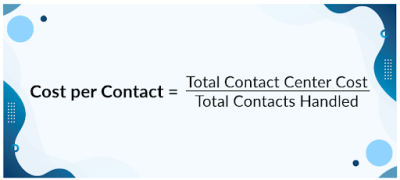
For example, an operation that costs $100,000 per month and handles 25,000 contacts has a cost per contact of $4.
This metric becomes more meaningful when it is evaluated alongside service quality metrics like:
- First call resolution (FCR): The percentage of inquiries resolved during the initial interaction.
- Average speed of answer (ASA): How long citizens wait before reaching an agent.
- Abandonment rate: The percentage of callers who disconnect before receiving assistance.
- Satisfaction (CSAT): How citizens rate their support experience.
Cost per contact and service-level metrics should be reviewed together because a lower cost is only meaningful if the agency is maintaining reliable service, resolving inquiries effectively, and giving citizens timely access to support.
Compliance and security requirements for a government BPO
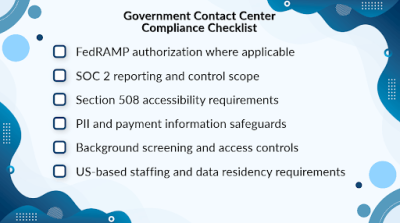
Government agencies face a different set of requirements than many private-sector organizations when outsourcing citizen support. A provider may have the staffing and technology to manage high contact volumes, but it also needs to demonstrate that its security practices meet the standards expected of public agencies. Several requirements are especially important when evaluating a government BPO partner.
FedRAMP, SOC 2, Section 508 accessibility, PII/PCI handling, US-based agents
Before selecting a provider, agencies should evaluate a few key areas:
- FedRAMP and cloud security: The Federal Risk and Authorization Management Program (FedRAMP) establishes a standardized security assessment and authorization process for cloud services used by federal agencies. If a government contact center uses a cloud platform to process federal information, the agency must determine whether that service requires FedRAMP authorization and verify its status. FedRAMP applies to the relevant cloud service offering, not automatically to the BPO provider itself. Agencies should evaluate the full technology environment, including integrations, data storage, and third-party services. State and local agencies may have different security requirements and procurement standards.
- SOC 2 and information security controls: SOC 2 is an independent examination of an organization’s controls related to security and other trust services criteria. A current SOC 2 Type II report can help agencies understand how a provider manages access, monitors systems, protects information, and maintains controls over time. SOC 2 is not a government authorization so agencies should review the report’s scope, exceptions, and services it covers.
- Section 508 accessibility: Section 508 of the Rehabilitation Act requires federal agencies to ensure that applicable information and communication technology provides people with disabilities access that is comparable to access available to others. This can include telecommunications equipment, software, digital documents, and other technology used to deliver government services. Agencies should confirm that the contact center’s communication tools, digital channels, and supporting systems meet the accessibility requirements that apply to their programs.
- PII, payment information, and agent security: Contact center agents may need to access personally identifiable information (PII) and payment details to complete their responsibilities. Providers should have safeguards in place to protect this information, including role-based access, least-privilege permissions, appropriate background screening, secure data handling, call recording controls, retention policies, and incident response procedures. Where payment card information is involved, agencies should also evaluate applicable PCI DSS requirements. Contracts should clearly establish data ownership, access restrictions, and procedures for removing access when an employee leaves the program.
- US-based agents: Domestic staffing may be more important for programs involving sensitive information, domestic data handling requirements, or specific contractual restrictions. Agencies should also verify where work is performed, who can access government information, whether subcontractors are involved, and how data moves through the provider’s systems.
Compliance needs to be evaluated across the entire operation and agencies need to understand how a provider’s controls apply to the specific platforms, employees, and services supporting their programs.
How to choose a government call center partner
After understanding the compliance standards to look out for, the evaluation process can begin. Not every BPO provider is equipped to support government operations. Agencies need a partner that understands the importance of public trust, policy accuracy, information security, and consistent service delivery.
A provider may have modern technology and competitive pricing, but those advantages mean little if its agents cannot explain agency procedures accurately or handle sensitive citizen information appropriately. The evaluation process needs to focus on people, processes, and controls behind the service.
The first decision agencies need to make is how their outsourced teams will be staffed. THe choice between dedicated and shared-pool agents can impact everything from program knowledge to the consistency of citizen interactions.
Dedicated brand-extension agents vs. shared-pool agents for public trust
A shared-pool model assigns agents to multiple clients based on available capacity. This can be a cost-effective option for straightforward inquiries, but it may create challenges when agents need detailed knowledge of specific programs, policies, and procedures.
A dedicated-agent model assigns employees exclusively to one agency or program. These agents receive specialized training and become familiar with the agency’s operations, communication standards, and citizen needs.
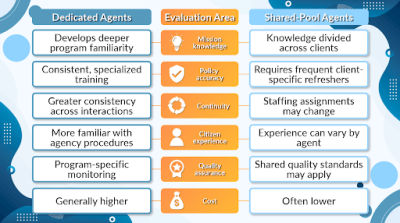
Neither model is automatically right for every government contact center. Shared teams might be better for basic inquiries with predictable answers, while dedicated agents can provide greater consistency when interactions involve sensitive information or more complex processes.
That emphasis on program knowledge and continuity also shapes how an agency’s outsourced team represents its mission.
Agents need to understand the organization they support and the responsibilities associated with each interaction. This is the thinking behind ROI CX Solutions’ brand specialist model. The model emphasizes dedicated employees who become an extension of the organization they represent.
Applied to government contact center services, this means agents receive program-specific training and develop familiarity with agency expectations and service procedures. The purpose of this model is to build a team that can represent the agency accurately and deliver a more consistent citizen experience.
The staffing model is only one part of the decision though. Agencies also need to evaluate whether a provider has the security practices, technology, management processes, and operational capacity to support the program over time.
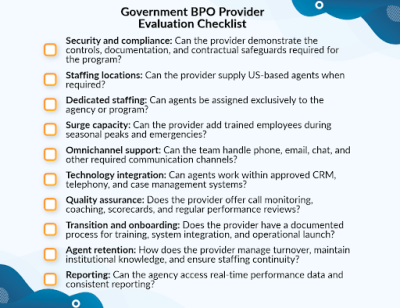
These questions will help your agency determine whether a provider can meet your requirements and maintain performance throughout the contract. A strong outsourcing partner will be transparent about how it operates, how it measures success, and how it responds when performance falls short.
The last consideration will typically be comparing outsourcing to maintaining operations internally. Even when a provider meets every requirement, ultimately agencies need to decide whether transferring specific responsibilities will improve service and make better use of internal resources.
The right operating model depends on the resources, service requirements, and long-term objectives of your agency. Comparing the responsibilities involved in each approach can help clarify where outsourcing makes sense.
| Consideration | In-House | Outsourced |
| Staffing | Agency manages recruitment and retention | Provider manages agent recruitment and staffing |
| Training | Agency develops and maintains training | Provider delivers training based on agency-approved procedures |
| Scaling | Depends on internal hiring and budget | Additional capacity can be arranged through the provider |
| Technology | Agency manages systems and infrastructure | Provider supports delivery within the agreed technology environment |
| Oversight | Direct internal management | Agency retains program oversight and monitors provider performance |
| Cost Structure | Salaries, benefits, facilities, and management | Contracted service fee and agreed additional expenses |
The decision will come down to which responsibilities benefit from external operational support and which should remain within the agency. The right partner should complement the agency’s existing capabilities while helping it deliver consistent service to the public.
Choose the right BPO Partner for reliable support
Government agencies need reliable support operations that can keep up with citizen needs without adding unnecessary strain to internal teams.
The right outsourcing partner can provide trained agents, additional capacity, and consistent service while meeting the agency’s security and compliance requirements. Just as important, the provider should understand the agency’s mission and be accountable for service quality.
ROI CX Solutions provides dedicated customer support backed by experienced agents, data-driven quality management, and flexible service options.
Connect with our team today to see how we can help your agency deliver more consistent, responsive citizen support.