

Ultimate Healthcare Call Center Outsourcing Strategy Guide
Introduction
Healthcare organizations face a communication challenge that is difficult to solve with a traditional front desk. Patients need help navigating increasingly complex healthcare systems, and at the same time administrators need to control costs and maintain high service levels.
A specialized medical call center can bridge that gap because trained contact center professionals can take care of incoming requests, so internal teams can handle more complex tasks.
Modern patient communication services can also extend beyond voice so patients can communicate through text, email, web chat, and more. A centralized healthcare contact center can coordinate those interactions while also providing patient communication history. This is fantastic for meeting customer expectations while also providing needed context for teams.
Understanding the services, technology, and benefits of healthcare call centers will help organizations make smarter decisions while also improving the patient experience.
Read Time: 15 minutes
Key Takeaways
- A healthcare call center can manage high-volume patient communication while allowing clinical and administrative teams to focus on other responsibilities
- Core services include scheduling, appointment reminders, patient follow-ups, insurance verification, billing support, and after-hours support.
- Healthcare call center software should support secure communications, omnichannel interactions, EHR/CRM integration, intelligent routing, reporting, and workforce management.
- Outsourcing can provide flexible scaling options to help healthcare organizations control staffing costs without sacrificing access.
Table of Contents
What is a Healthcare Call Center?
A healthcare call center is a specialized contact center that manages patient, member, provider, or caregiver communications on behalf of a healthcare organization. Unlike a general, all-purpose call center, a healthcare call center must account for the sensitivity of health information, terminology, payment processes, appointment workflows, and the emotional nature that comes with many patient interactions.
The scope of a healthcare contact center can range from straightforward admin support to more specialized services. For example, an organization may outsource appointment scheduling and reminders, while keeping clinical decision making within its internal team. It is important to note that outsourcing communication does not mean outsourcing clinical responsibility. The specific tasks assigned to a contact center should be determined by the organization’s clinical, regulatory, and operational needs.
Below, we will further examine how traditional contact centers and healthcare call centers, also referred to as medical contact centers, differ and where healthcare call centers fit into the patient journey.
Difference between traditional call centers and medical contact centers.
A traditional call center is usually designed around customer service, sales, technical support, or general inquiries. A medical contact center works in a more specialized environment because healthcare interactions will involve complex terminology, sensitive information, or even insurance requirements. Therefore agents will need to have healthcare specific training and clearly defined escalation procedures.
The technology is different as well because a healthcare contact center might need to interact with electronic health records, patient portals, CRM platforms, and scheduling systems. In addition, HIPAA adds another layer of responsibility. The U.S. Department of Health and Human Services states that businesses must implement appropriate administrative, physical, and technical safeguards to protect electronic protected health information.
This is what sets medical call centers apart from traditional call centers. Beyond just answering calls, healthcare contact centers need the right security measures, staff training, escalation procedures, and technology integrations in place to protect patient information and support healthcare-specific workflows.
The role of a healthcare call center in the patient journey.
A patient’s experience with a healthcare organization does not start when they enter the examination room. Sometimes it simply starts with a phone call asking whether a provider accepts new patients. From there it can continue with appointment scheduling, billing conversations, and follow up appointments. Each of these interactions will influence how accessible and responsive the organization feels.
A healthcare call center can support multiple points in this journey by:
- Helping patients reach the right department
- Scheduling and rescheduling appointments
- Providing appointment reminders
- Supporting registration and administrative processes
- Answering non-clinical questions
- Following up after appointments
- Supporting billing and payment inquiries
- Verifying insurance information
- Escalating clinical concerns according to established protocols
- Providing after-hours and overflow support
Healthcare call centers can make it easier for patients to get the help they need while alleviating the amount of work internal teams have.
Core Healthcare Call Center Services
Healthcare organizations can configure contact center services around their specific operational needs and patient interactions. Some may only need basic answering and appointment scheduling support, while others need a broader combination of patient communication, revenue cycle management, follow-up outreach, and after-hours support. Services can also be scaled up or down as needs change making it easier to adapt to volume changes throughout the year. This flexibility allows healthcare organizations to outsource the tasks that place the most strain on internal teams while keeping clinical responsibilities with the appropriate staff.
Appointment Scheduling and Management.
Appointment scheduling is one of the most common healthcare contact center functions as well as one of the most important ones. Patients that are having a difficult time scheduling or changing their appointments might delay them or simply not show up. Relatient notes that missed appointments can also put patients behind on their care and create downstream operational challenges. A healthcare call center can help address these challenges by taking care of:
- New patient scheduling
- Appointment changes and cancellations
- Provider availability inquiries
- Appointment confirmations and reminders
- Waitlist management
- Follow-up scheduling
- Referral-related scheduling
Technology like automated reminders and two-way communication help make these processes even more efficient and effective. Relatient also highlights the importance of integrating reminder systems with EHR or practice management systems so staff can see patient responses and act on them without relying on separate systems.
For healthcare organizations, this makes scheduling easier for patients while reducing the amount of administrative work.
Patient Recall and Follow-up Services.
Healthcare organizations often need to communicate with patients after an appointment which is where outbound patient communication services become a major asset. They can include reminders, recall campaigns, follow-ups, satisfaction surveys, preventative care outreach, and much more.
A structured follow-up program is a great way to help reduce missed appointments and keep patients engaged between visits. The benefit of this is that consistent communication will help organizations identify patients who need additional assistance and route those situations to the appropriate internal team.
These services are one of many elements that help move organizations from reactive support to proactive engagement.
Insurance Verification and Prior Authorization Support.
Insurance verification and prior authorization can be time-consuming and complicated processes for both healthcare staff and patients. Typically before an appointment or procedure staff need to confirm a patient’s eligibility, coverage, benefits and whether prior authorization is required. Information that is incomplete or inaccurate can create unexpected costs or additional administrative work.
A healthcare call center can support these processes by:
- Handling eligibility and benefits verification
- Gathering required patient information
- Checking authorization requirements
- Following up on pending requests
- Communicating with insurance providers
These services reduce the workload for internal teams while ensuring important information is addressed before a patient receives care.
For patients, efficient insurance support can mean fewer surprises and less time spent navigating complicated coverage questions. For healthcare organizations, it can help with coordination between teams and create a smoother patient experience.
Medical Billing and Revenue Cycle Management (RCM).
Billing questions can be among the most frustrating interactions for patients because healthcare charges and insurance statements are often difficult to understand.
Healthcare BPO services can support portions of this revenue cycle by taking care of billing inquiries, payment support, account questions, claims related communication, and other administrative processes. This creates a clearer experience for the patient while helping the organization reduce avoidable delays. A well designed process will give patients a consistent point of contact while also allowing internal billing specialists to focus on more complex cases.
Clinical Triage and 24/7 Answering Services.
Not every healthcare organization will need a contact center for clinical triage services. However, when it is part of a service model, it will need specialized personnel, approved clinical protocols, escalation procedures, and clear boundaries regarding what the contact center can and cannot advise.
The more appropriate model is often going to be a 24/7 medical answering service that identifies the nature of the request, gathers approved information, and escalates clinical issues to the appropriate on=call provider or team.
Patients do not stop having questions when the office closes so after-hours support is a great way to give them support when they need it most.
Critical Features of Healthcare Call Center Software
The right healthcare call center software provides the technology needed to communicate with patients effectively while protecting sensitive information. As patient expectations continue to rise, healthcare organizations need contact center technology that supports more than just basic voice calls. Features such as SMS, web chat, intelligent routing, automation, and EHR integration can help create a patient experience that is more connected.
Not every contact center platform is built for the unique demands of healthcare so organizations need to look for technology that supports HIPAA requirements, secure data handling, seamless system integration, call routing, and real-time analytics.
H3: HIPAA Compliance and Data Encryption.
The most important feature of healthcare software is HIPAA compliance and it should not be reduced to purchasing a specific software package. As stated previously, the HHS Security Rule has specific safeguard requirements for electronic protected health information. This includes access controls, audit controls, authentication, and transmission security.
Healthcare organizations need to evaluate how a contact center manages:
- User authentication
- Role-based access
- Data transmission
- Data storage
- Audit logs
- Device security
- Workforce training
- Incident response
- Vendor access
HHS also emphasizes risk analysis as a foundational part of meeting Security Rule Requirements.
Encryption is just as critical and organizations should understand how information is protected both in transit and at rest, what standards are used, and how encryption keys are managed.
Healthcare organizations should also understand how a potential HIPAA-compliant call center partner manages information security, risk, access, and third-party controls.
Three frameworks and certifications healthcare organizations may encounter during vendor evaluations are SOC 2 Type II, ISO 27001, and HITRUST CSF
| Standard/Certification | What It Addresses | Why It Matters |
| SOC 2 Type II | Evaluates controls related to areas like security, availability, confidentiality, processing integrity, and privacy over a period of time. | Provides evidence that a provider has established and operated defined controls. |
| ISO 27001 | An international standard for establishing, implementing, maintaining, and improving an information security management system. | Demonstrates a structured approach to security, risk management, and continuous improvement. |
| HITRUST CSF | A healthcare-focused security and risk framework that brings together requirements from multiple standards and regulatory sources. | Can provide additional assurance for organizations looking for a security framework specifically designed to address healthcare and sensitive information. |
Omnichannel Support (Voice, SMS, Email, Web Chat).
Not every patient interaction is going to happen over the phone, which is why it is important that different communication channels are connected. This is where omnichannel support becomes an advantage because it gives healthcare organizations the ability to communicate with patients on their preferred channel while also providing agents with context from previous interactions.
It’s important to note the difference between multichannel and omnichannel communication. Multichannel means an organization offers multiple channels. Omnichannel means those channels work together.
For example, a patient calls about an appointment, receives a text confirmation, and later responds to a follow-up message. A properly integrated contact center should allow authorized staff to have access to communication history, rather than treating every interaction as an isolated event.
Seamless EHR and CRM Integration (Salesforce Health Cloud, Epic, Cerner).
Integration can have a major effect on the efficiency of a healthcare contact center. If systems can’t properly integrate this might force agents to switch between multiple applications and ask patients to repeat details. The right integrations, on the other hand, help agents access relevant information from the systems they are authorized to use and document interactions within established workflows. That’s why EHR interoperability should be an important consideration when evaluating a healthcare contact center.
Platforms like Epic and athenahealth, integration may involve APIs, authentication, data mapping, permissions, and workflow configuration. It’s crucial that organizations understand exactly what information the contact center needs to access and whether the integration supports those workflows.
Key technical requirements to evaluate are:
- API availability: Does the EHR provide APIs that allow authorized third-party systems to exchange information?
- FHIR support: Can the contact center use FHIR-based APIs to securely access standardized healthcare data?
- Authentication: How are users and applications authenticated? QAuth 2.0 and other secure authentication methods may be required depending on the platform.
- Role-based access: Can access be limited to only the patient information and functions an agent needs?
- Data mapping: Can information from the EHR, CRM, scheduling system, and contact center platform be mapped consistently?
- Real-time vs batch data: Does the workflow require information to update in real time or can data be synchronized periodically?
- Auditability: Are API calls, user activity, and changes to patient information logged for auditing?
- Integration testing: Does the provider have a process for testing integrations before going live?
The exact integration requirements are going to vary by EHR and organization. Epic and athenahealth may have different APIs, authentication requirements, permissions, and implementation processes, so healthcare organizations should ask prospective vendors to explain how their integration works with the system already in use.
Intelligent Call Routing and IVR.
Interactive voice response (IVR) and intelligent routing help patients reach the right resource faster. So instead of sending every caller to the same queue, routing logic directs interactions based on factors such as:
- Department
- Patient type
- Reason for calling
- Business hours
- Language
- Account type
- Agent skill
- Urgency
Effective IVR makes navigation easier and the best systems use automation to handle simple requests while giving patients an easy path to a human when they need one.
Real-time Analytics and Performance Reporting.
A healthcare contact center should be measurable. Administrators should be able to understand what patients are contacting the organization about and overall efficiency of agents and systems. Analytics like the ones below will be able to reveal what is working and where improvements need to be made.
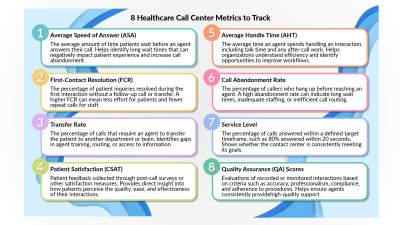
A strong healthcare contact center should look at these metrics together rather than separately. Lets say average handle time reduces, this might appear to be a positive shift but not if it also causes FCR or patient satisfaction to decline.
Top Healthcare Call Center Companies (Competitor Benchmarking)
Healthcare organizations evaluating outsourcing partners should understand the difference between a specialized BPO, a technology provider, and a large healthcare enterprise. Each type of provider offers different capabilities and levels of support, so the right fit will depend on the specific goals and needs of the organization.
Some companies might need a fully managed team to handle patient communications, while others may simply need the technology to improve an existing internal operation. It’s also important to consider factors like healthcare experience, compliance, scalability, system integration, and the ability to support specialized workflows.
No single company will be the right choice for every organization, which is why healthcare leaders should evaluate providers based on the services and outcomes that matter most to their organization.
In-depth look at industry leaders
The healthcare call center market includes several types of providers, from specialized BPOs and contact center technology companies to large healthcare enterprises with their own patient support infrastructure. Since these companies operate differently, healthcare organizations should evaluate them based on the type of support they need.
Magellan Solutions is an example of a specialized healthcare BPO services including appointment scheduling, patient intake, reminders, benefits verification, prior authorization support, and omnichannel support. This type of provider is a good option for organizations looking to outsource specific patient-facing functions.
Nextiva has a more technology-first approach because its contact center platform provides capabilities like omnichannel communications, automation, analytics, routing, and other integrations. Instead of supplying a completely outsourced workforce, a platform like Nextiva gives organizations existing employees the tools needed to manage patient communications more efficiently.
UnitedHealth Group, through businesses like Optum, represents a much broader healthcare enterprise model. Optum provides patient support, scheduling, billing assistance, care navigation, and other healthcare services across its network. Its business services also include patient access contact center solutions, medical answering services, scheduling, nurse messaging and triage, and other support functions.
ROI CX Solutions takes a specialized BPO and CX outsourcing approach, combining trained teams, advanced technology solutions, and scalable contact center operations. Healthcare services include patient communication and appointment support, with capabilities designed around secure handling of sensitive patient information. ROI also provides omnichannel support, 24/7 operations, and the ability to scale up or down as client needs change.
There isn’t one type of healthcare call center provider that is right for every organization. A hospital with a large internal team may primarily need better technology and automation, whereas a growing physician group may need an outsourced team to handle scheduling and patient calls.
Comparison of specialized BPO vs. SaaS solutions.
Organizations should not be focusing on which company is best, but instead be thinking about what type of solution they actually need. A Software as a Service (SaaS) contact center platform provides the technology whereas a Business Process Outsourcing (BPO) will provide people, processes, management, training, and technology. Sometimes organizations need both.
| Capability | Healthcare BPO | SaaS Contact Center |
|---|---|---|
| Trained agents | Yes | No |
| Workforce Management | Typically included | Managed by customer |
| Technology Platform | Typically included/integrated | Core offering |
| Patient Scheduling | Can be performed by agents | Requires customer staff |
| After-Hours Coverage | Yes | Managed by customer |
| Scalability | Staff scales with demand | Software scales but staffing stays internal |
| Implementation | Managed operational transition | Technology implementation |
| Best Fit | Organizations needing staff, technology, and improved operations | Organizations with internal teams in place needing technology |
If your organization already has a solid internal contact center, SaaS might be something you should look further into. However if your organization is struggling with staffing, large call volumes, or huge amounts of administrative work, healthcare BPO services might be the better choice.
A hybrid model can also work. What that looks like is the BPO providing the workforce while integrating with the organization’s existing CRM, EHR, telephony, and analytics.
Strategic Benefits of Outsourcing
Outsourcing healthcare contact center operations can do so much more than provide immediate cost savings, though that is one of the main reasons organizations consider it. The right partner can help companies improvise patient access, reduce administrative pressure, and create the flexibility needed to keep up with demand.
Cost Reduction vs. Quality of Care.
Oftentimes, reducing costs and maintaining quality of care can feel like competing priorities. Cutting staffing or resources too aggressively can lead to overwhelmed employees and poorer patient experiences. On the other hand, maintaining large internal teams to handle every patient interaction can increase labor costs, especially when call volumes fluctuate.
Healthcare call center outsourcing can help organizations find the balance between the two. Moving appropriate administrative and communication tasks to a specialized team allows organizations to control staffing costs without reducing access to patient support. Agents handle routine requests, like appointment scheduling, while clinical teams remain focused on patient care. Value comes from using resources more strategically. A healthcare organization can maintain access and responsiveness for patients without requiring internal teams to handle every call and task.
In addition, the right outsourcing provider needs to be evaluated on more than just price because the lowest cost per interaction does not always mean the best value. If patients face long wait times, frequent transfers, or unresolved issues, those savings can be quickly offset by repeat calls, missed appointments, or staff rework. Organizations should consider cost per interaction alongside service quality and overall operational performance.
As you consider outsourcing, try to find a partner that can deliver the right level of service at the right cost. Cost efficiency measured alongside patient experience and operational outcomes will help healthcare organizations reduce unnecessary expenses while supporting quality of care.
Handling Peak Call Volumes and Seasonal Surges.
Healthcare demand is rarely predictable for a variety of reasons. Open enrollment can increase calls for health plans, a new virus can break out, or billing can produce spikes in questions. This is why building a permanent internal team large enough to handle the highest possible call volume can be expensive and inefficient.
A scalable healthcare call center gives organizations another option because teams can increase coverage during high-demand periods and cut back down once volume normalizes. At ROI CX Solutions, we understand that having that flexibility throughout the year is not only important for patient satisfaction, but also for staying competitive.
With the right partner, outsourcing can provide flexibility and efficiency, but choosing that partner requires a closer look at what they offer.
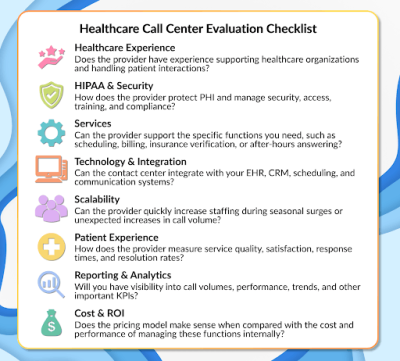
For healthcare leaders evaluating their options, the best solution is the one that balances cost, quality, scalability, security, and patient experience.
ROI CX Solutions helps healthcare organizations extend their patient communication capabilities with scalable, trained teams, and healthcare-focused technology integrations. Explore our healthcare call center services and see how we can help you build a more efficient, patient-focused support operation.